
The World in a Water Drop — Observing Microorganisms
Aim
Collect pond water and soil suspension, look at the tiny living things in them under a microscope, and sort them into groups.
Apparatus
- A sample of pond or stagnant water in a clean container
- Moist garden soil, a beaker, a glass rod and a spoon
- A dropper, glass slides and coverslips
- A compound microscope or a foldscope
- A chart or book showing common microbes, for comparison
- Science notebook and pencil
Procedure
- With your teacher, collect pond water in a clean container. Put one drop on a slide with a dropper.
- Lower a coverslip gently over the drop.
- Put the slide on the microscope stage and look through the eyepiece at low power.
- Look for tiny moving shapes. Note their colour and shape, and whether they move.
- Compare them with pictures of microbes and record each one in the table.
- Put moist soil in a beaker with a spoon, add water and stir well with a glass rod.
- Let it stand. The cloudy liquid is called soil suspension.
- Take a drop from the top layer, put it on a slide, cover it and observe it.
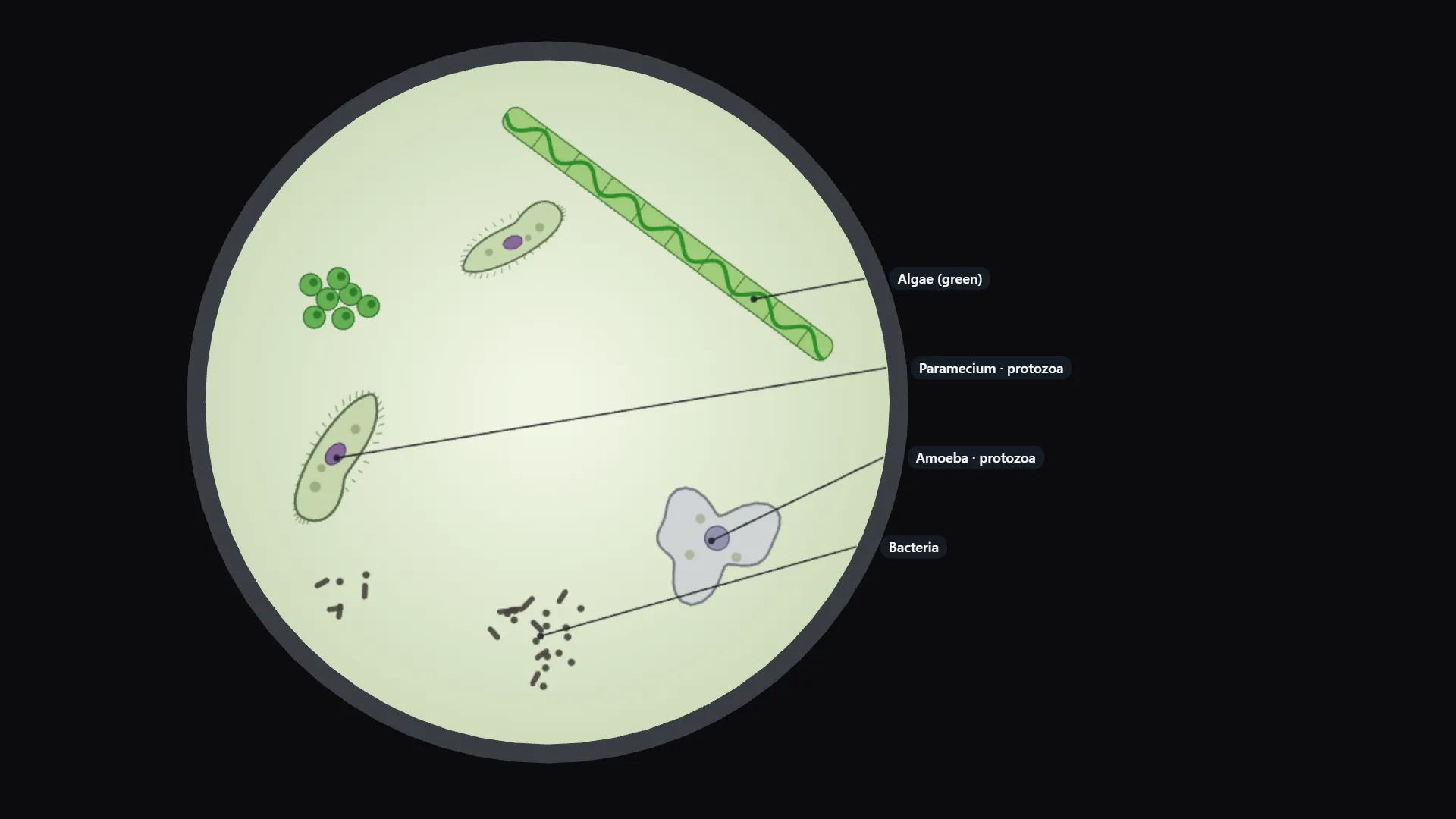
Interactive 3D Experiment
Loading simulation…
What to observe
- Which shapes swim fast, which creep slowly, and which do not move at all?
- Which tiny living things are green?
- How is the soil suspension different from the pond water?
- Can you tell a soil particle from a living thing?
Safety
- Collect pond water only with your teacher or an elder, and never lean over the edge of a pond.
- Never touch the soil or pond water with bare hands. Use a spoon and a glass rod, and wash your hands after.
- Take the drop of soil suspension from the top layer only, after the heavy particles have settled.
- Use only one small drop — too much liquid floats the coverslip and spills on the stage.
- Lower the coverslip gently so no air bubbles form, and do not press it down.
- Focus at low power first — the organisms keep moving and are easily lost at high power.
- Dust specks, air bubbles and soil particles are not living — look for movement and a definite shape.
- Dispose of the samples as your teacher says and clean all the slides after.
Notes
- In the 1670s Antonie van Leeuwenhoek, a Dutch cloth-merchant, ground his own tiny lenses and became the first person to see bacteria and other 'little animals' swimming in a drop of water. He is called the Father of Microbiology.