
Verifying the Laws of Reflection
Aim
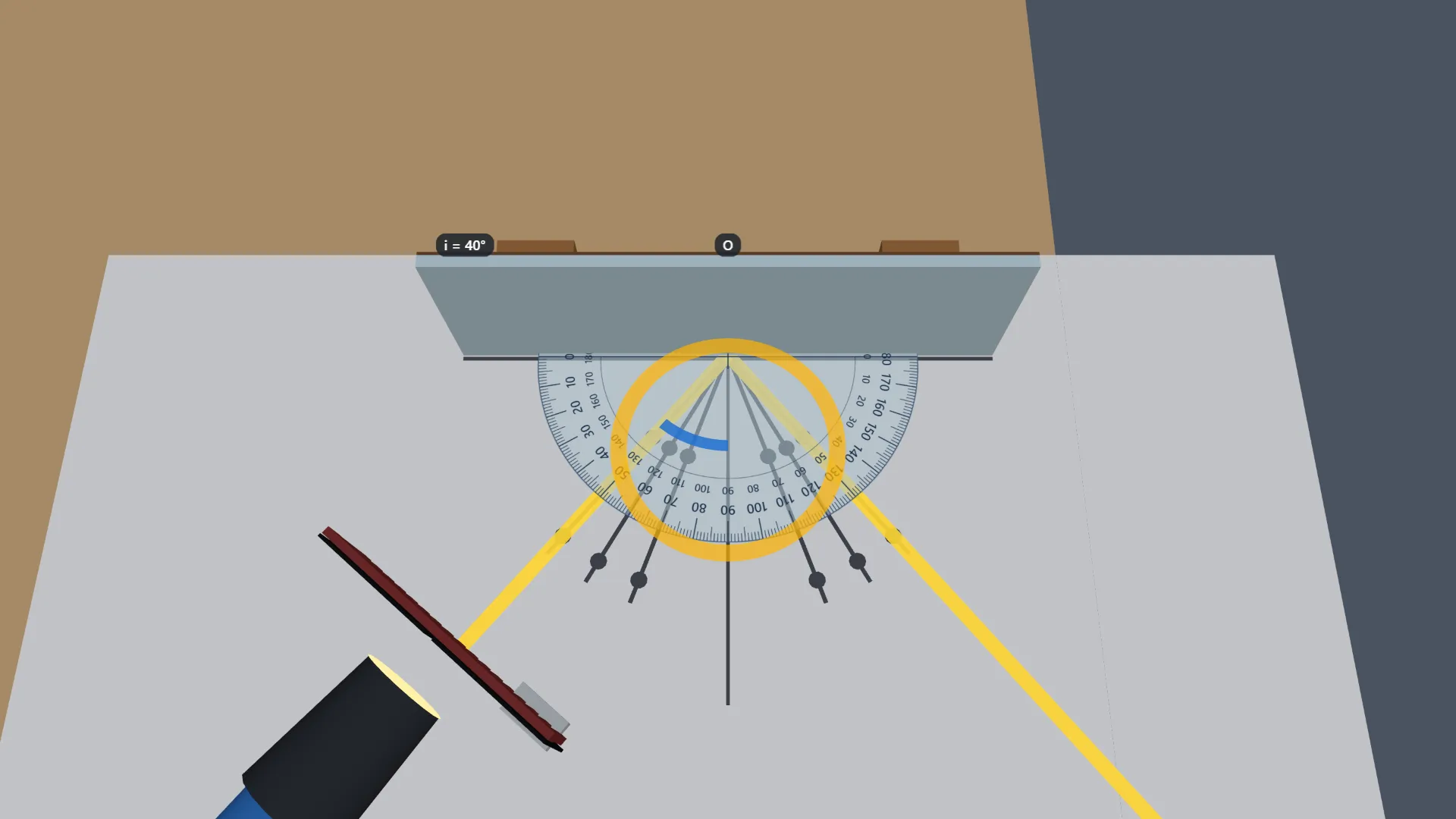
To trace the path of a light ray reflected from a plane mirror, and to verify that the angle of incidence equals the angle of reflection, and that the incident ray, the reflected ray and the normal all lie in the same plane.
Apparatus
- Science notebook and pencil
- A plane mirror with a stand
- A torch, a comb, and a paper clip to hold the comb upright
- A sheet of white paper and a strip of black paper (to make a single slit)
- A protractor and a ruler
Procedure
- Spread the white paper on the table and stand the plane mirror upright on it.
- Cover all openings of the comb with black paper except one in the middle, to make a thin slit.
- With the torch behind the slit, send a thin beam along the paper onto the mirror at O.
- Mark the incident and reflected rays. Remove the mirror and draw the normal at O, at 90°.
- Measure angle i and angle r from the normal with the protractor and record them.
- Repeat for different angles. Then send the beam along the normal and note both angles.
- With part of the paper over the table edge, see the reflected beam on it, then bend it down.
Interactive 3D Experiment
Loading simulation…
What to observe
- For every angle, the angle of reflection (r) equals the angle of incidence (i).
- Both angles are measured from the normal, never from the mirror.
- Sent along the normal, both angles are 0° and the light comes back along its own path.
- The reflected beam is seen on the overhanging paper only while it is flat, in line with the sheet.
- So the incident ray, the reflected ray and the normal lie in the same plane.
Safety
- Darken the room a little so the beam shows, but keep enough light to move about safely.
- Cover all comb openings but one, so a single thin, sharp beam falls on the mirror.
- Stand the mirror exactly upright and mark the line of its reflecting surface, not the back of the glass.
- Do not shine the torch into anyone's eyes.
- Mark each ray with two well-separated dots, and use a sharp pencil and a ruler.
- Do not move the mirror or the paper during a reading; if either shifts, take that reading again.
- Draw the normal at exactly 90° to the mirror line, and measure both angles from the normal.
- Read the protractor with your eye directly above the mark, to avoid parallax error.
Notes
- Science Spark: frosted glass is ordinary glass with a roughened surface. It scatters light in many directions, so shapes behind it look hazy - which is why it is used in bathroom windows.
- Both laws hold for rough surfaces too, but there the normals point in many directions, so the light is scattered and no image is seen.
- In the simulation the readings are ideal; with real pencil lines and protractors they may differ by 1° or 2°.