
Analysing Values Behind India’s Culture of Welcome
Aim
To analyse quotations and legends from the chapter, find the Indian values they reflect, and classify each as fact, opinion or legend.
Apparatus
- Cards with quotations and legends from the chapter (an example set of six)
- Chart paper with columns for Fact, Opinion and Legend
- Sketch pens
- A notebook with the observation table
Procedure
- Pick a card and read its quotation or legend.
- Find the community or event it relates to. Tap it on the card.
- Decide which Indian value it reflects. Tap it.
- Fact: can be checked. Opinion: a viewpoint or praise. Legend: a traditional story. Drag the card.
- Write the card's row in the table. Do steps 1–5 for all six cards.
- Write what you found about facts, opinions and legends.
Interactive 3D Experiment
Loading simulation…
What to observe
- Vasudhaiva kuṭumbakam means the whole world is one family. Atithi devo bhava means the guest is like a god. Karuṇā means compassion.
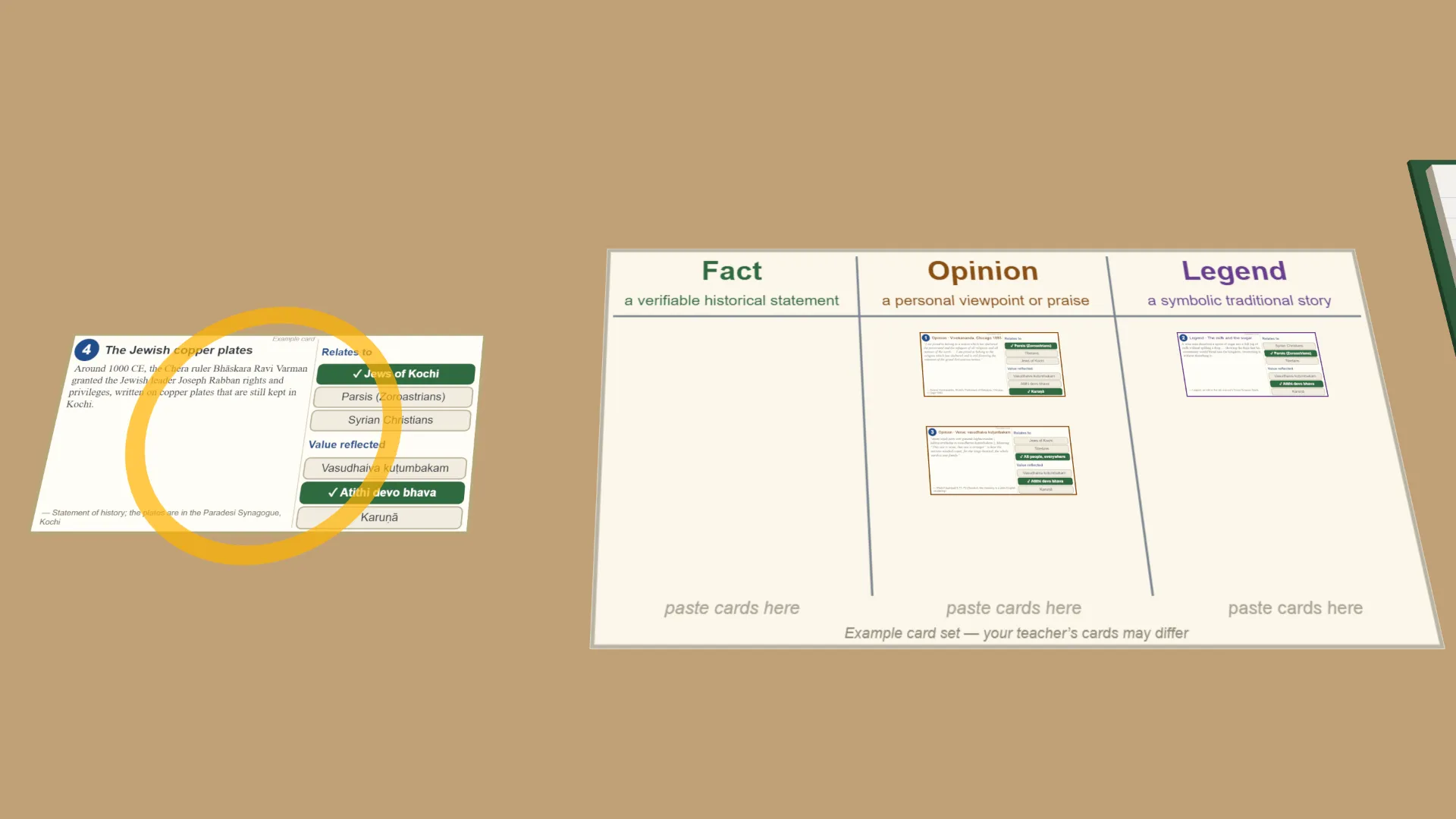
- A fact can be checked, like the copper plates still kept in Kochi.
- Swami Vivekananda's “I am proud…” is praise, so it is an opinion.
- A legend, like the milk and the sugar, may not be provable, but it still carries a value.
Notes
- In the Parsi legend, a wise man stirred sugar into a full jug of milk without spilling a drop. It showed the Raja that his people would sweeten the kingdom without disturbing it.
- Read each card carefully before you classify it.
- Talk over disagreements in your group, and check the chapter when you are unsure.
- The six cards are an example set. Your teacher's cards may differ. A value can often be argued in more than one way.