
Investigating the Triangle Inequality
Aim
Find out, by trying sticks and by construction, when three lengths can form a triangle — the triangle inequality.
Apparatus
- Broom sticks, straws or matchsticks cut to different lengths
- Ruler and pencil
- Compass
- Scissors
- Notebook to record results
Procedure
- Cut sticks of 2, 3, 4, 5, 6, 8, 10, 15 and 30 cm.
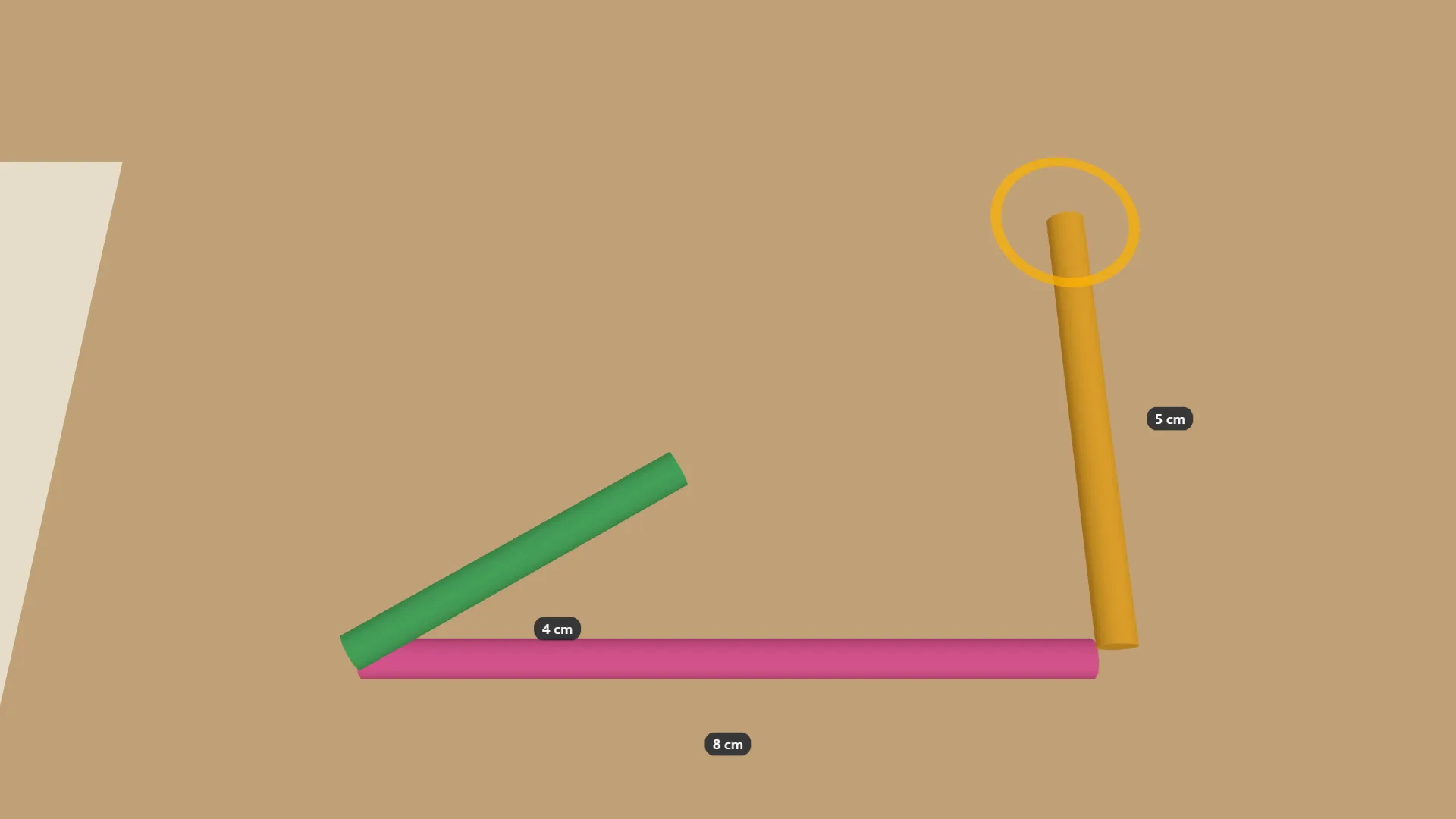
- Pick the sticks 3, 4 and 8 cm. Try to make them meet end to end in a closed triangle.
- Repeat with the sets 2, 3, 6; 4, 5, 8; 10, 15, 30 and 6, 6, 6 cm.
- For each set, compare the sum of the two shorter lengths with the longest. Record it.
- Check 3, 4, 8 and 4, 5, 8: base AB = 8 cm, circles of the other two lengths from A and B.
- Write the rule that tells when three lengths can form a triangle.
Interactive 3D Experiment
Loading simulation…
What to observe
- When the two shorter sticks together are shorter than the longest, they lie flat and leave a gap.
- The circles from A and B cut each other only when the two lengths add up to more than AB.
- A triangle forms only when the sum of the two shorter lengths is greater than the longest.
Notes
- The straight path between two points is always shorter than a path through a third point, so one side of a triangle is never as long as the other two together.
- The triangle inequality is used far beyond geometry, for example in how GPS estimates distances.
- Cut the sticks to exact lengths and measure them again; a stick 2 mm short can change the result.
- Join the sticks end to end without overlapping them at the corners.
- Check all three pairs of sides against the third, not just the two shortest.
- Borderline case: when two sides add up exactly to the third, the sticks lie flat in a line and no triangle is formed.
- Handle scissors carefully and cut away from your fingers.