
Analysing Primary Sources: Foreign Travellers’ Accounts of India
Aim
To read what Xuanzang and the Arab historian Al-Masudi wrote about India, and use it to learn about society, religion and rulers in the 6th–10th centuries.
Apparatus
- Three excerpts — Xuanzang on Kannauj and Harsha, Xuanzang on the people outside the city, Al-Masudi on a Rashtrakuta king
- Two highlighters of different colours (yellow and pink)
- A notebook with the observation table
Procedure
- Read the three excerpts carefully. Tap each one, from the left.
- With the yellow highlighter, mark the facts — details that could be checked.
- With the pink highlighter, mark the authors’ opinions or impressions.
- Fill the table for each source — author, date, one detail and one limitation.
- Discuss in pairs why Xuanzang wrote. Turn the card to see.
- Note why travellers’ accounts are valuable to historians despite their limits.
Interactive 3D Experiment
Loading simulation…
What to observe
- A fact is a detail that can be checked, such as Kannauj’s ditch and towers or the coins of the Rashtrakuta kingdom.
- An opinion is the author’s impression, such as ‘the greatest of the kings’ or a king who ‘forgot to sleep or to eat’.
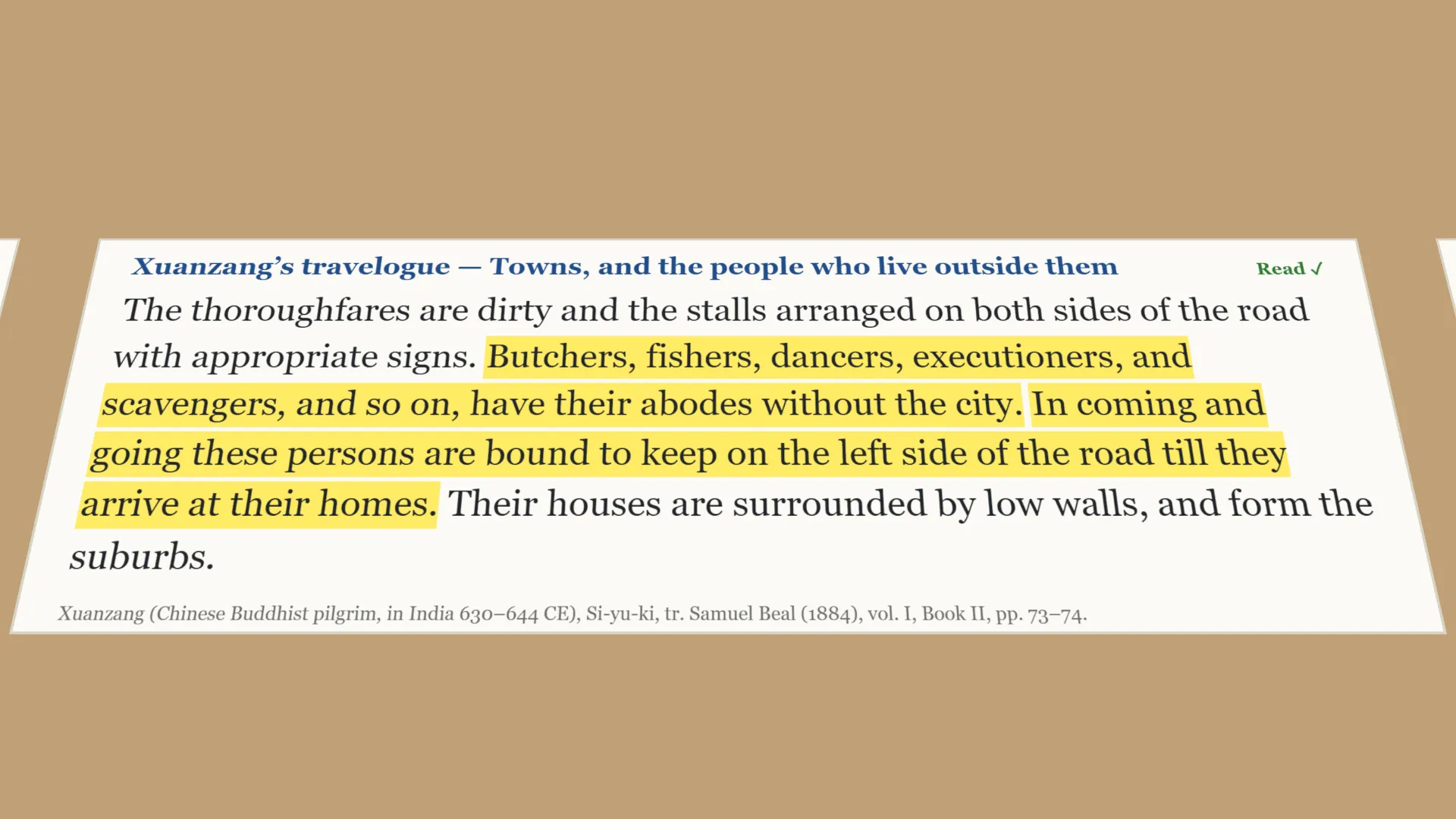
- Xuanzang saw butchers, fishers, scavengers and others made to live outside the city walls.
- Al-Masudi praised the Rashtrakuta king because Islam was honoured and protected in his kingdom.
- Each traveller was an outsider with his own beliefs, so historians check them against inscriptions and coins.
Notes
- Xuanzang’s travelogue is one of the most valuable sources for 7th-century India, even though he wrote mainly to record Buddhist sites and teachings, not political history.
- Do not treat a single source as the whole truth. Cross-check a traveller’s account with other evidence, such as inscriptions or coins.
- The excerpts are the travellers’ own words in old public-domain translations — Samuel Beal’s Xuanzang (1884) and Elliot & Dowson’s Al-Masudi (1867).