
Tracing the Journey of Money
Aim
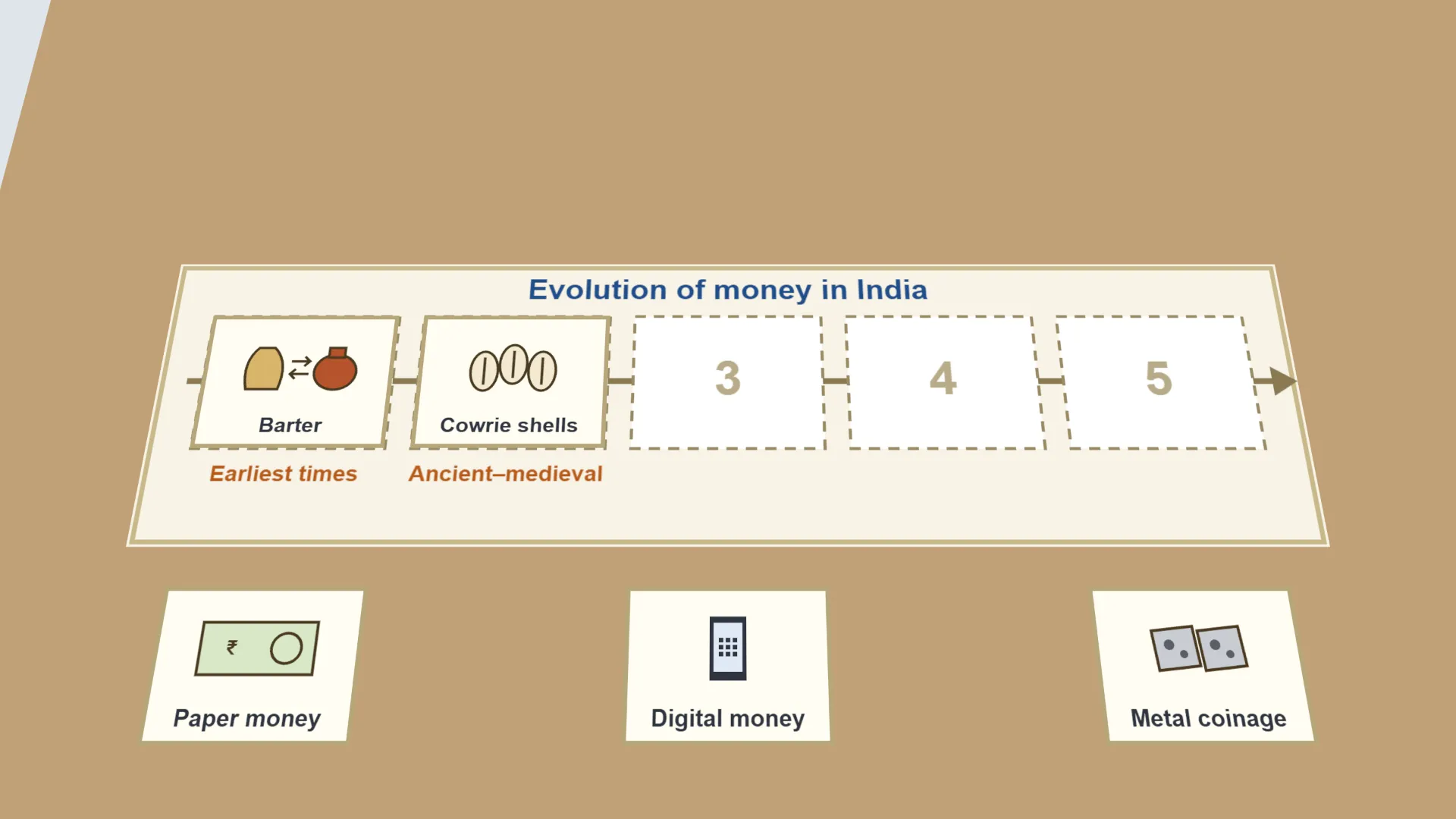
To put the forms of money used in India in order (barter, cowrie shells, metal coins, paper money and digital money) and find which function of money each new form improved.
Apparatus
- Textbook timeline (Fig. 11.10, Evolution of money in India)
- Notebook
- Coloured pencils
- Chart paper (optional)
Procedure
- Put the five forms of money on a timeline in order, noting when each one appeared.
- Draw a table in your notebook with the five forms in order.
- For each form, write one advantage it had over the form before it.
- Match each form to the function of money it shows best.
- Name one real example of each form, like kārṣhāpaṇas or UPI.
- Compare with a partner. Which change in money was the most important, and why?
Interactive 3D Experiment
Loading simulation…
What to observe
- Each new form of money solved a problem of the one before it.
- Money does four jobs: medium of exchange, store of value, common measure of value and standard of deferred payment.
- Discuss with a partner: which single change mattered most, and why?
Notes
- Social Science Spark: the word 'rupee' is believed to come from the Sanskrit rūpa, the symbol punched onto ancient kārṣhāpaṇa coins.
- Keep the stages of the timeline in the right order.
- Use the textbook's meanings of the four functions of money instead of guessing.