
Tracing the Invisible Chain — From Farm to Market
Aim
To trace the infrastructure that works together in an everyday task, and to sort each part under Transport, Communication or Energy infrastructure.
Apparatus
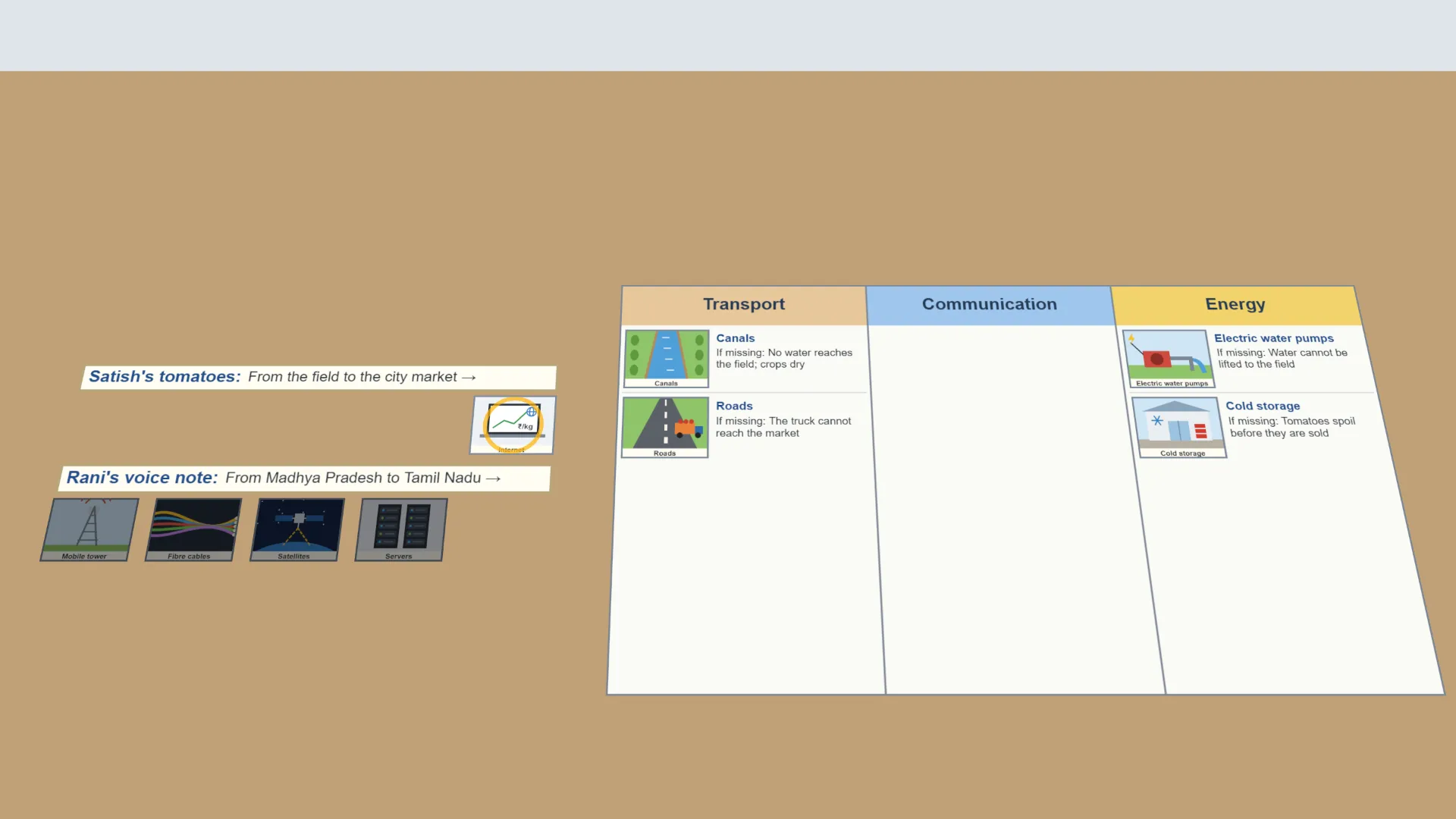
- The scenario of Satish's tomatoes (Fig. 7.3 of your textbook)
- Infrastructure Element Cards (canals, electric water pumps, roads, cold storage, the internet, mobile towers, fibre cables, satellites)
- A three-column chart labelled Transport, Communication and Energy
Procedure
- Re-read how Satish's tomatoes reached the city market.
- List every element in the chain from field to market, one per card.
- Sort each card into its column — Transport, Communication or Energy.
- For each element, note what would happen to the tomatoes if it were missing.
- Repeat for Rani's voice note from Madhya Pradesh to Tamil Nadu, and compare the chains.
- Record your findings in the observation table.
Interactive 3D Experiment
Loading simulation…
What to observe
- Satish's tomatoes need transport, communication and energy together.
- Rani's voice note travels only on communication links.
- Remove one piece of the chain and the whole task can fail.
Notes
- Social Science Spark: cargo trains use 75–90 per cent less energy than road transport. Physical infrastructure is connected like pieces of a puzzle — remove even one piece, like cold storage or the internet, and the whole chain can break down.
- Some elements may fit more than one category. Discuss with your partner and justify the category you choose.