
Tracing Cultural and Historical Links with India’s Neighbours
Aim
To identify and match specific cultural, religious, trade or historical links between India and selected neighbouring countries, as described in the chapter.
Apparatus
- A set of clue cards (prepared by the teacher or students)
- Index cards with country names
- Glue stick or tape
- Chart paper
- The chapter text for reference
Procedure
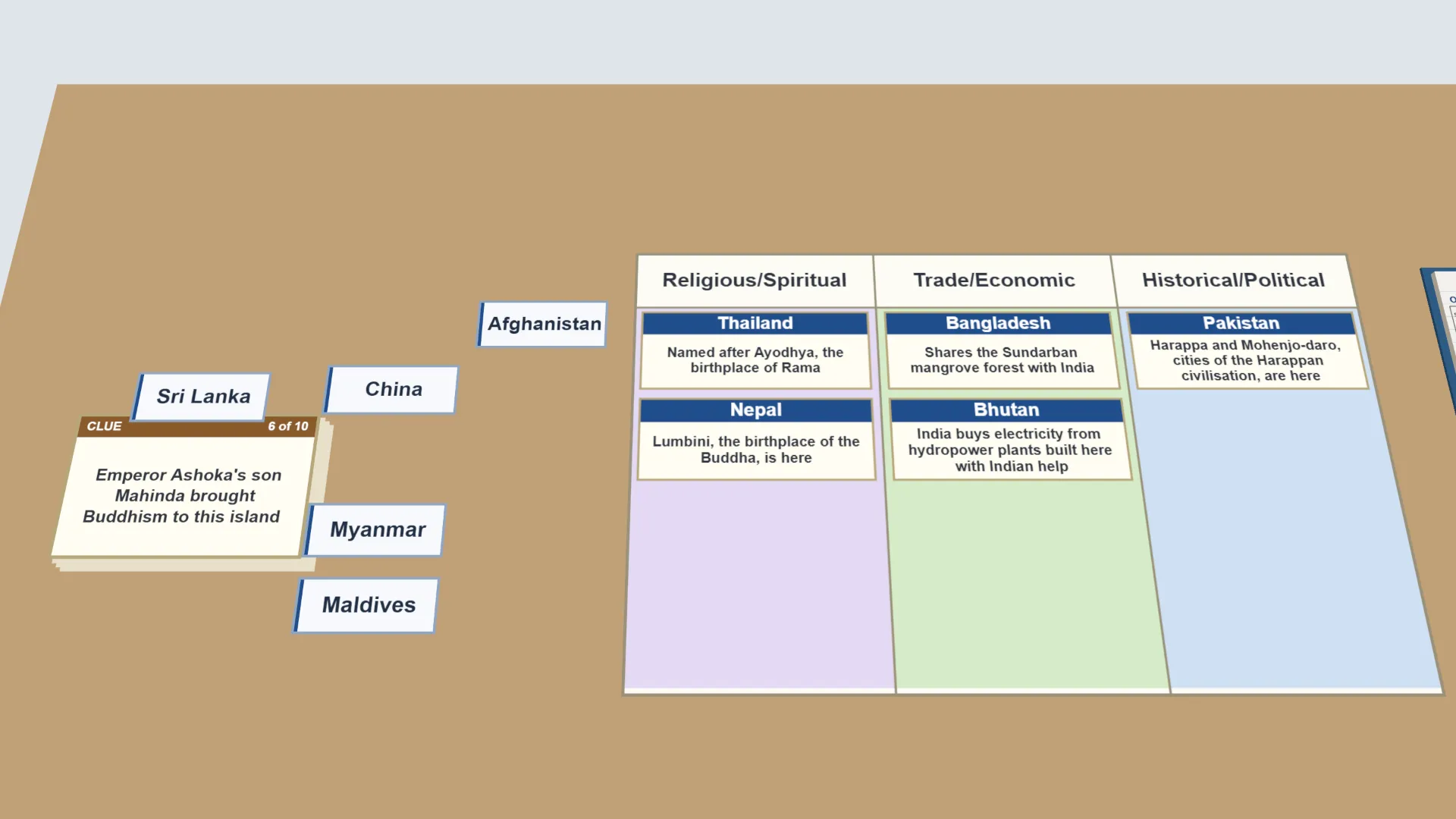
- Read the clue card on top of the pile. Each describes one link with a neighbour.
- Tap the country card that the clue is about.
- Paste the pair in its column - Religious/Spiritual, Trade/Economic or Historical/Political.
- Read why each link belongs to its type, and match the rest of the clues.
- Present one pair to the class - tap it on the chart to read its one-line explanation.
- Fill in the observation table, one row for each matched pair.
Interactive 3D Experiment
Loading simulation…
What to observe
- Religious and spiritual links - Lumbini in Nepal, Buddhism in Sri Lanka, Xuanzang from China, Ayutthaya in Thailand.
- Trade and economic links - the shared Sundarbans, electricity from Bhutan, cowrie shells from the Maldives.
- Historical and political links - Harappan cities, Ashoka's inscriptions at Kandahar, Bahadur Shah Zafar's exile.
Notes
- Social Science Spark: Buddhism, which began in India, travelled to almost every one of India's neighbours - from Sri Lanka and Myanmar to Bhutan, Thailand and Indonesia - through monks, pilgrims and traders, not conquest. Ideas can cross borders peacefully.
- Precaution: read each clue carefully before matching; do not guess, and look back at the chapter text when unsure.
- The page gives two example clues (Ayodhya, the Sundarbans); the other eight clue cards are a standard set written from NCERT and official facts.