
Constructing a Timeline of Turning Tides
Aim
To make a timeline of key events of the 11th and 12th centuries, and to sort each event as a conflict or invasion, or as an achievement in governance, science or culture.
Apparatus
- A long strip of chart paper and a ruler
- Sketch pens of two contrasting colours (red and green)
- Ten event cards with their years (in place of the chapter text)
- A notebook with the observation table
Procedure
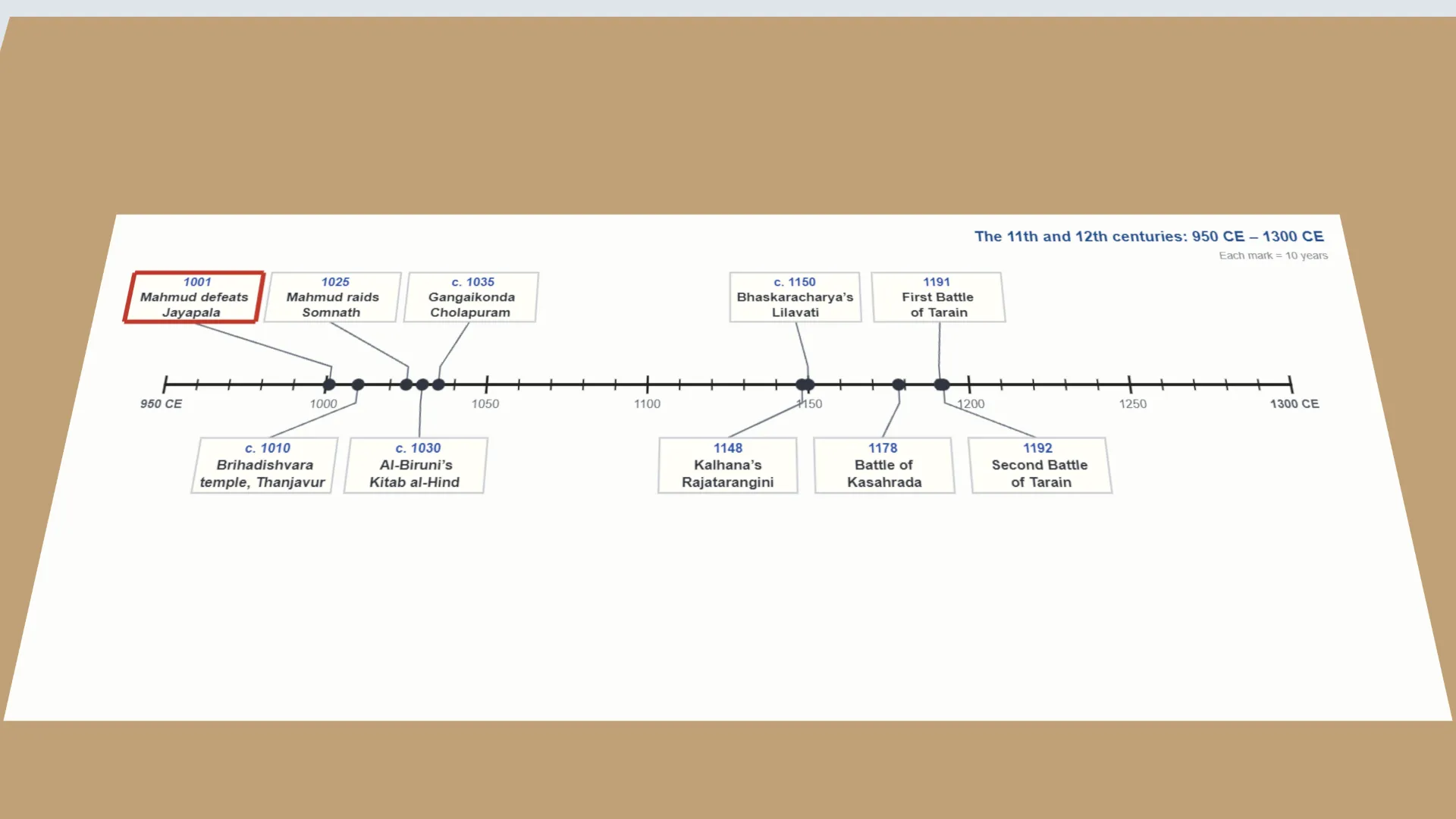
- Draw a timeline and mark it in decades from 950 CE to 1300 CE. Tap the strip, then the ruler.
- Drag each event card to its year. The labels go above and below the line in turn.
- With the red pen, box every conflict or invasion.
- With the green pen, box every achievement in governance, science or culture.
- Add a key for the two colours.
- Record all ten events and their categories in the table.
Interactive 3D Experiment
Loading simulation…
What to observe
- Conflicts include Mahmud of Ghazni’s raids (1001–1025) and the two Battles of Tarain (1191, 1192).
- Achievements include the Chola temples, Al-Biruni’s book on India, the Rajatarangini and the Lilavati.
- Conflict and achievement happened in the same two centuries — often close together on the line.
- Labels alternate above and below the line, so close dates such as 1191 and 1192 do not overlap.
Notes
- Historians have often hesitated to dwell on the ‘darker periods’ of history, such as invasions. Facing them helps us understand what made them possible — and no one living today is responsible for the past.
- Double-check each date before plotting it, and keep the timeline to scale so that the decades are evenly spaced.
- The ten events and years are standard dates from history books; some are approximate (marked c.).