
Constructing a Timeline of India’s Freedom Struggle (1857–1947)
Aim
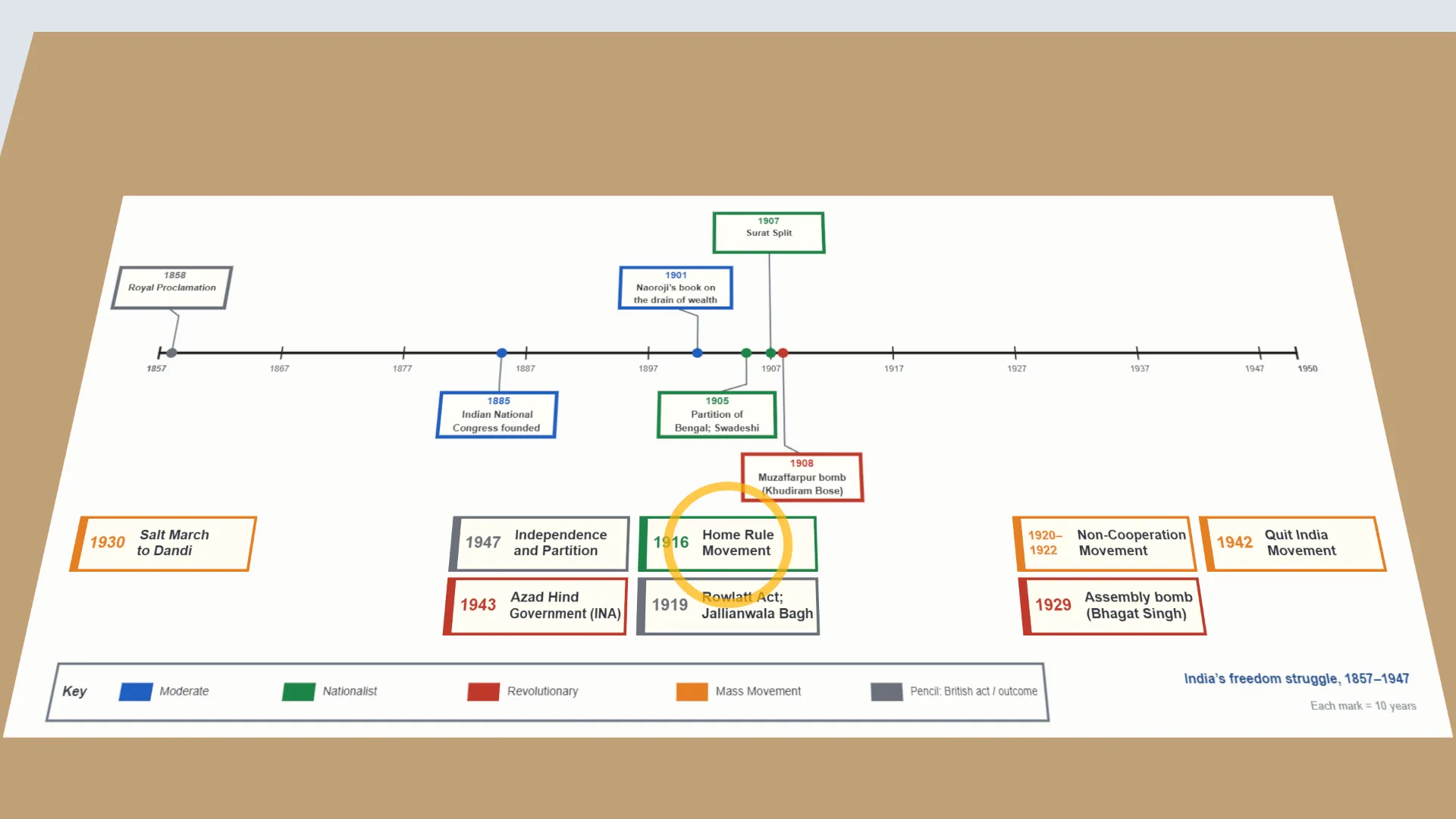
To make a colour-coded timeline of key events in India's freedom struggle from 1857 to 1947, and to sort each event by its approach: Moderate, Nationalist, Revolutionary or Mass Movement.
Apparatus
- A long strip of chart paper, a ruler and a pencil
- Four coloured sketch pens (Moderate, Nationalist, Revolutionary, Mass Movement)
- Fourteen event cards with their years (your list from the chapter)
- A notebook with the observation table
Procedure
- Draw a line from 1857 to 1950, marked every ten years. Tap the strip, then the ruler.
- Decide the colour code and write it in a legend box in one corner.
- Drag each event card to its year on the line. Its colour shows its approach.
- Swap with a partner. Tap each approach's lane to check its events in order.
- Record six events and their approach in the table.
Interactive 3D Experiment
Loading simulation…
What to observe
- The Moderates came first (Congress, 1885), then the Nationalists (Partition of Bengal, 1905).
- Revolutionary acts ran from 1908 to 1943, at the same time as other approaches.
- Gandhi's mass movements ran from Non-Cooperation (1920) to Quit India (1942).
- The approaches overlapped — they did not follow one another in a neat, single line.
Notes
- A timeline in colour shows how Moderate persuasion, Nationalist assertion, revolutionary acts and mass movements overlapped.
- Check each date before marking it, and keep the colour code the same on the timeline and in the legend.
- British measures and the outcome (1858, 1919, 1947) are written in pencil, as they are not an Indian approach.
- The fourteen events and years are standard dates from history books.