
Constructing a Timeline of Cultural Currents (13th–17th Centuries)
Aim
To make a colour-coded timeline of cultural developments from the 13th to the 17th century, sorting each event by the domain of culture it belongs to.
Apparatus
- A long strip of chart paper, a ruler and a pencil
- Coloured pencils or sketch pens, one colour for each domain
- Fourteen event cards from the reference table
- A notebook
Procedure
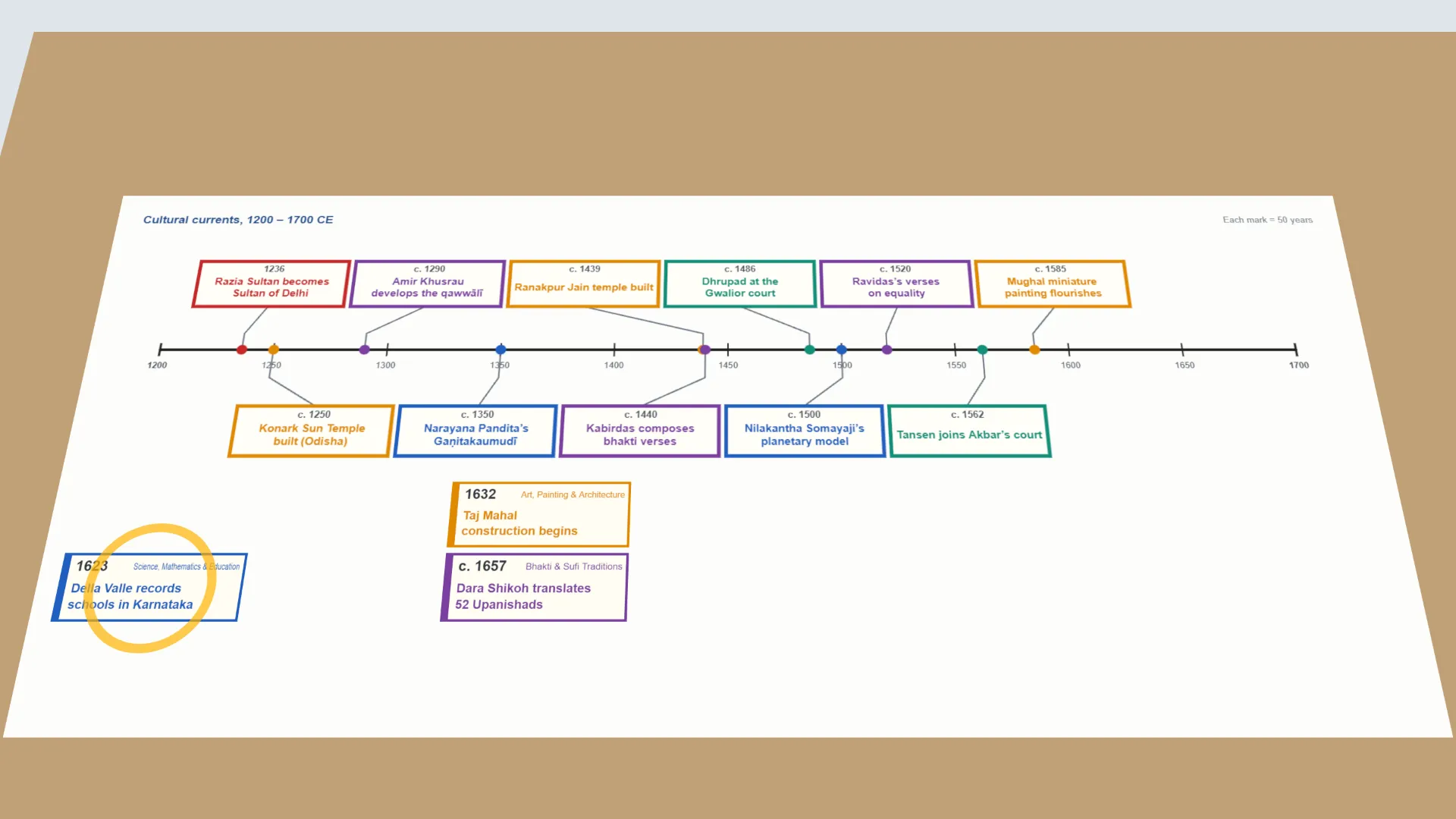
- Draw a line across the chart and mark it every 50 years from 1200 to 1700 CE.
- Drag each event card to its year. Its dot and label appear in its domain's colour.
- Add a legend box showing what each colour stands for.
- Tap each domain in the legend to follow its events along the timeline.
- Write each domain's number of events and its first and last year in the table.
Interactive 3D Experiment
Loading simulation…
What to observe
- Art, Painting & Architecture (1250–1632) and Bhakti & Sufi Traditions (1290–1657) run across almost the whole period.
- Musical Traditions come in a sudden burst — both events within 76 years (1486–1562).
- Events of different domains overlap in the same years, such as 1439 and 1440, or 1623 and 1632.
- Which domain do you think shows the most continuous activity? Discuss with a partner.
Notes
- Social Science Spark: even as rulers changed many times, traditions continued, rulers of different backgrounds supported culture, and people from all sections of society took part.
- Keep one scale all along the line, and keep the colours the same as in the legend.
- Check each date against the textbook before marking it.