
Tiling the Floor — Discovering the HCF
Aim
Cover rectangles exactly with equal square tiles, find which tile sizes fit with no gaps, and link the largest tile that fits to the common factors and the Highest Common Factor (HCF) of the two sides.
Apparatus
- Squared (graph) paper notebook
- Coloured pencils or sketch pens (at least 3 colours)
- Ruler, pencil and a pair of scissors
- Square paper cut-outs of side 1, 2, 3, 4 and 6 units
Procedure
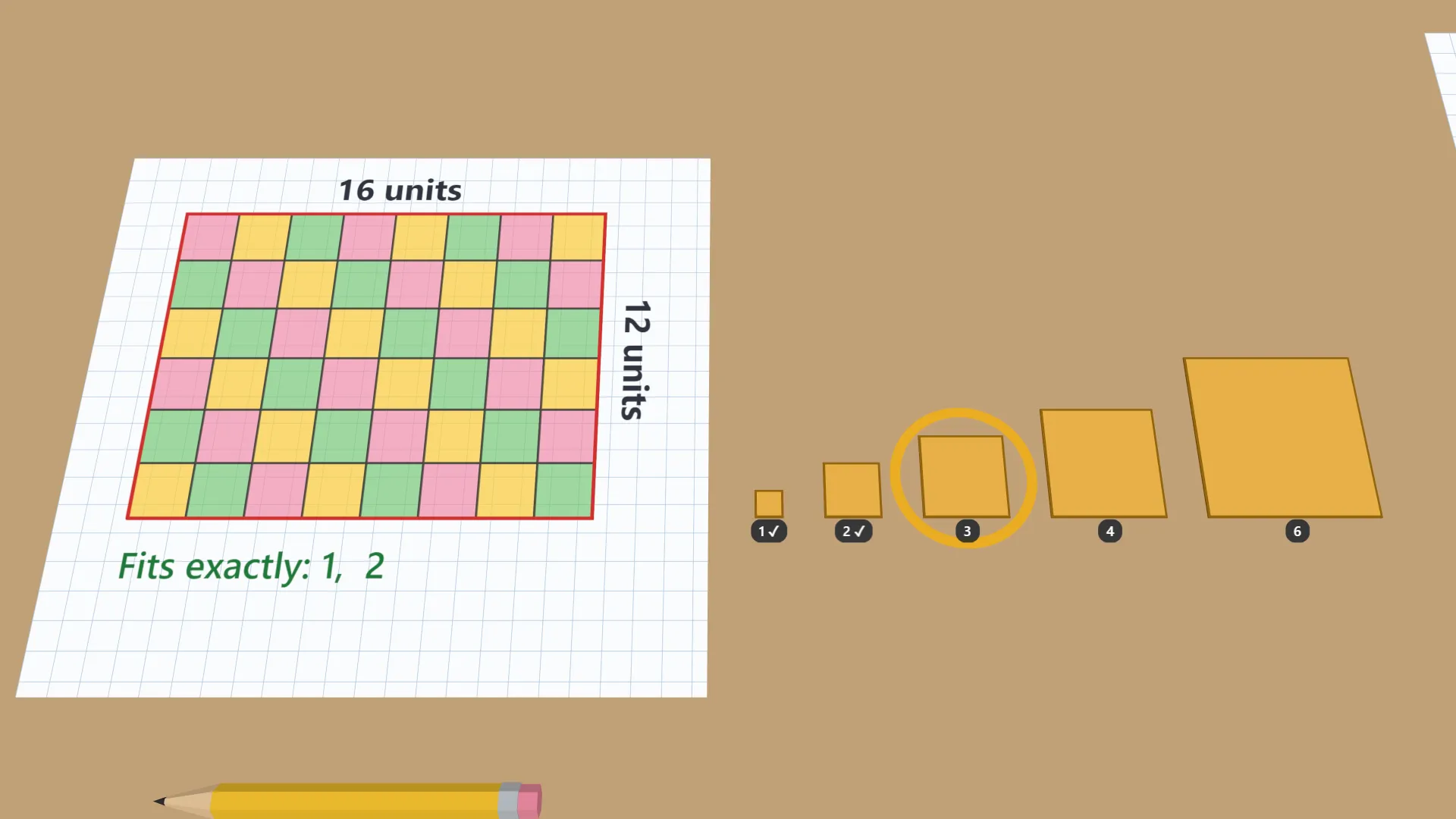
- Draw a rectangle 16 units long and 12 units wide on squared paper (Sameeksha's room).
- Cover it with square tiles of side 1, 2, 3, 4, then 6 units, one size at a time.
- Circle the largest tile that covers it exactly, with no gaps. Its side is the HCF of 16 and 12.
- In the table, write the factors of both sides, the common factors and the HCF.
- Write a sentence linking "the largest tile that fits" to the HCF.
- Repeat for the rectangles 24 × 18 and 30 × 20 (also try tiles of side 5 and 10 on 30 × 20).
Interactive 3D Experiment
Loading simulation…
What to observe
- Which tiles cover each floor with no gaps? Are their sides the common factors of the two sides?
- Is the largest tile that fits the HCF of the two sides?
- Why is a tile that divides only one side not enough?
Notes
- The HCF is also called the GCD. Euclid (about 300 BCE) found it by replacing the larger number by its remainder with the smaller one; the last non-zero number is the HCF.
- The largest square that tiles a rectangle exactly has a side equal to the HCF of the two sides.
- Draw the rectangle by counting squares, not by measuring with a ruler.
- Lay the tiles without overlapping and without any tile going past the edge.
- Test each tile size over the whole rectangle, not just one corner.
- The tile side must divide both the length and the breadth; dividing only one is not enough.
- The answer is the largest common tile, not the largest factor of one of the numbers.
- Use scissors carefully when cutting the tiles.