
Solid, Liquid or Gas? — Comparing the Three States of Matter
Aim
Observe and compare the shape, volume and flow of solids, liquids and gases, and relate them to how strongly the particles attract each other and how big the spaces between them are.
Apparatus
- A few solid objects — an iron nail, a piece of rock salt, a stone, a wooden block and a key
- Three clean, dry containers of different shapes, with a marker or a paper strip
- About 200 mL of water
- Two transparent gas jars or glass tumblers, a glass plate and an incense stick
- Science notebook and pencil
Procedure
- Gently try to change the shape of each solid. Record the iron nail and the rock salt.
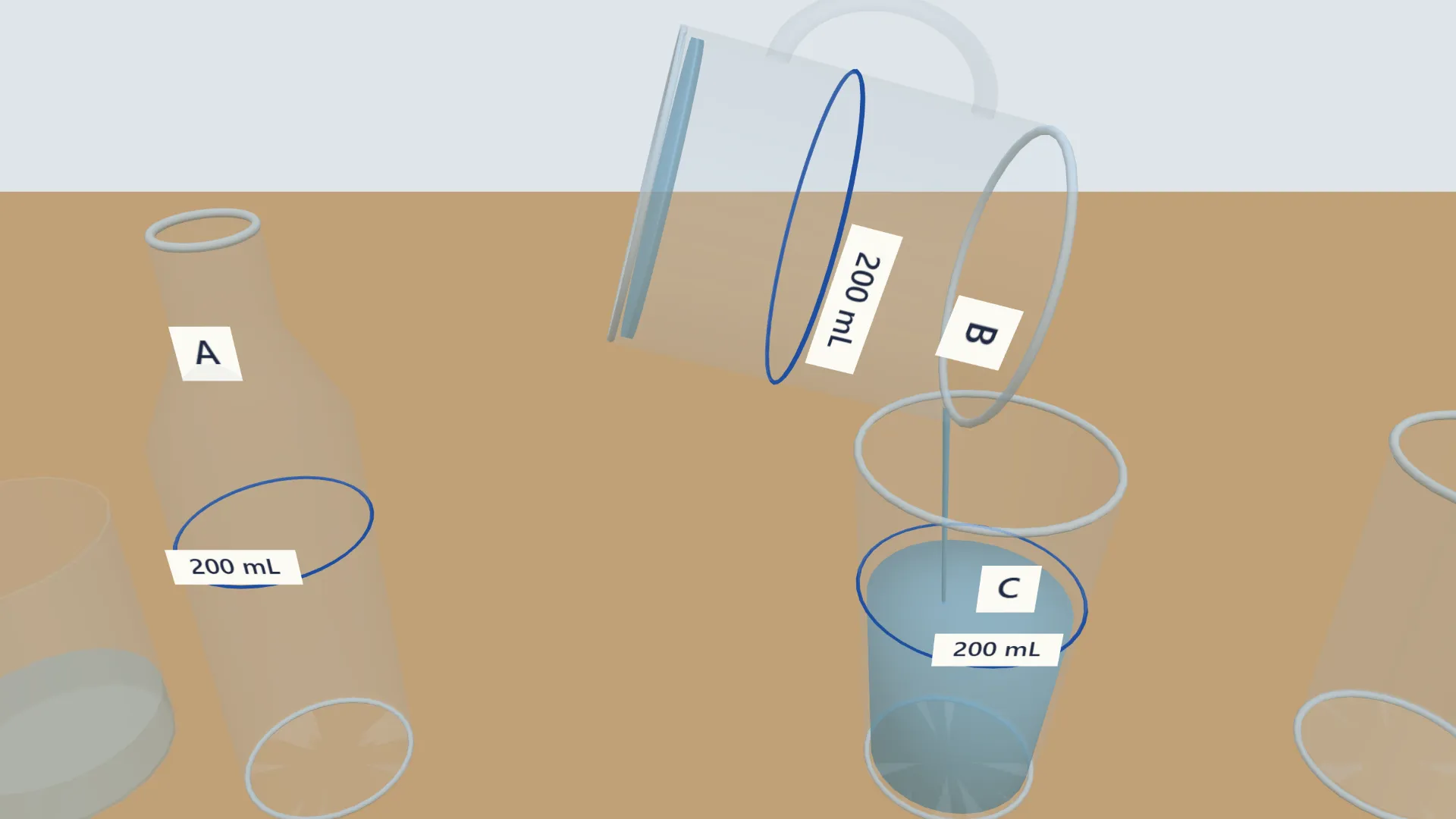
- Mark a 200 mL level on each of the three containers A, B and C.
- Fill A with water up to the mark. Pour it into B, then into C. Record the water.
- Light the incense stick, collect its smoke in jar A and cover it with the glass plate.
- Turn jar B over jar A, slide the plate out gently and watch the smoke. Record it.
- Put the incense stick out completely, then read your table.
Interactive 3D Experiment
Loading simulation…
What to observe
- Do the solids keep their own shape and size when you press them?
- Does the water keep its shape in A, B and C? Does it always reach the 200 mL mark?
- Where does the smoke go when the glass plate is removed?
- Which can flow — the solids, the water, the smoke?
Safety
- Light the incense stick carefully, under your teacher's supervision, away from paper, clothing and hair.
- Handle the gas jars, tumblers and glass plate gently — glass chips and breaks easily.
- Do not breathe in the incense smoke directly; work in a well-ventilated room.
- Mark the 200 mL level accurately and pour carefully, without spilling, or the volume comparison fails.
- Read the water level with your eye at the same height as the mark (no parallax error).
- Slide the glass plate off gently, so the smoke is not disturbed by a rush of air.
- Try to change the shape of the solids gently; do not hammer or force them.
- Put the incense stick out completely at the end.
Notes
- The temperature at which a solid melts depends on how strongly its particles pull on one another. Ice melts at 0 °C, common salt near 800 °C and iron at about 1538 °C — the stronger the attraction, the higher the melting point.