
Role-Play: Identifying the Three Organs of Government
Aim
To sort real-life governance scenarios under the correct organ of government - legislature, executive or judiciary - and to understand how the three organs work together through separation of powers.
Apparatus
- A set of scenario cards
- Three labelled envelopes or boxes marked Legislature, Executive and Judiciary
- Sketch pens
- Chart paper
Procedure
- Work in groups of three or four students.
- Each group gets a set of scenario cards, each describing an action of government.
- Read every card and sort it into the right envelope - Legislature, Executive or Judiciary - by which organ does that job.
- Each group presents one scenario to the class and explains why it belongs to that organ.
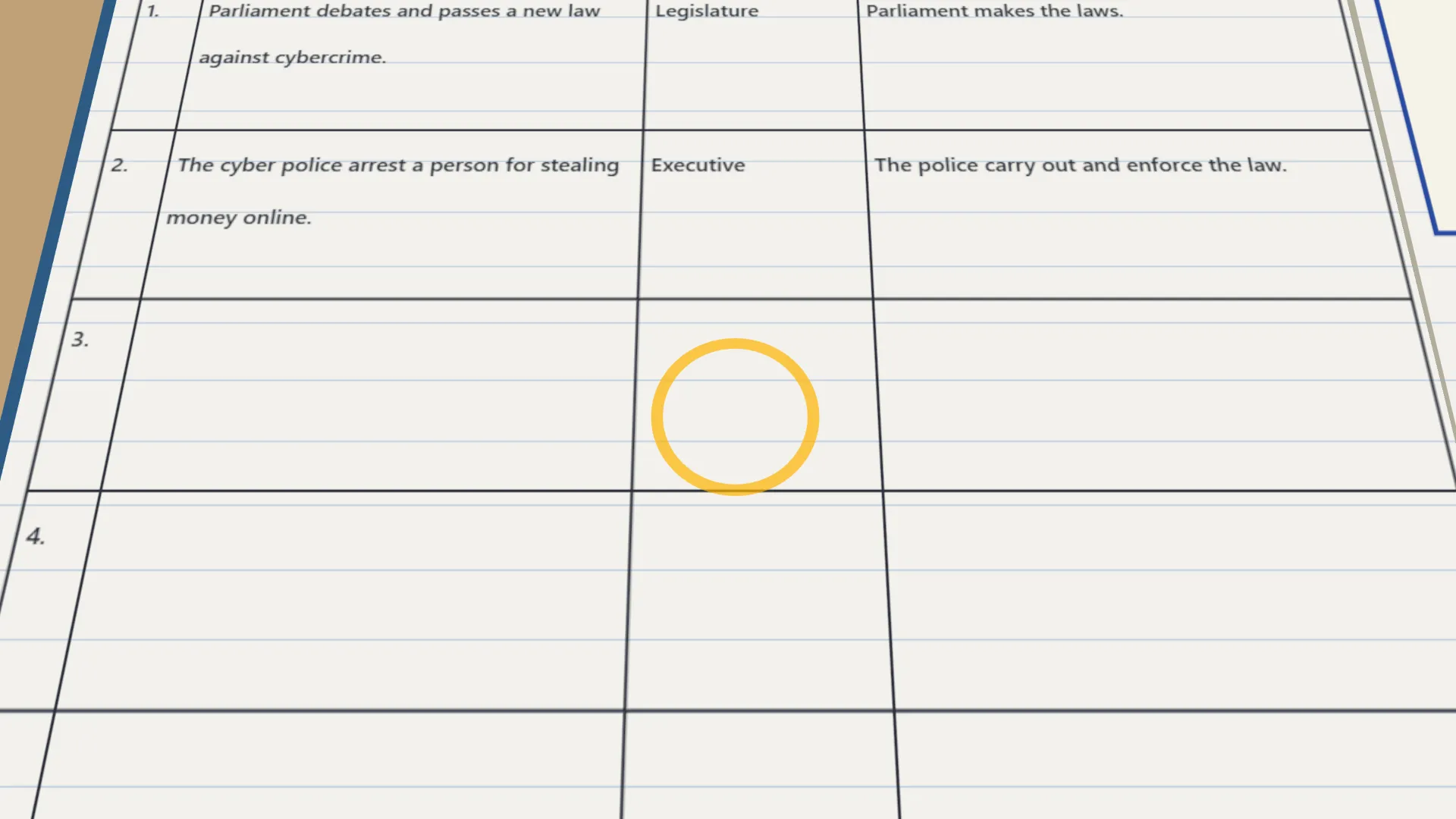
- Record five scenarios in the observation table, with the organ and a short reason for each.
- As a class, discuss what might go wrong if all three organs were controlled by the same group, and link it to separation of powers.
Interactive 3D Experiment
Loading simulation…
What to observe
- The legislature makes laws, the executive carries them out, and the judiciary decides disputes and punishments.
- Keeping the three organs separate protects citizens from the misuse of power.
Safety
- Read each scenario carefully before sorting. If a scenario seems to belong to two organs, discuss it as a class rather than guessing.
- Handle the cards gently so they can be used again.
Notes
- Separation of powers keeps the legislature, executive and judiciary independent of one another. This system of checks and balances allows one organ to question or restrain another if it oversteps its role, protecting citizens from the misuse of power.