
The Parity Puzzle
Aim
Use number cards, sign cards and two-coloured tokens to find out why every expression made by placing + and − signs between four given numbers has the same parity, and use this to say whether an expression is odd or even without working it out.
Apparatus
- Number cards 0–20 (or paper slips), one set per group
- Sign cards, four + and four −
- About 40 two-coloured counters (one colour for positive, one for negative)
- Chart paper, ruler and coloured sketch pens
Procedure
- Lay out 3, 4, 5, 6 with a sign card in each gap. List all eight sign arrangements using the branching diagram.
- Work out the value of each expression and mark it odd or even.
- Repeat with 5, 6, 7, 8 and with another set of four consecutive numbers of your own.
- Repeat with numbers that are not consecutive, such as 7, 2, 10, 5. Are the results still of one parity?
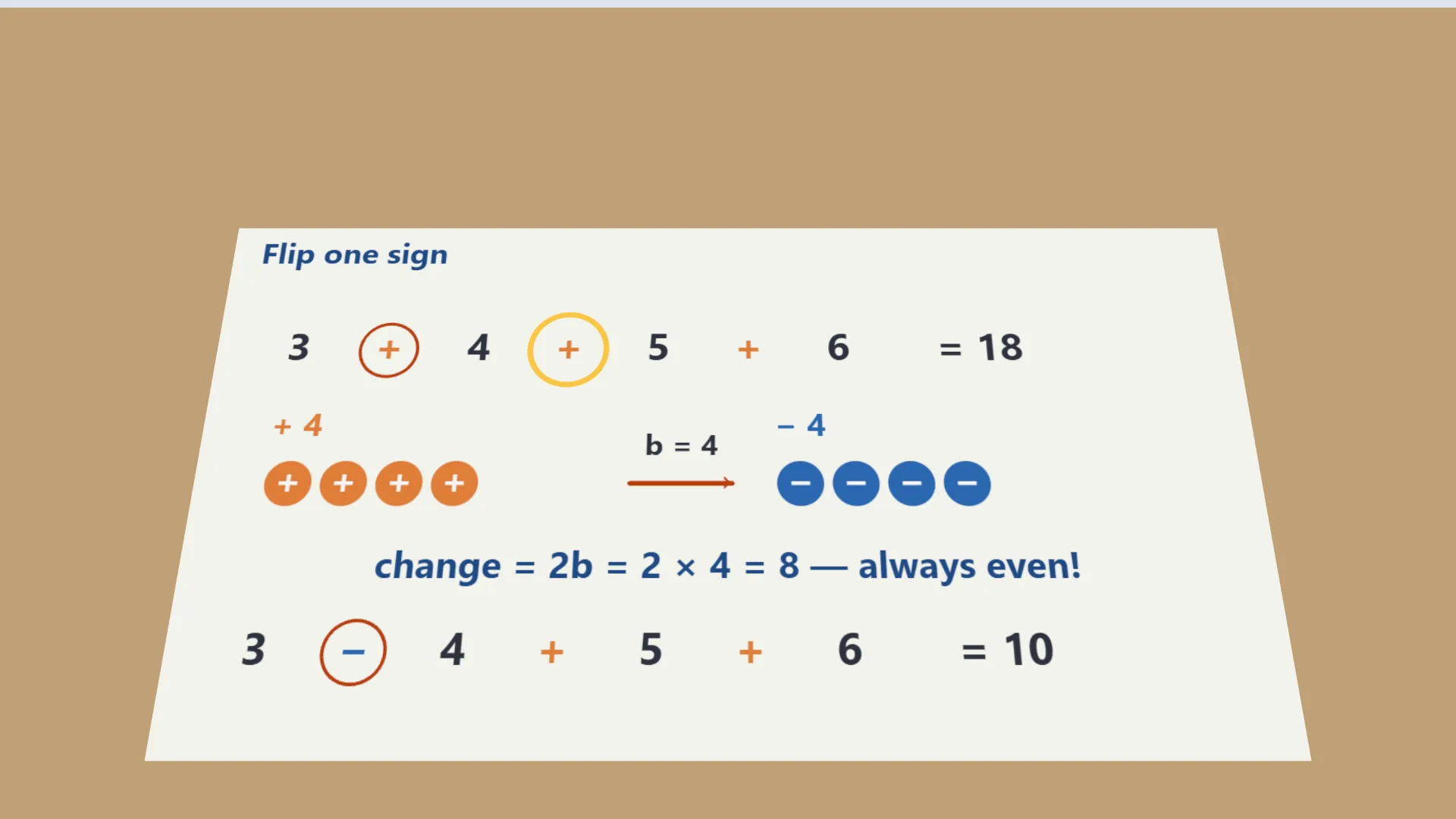
- Flip one sign and show the change with tokens: + b becomes − b, a change of 2b. Try three flips.
- Write why flips that change the value by an even number keep all eight values of the same parity.
- Try five numbers and then six. Write your conjecture in one sentence.
Interactive 3D Experiment
Loading simulation…
What to observe
- All eight expressions have values of the same parity, whichever signs are used.
- This holds for consecutive numbers and for numbers chosen at random.
- Flipping one sign changes the value by 2b, always even, so the parity never changes.
- Every value has the parity of the plain sum of the numbers. The same holds for five and six numbers.
Notes
- Math Spark: parity is an invariant, something that refuses to change. In the sliding 15 puzzle a parity argument shows that swapping only the tiles 14 and 15 is impossible. On a chessboard with two opposite corners removed, 31 dominoes can never cover the 62 squares left.
- List the eight arrangements with the branching diagram, so that none is missed and none is repeated.
- Work from left to right when evaluating. A wrongly evaluated expression can make the pattern look false.
- Take care with negative results. The parity of −5 is odd, just as for 5.
- Keep the number cards in the same order. Rearranging them changes the expressions.
- Use one colour of token for positive and the other for negative, and cancel them in pairs.
- Flip exactly one sign at a time when testing the change of 2b.
- Test with a set of non-consecutive numbers before writing the conjecture.