
The Date Detective
Aim
Decode the ‘Think of a Date’ trick using letter-numbers, recover a hidden date from the final answer, and change the trick so that a different number has to be subtracted at the end.
Apparatus
- A wall calendar or desk calendar of the current year
- Slips of paper, pencils and a notebook for recording
- Chart paper and coloured sketch pens for the flow chart
- A calculator, only for checking the arithmetic afterwards
Procedure
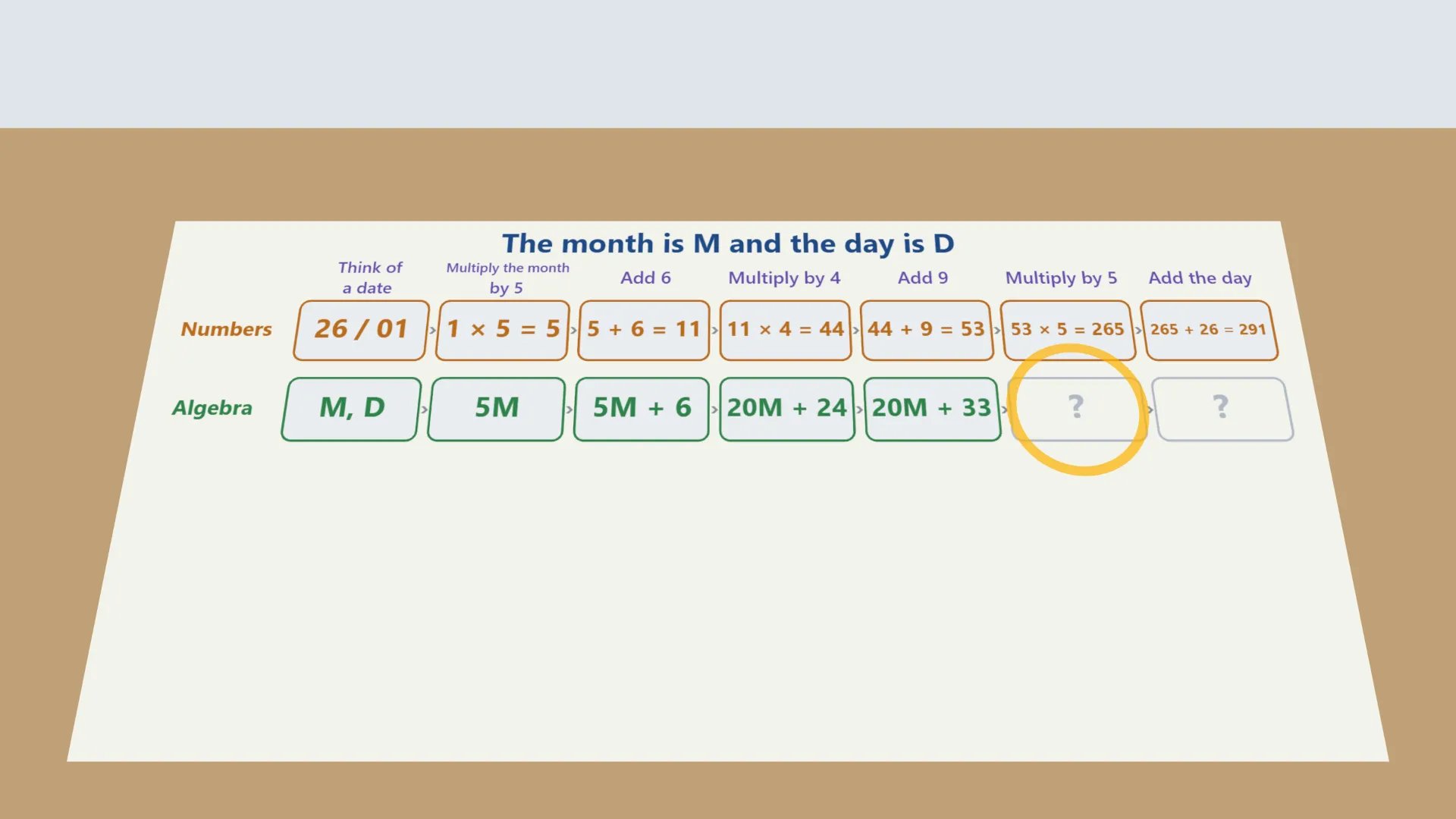
- Write the seven steps: think of a date, month × 5, add 6, × 4, add 9, × 5, add the day.
- Partner A thinks of a date and keeps it secret. Partner B reads the steps. A announces only the answer.
- Partner B subtracts 165: the last two digits are the day, the digits before them the month.
- Check with Partner A. Repeat for 25/12, 07/08, 15/08 and a birthday. Fill in the table.
- Let the month be M and the day D. Write the expression after each step. Is it 100M + 165 + D?
- Explain why the day and the month never get mixed up in the final number.
- Change ‘add 9’ to ‘add 4’. Use algebra to find the new number to subtract. Test it.
Interactive 3D Experiment
Loading simulation…
What to observe
- The steps give 5M, 5M + 6, 20M + 24, 20M + 33, 100M + 165 and finally 100M + 165 + D.
- Answer − 165 = 100M + D: the last two digits are the day, the digits before them the month.
- D is less than 100, so it never carries into the hundreds: day and month never mix.
- With ‘add 4’ instead of ‘add 9’ the answer is 100M + 140 + D, so 140 is subtracted.
Notes
- Math Spark: the trick rests on place value. The month is multiplied by 5 × 4 × 5 = 100, which pushes it into the hundreds place, while the day, never more than 31, stays in the tens and units. The 6 and 9 only disguise the trick: they become 6 × 4 × 5 + 9 × 5 = 120 + 45 = 165, exactly what you subtract. Calendar formulas such as Zeller’s rule use the same idea to find the weekday of any date.
- Follow the seven instructions in the correct order and finish each one before the next.
- Multiply the whole running total, not just the last part added.
- Read the last two digits as the day: 7 August gives 807, so M = 8 and D = 07.
- Take the month as its number, 1 to 12, and the day as 1 to 31.
- Do not reveal the date until the final answer has been announced and decoded.
- When the constant is changed, rework the algebra from the beginning; do not adjust 165 by guesswork.
- Test any changed version on at least three dates before using it.
- Use the calculator only to check the arithmetic after the trick is done.