
Testing Proportionality in Mixtures
Aim
Test whether two ratios are proportional by cross-multiplication, and build equivalent ratios with everyday mixtures such as rice and urad dal, coloured water and spice powders.
Apparatus
- Rice and urad dal (or two colours of beads or pulses), about 2 cups of each
- A set of identical measuring cups or spoons (at least 6)
- 4–6 transparent glasses or small bowls
- Red and blue water colour (or food colour) and a dropper
- Chart paper, ruler, pencil and coloured sketch pens
Procedure
- Measure 2 cups of rice and 1 cup of urad dal into a bowl. Write the mixture as 2 : 1.
- Double and triple both quantities to make 4 : 2 and 6 : 3.
- Test each pair: for a : b and c : d, is a × d = b × c? Record both products.
- Make a mixture not proportional to 2 : 1, such as 5 cups of rice and 2 of dal. Test 2 : 1 and 5 : 2.
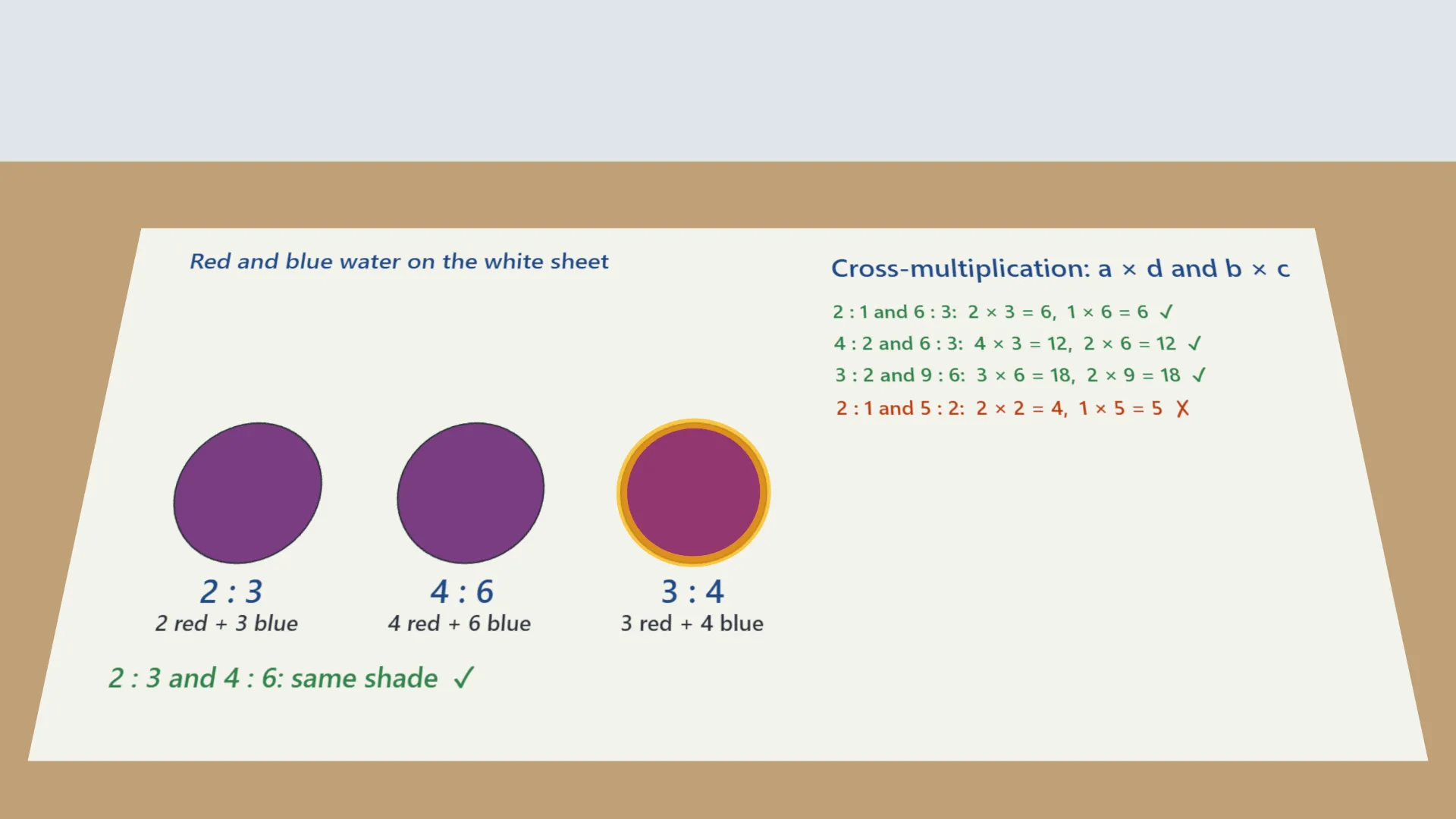
- Mix red and blue in 2 : 3 and 4 : 6; compare the shades on white. Repeat with 2 : 3 and 3 : 4.
- Build 8 : 4 : 2 : 1 with four colours of beads, halve every term, and check the factor of each pair.
- Write, in your own words, the rule that decides whether two ratios are proportional.
Interactive 3D Experiment
Loading simulation…
What to observe
- 2 : 1, 4 : 2 and 6 : 3 give equal cross products, so they are proportional.
- 2 : 1 and 5 : 2 give 4 and 5, which are not equal, so they are not proportional.
- The colours 2 : 3 and 4 : 6 look the same; 2 : 3 and 3 : 4 do not.
- a : b and c : d are proportional exactly when a × d = b × c, that is, when every term is multiplied by the same factor.
Notes
- Math Spark: cross-multiplication is the trairasika, or ‘rule of three’, of Brahmagupta (7th century) and Bhaskaracharya (12th century). Arab and European merchants called it the ‘Golden Rule’. Every time you scale a recipe for guests, you use it.
- Level the top of each measuring cup with a straight edge so that every cup holds the same amount.
- Use the same cup or spoon for both ingredients throughout.
- Keep the terms in the same order in both ratios: rice : dal must not become dal : rice.
- Both quantities in a ratio must be measured in the same unit.
- Multiply the first term of one ratio by the second term of the other, and write both products before comparing.
- Count the drops carefully and hold the dropper vertical so the drops are of equal size.
- Compare the glasses against the same white sheet, in the same light.
- Do not eat or taste the rice, dal or coloured water; wash your hands after the activity.