
Straightening the Curve — Measuring a Curved Line
Aim
Measure the length of a curved line or object using a thread and a metre scale.
Apparatus
- Science notebook / lab record and pencil
- A piece of thread or string, about 1 metre long
- A metre scale or 15-cm scale
- A curved object (for example the rim of a tumbler, a bangle, or a curved leaf edge)
Procedure
- Choose a curved object or a curved line.
- Lay the thread along the whole curve without stretching it. Mark the start and end on the thread.
- Lift the thread and straighten it along the metre scale.
- Read the length between the two marks.
- Repeat for two more curved objects and record each reading in the table.
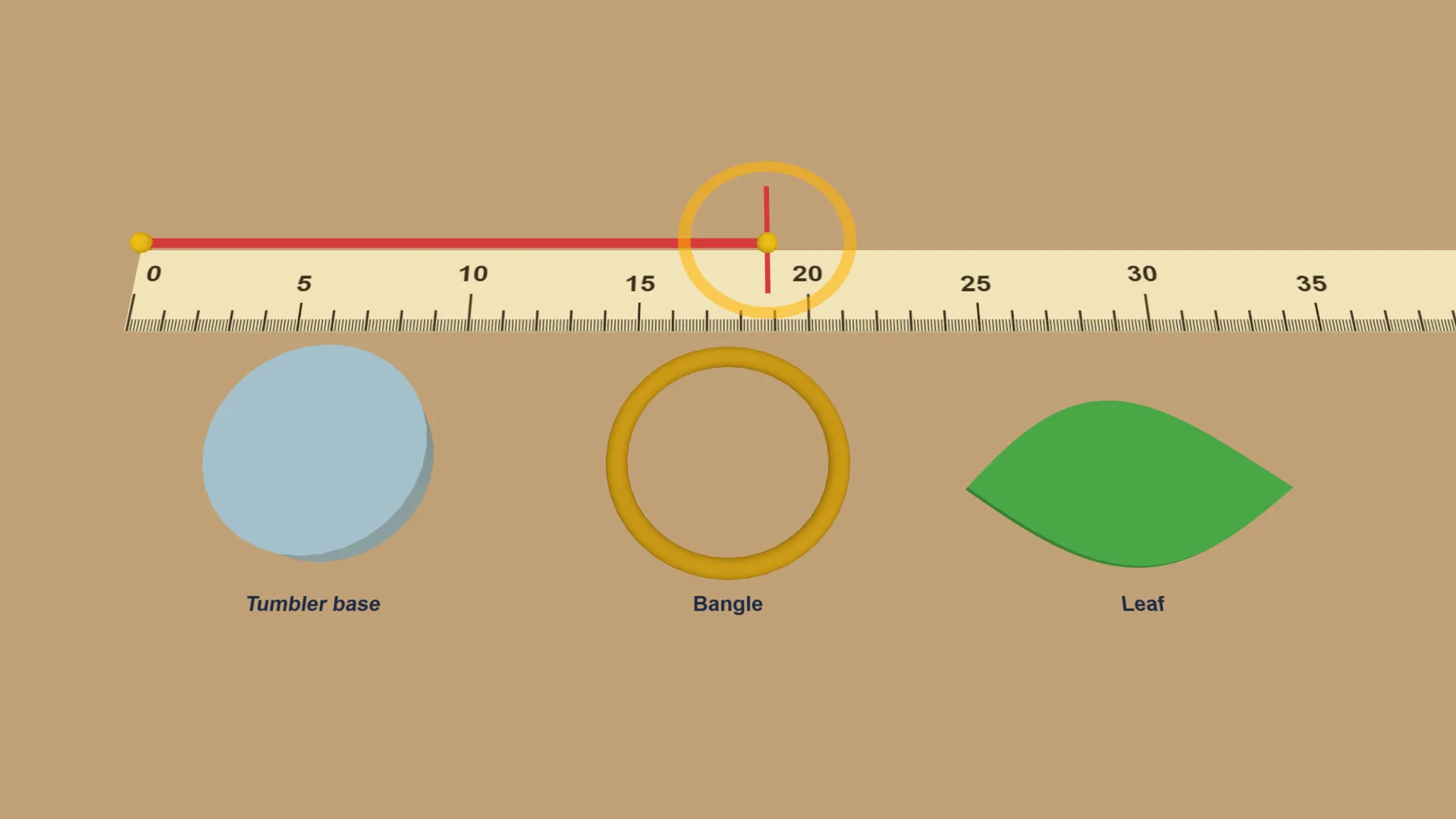
Interactive 3D Experiment
Loading simulation…
What to observe
- How does the thread follow the curve?
- What is the length between the two marks once the thread is straight?
- Why can a rigid scale not measure a curve directly?
Safety
- Lay the thread gently without stretching it. A stretched thread gives a wrong reading, and one that snaps can whip back into the eyes.
- Never wind or tie the thread around your fingers, wrist or neck, or around a classmate's.
- If the thread must be cut, use round-tipped scissors, cut away from your body, and only with the teacher's permission.
- Prefer a plastic or steel object to a glass tumbler or bangle. Report any breakage at once and never pick up broken glass with bare hands.
- Hold the object steady, read the scale with your eye straight above the marking, and put all thread pieces in the dustbin.
Notes
- A tailor's flexible measuring tape can measure curved lengths directly because it bends along the body. A rigid scale cannot measure a waist or chest.