
Spot the Pattern — Identifying Stars and Constellations
Aim
To identify common star patterns — the Big Dipper, the Little Dipper, the Pole Star and the constellation Orion — and to understand how imaginary lines help us recognise them in the night sky.
Apparatus
- Science notebook / lab record and pencil
- Black chart paper and white/silver sketch pens or star stickers
- Printed copies of star-pattern charts (Big Dipper, Little Dipper, Orion) for reference
- A torch covered with red cellophane (for later outdoor use, optional)
Procedure
- On black paper, mark dots for the stars of the Big Dipper, following the reference chart.
- Draw straight lines joining the dots to make the dipper (ladle) shape.
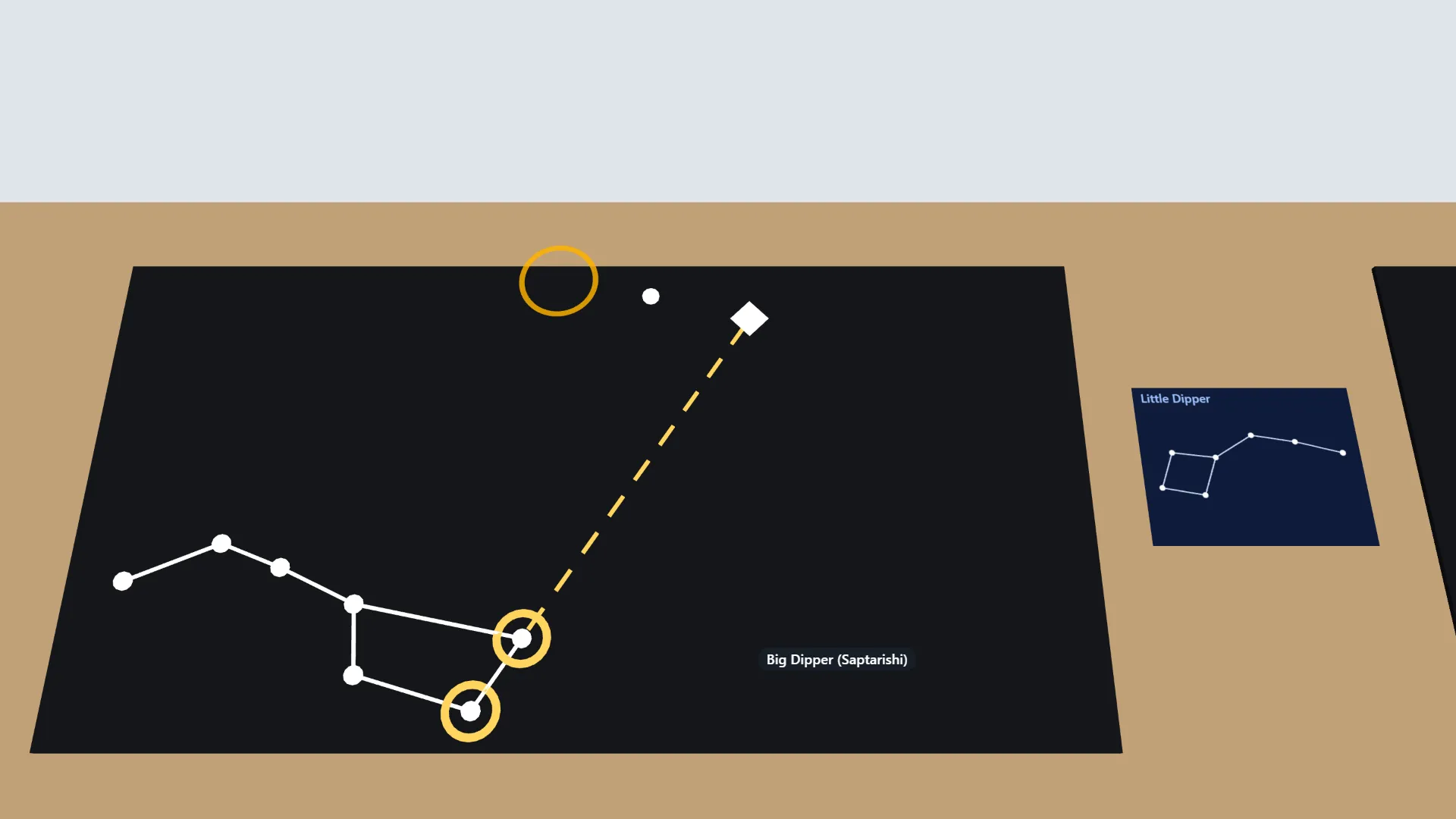
- Extend a line through the two pointer stars about five times their gap to find the Pole Star.
- Draw the Little Dipper and mark the Pole Star at the end of its handle.
- On another sheet, mark Orion's belt, complete the hunter, and mark Sirius along the line from the belt.
- Label each pattern with its name and Indian name, and fill in the table.
Interactive 3D Experiment
Loading simulation…
What to observe
- The Big Dipper looks like a ladle with a long handle.
- The line through the two pointer stars leads to the Pole Star.
- The Pole Star is at the end of the Little Dipper's handle.
- Orion's three belt stars lie in a row, and Sirius lies along the line from the belt.
Safety
- Never look at the sun to practise observing the sky — not with the naked eye, and never through a torch, binoculars, cellophane, smoked glass, X-ray film or a mobile camera.
- Do this chart activity in a well-lit, ventilated room. Working on black paper in dim light strains the eyes.
- Use a marker dot or a star sticker for each star. Never use a compass point, pin or needle to prick holes in the chart paper.
- Use round-tipped scissors with the teacher's permission, keep sketch-pen caps closed, and do not put stickers, caps or pens in the mouth.
- Never shine the red-cellophane torch into anyone's eyes, and keep the cellophane away from flames and hot bulbs.
Notes
- Science Spark: In India, the Big Dipper is known as Saptarishi (the Seven Sages) and the Pole Star as Dhruva tara. Different tribal communities picture the same four stars as a 'grandmother's cot' or a fisherman's boat!