
Squares of Sums and Differences
Aim
Verify (a + b)² = a² + 2ab + b² and (a − b)² = a² − 2ab + b² by cutting and rearranging paper squares, and use them to square numbers quickly.
Apparatus
- Graph paper and chart paper
- Coloured paper in four colours
- Scissors, glue stick, ruler and pencil
- Sketch pens for labelling
- Notebook for recording areas
Procedure
- Cut a square of side 13 cm. Mark 10 cm and 3 cm on two adjacent sides and rule lines to make four regions.
- Colour the four regions, cut them apart and find each area. Add them and compare with 13 × 13.
- Write 13² = (10 + 3)² = 10² + 2(10 × 3) + 3². Repeat with a square of side 65 units.
- With letters, draw a square of side (a + b), label the four regions and write Identity 1A.
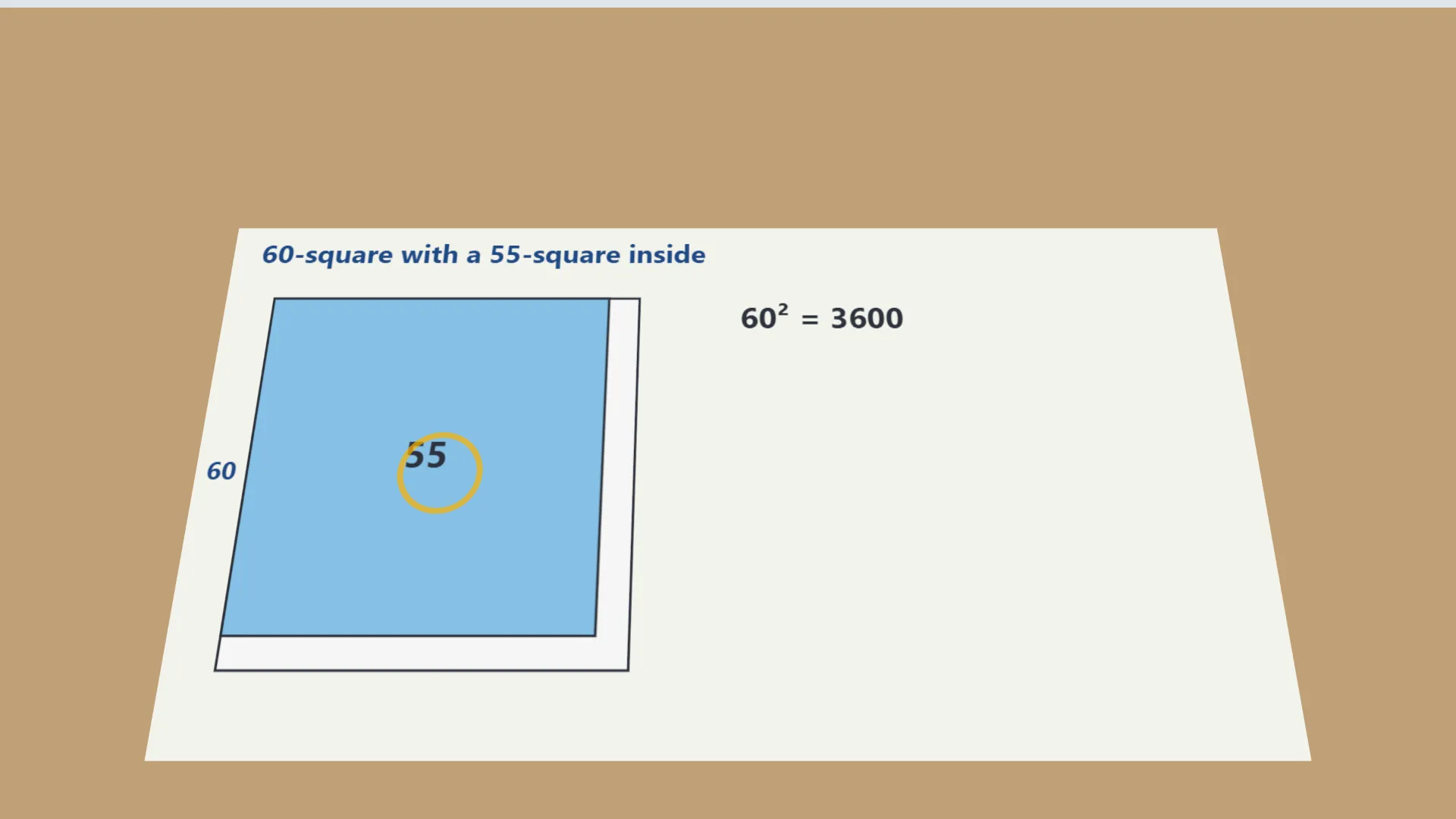
- For a difference, mark a square of side 55 inside a square of side 60 and remove the two 60 × 5 rectangles.
- The 5 × 5 corner was removed twice, so add it back once. Repeat with letters to get Identity 1B.
- Use the identities to find 104², 37², 99² and 58², and check each by long multiplication.
- Expand (6x + 5)² and (3j + 2k)² by the distributive property and by the identity, and compare.
Interactive 3D Experiment
Loading simulation…
What to observe
- The four regions of a square of side (a + b) add up to a² + 2ab + b². The two rectangles are equal, so 2ab appears.
- In (a − b)² the b × b corner is removed twice, so it is added back once. The middle term is subtracted and b² stays positive.
- Both identities give the same answers as long multiplication, for example 103² = 10609 and 98² = 9604.
Notes
- Math Spark: cutting a square into a², two ab rectangles and b² is one of the oldest proofs without words. Euclid recorded it more than 2300 years ago in Book II of the Elements. The middle term 2ab is the reason (a + b)² is not a² + b².
- Draw on graph paper and cut exactly along the ruled lines, or the pieces will not fit.
- Check that the two rectangles are congruent, both a by b, before pasting.
- Use a different colour for each piece and label every piece with its area.
- Fit the pieces edge to edge with no overlap and no gap. Paste only after the arrangement is confirmed.
- In the (a − b)² arrangement the small b × b square is removed twice and added back once.
- Take a larger than b when working with (a − b)².
- Verify each identity with your own values of a and b before generalising.
- Use scissors carefully and keep the glue away from the labelled faces.