
Splitting the Unit — Tenths and Hundredths
Aim
Measure everyday objects with a scale to see why smaller units are needed, and write lengths as tenths and hundredths of a unit using the decimal point.
Apparatus
- A 15 cm ruler with millimetre markings
- Small objects to measure: pencil, eraser, screw, chalk, leaf, ribbon
- A strip of paper (about 10 cm long)
- Coloured pencils or sketch pens and a sharp pencil
- Dot grid / graph paper notebook
Procedure
- Look at the ruler. Between 2 and 3 there are 10 equal small parts. Each part is 1/10 cm.
- Lay the pencil with its blunt end at 0. The tip is at the 7th small mark after 2, so it is 2 7/10 cm = 2.7 cm.
- Measure the eraser, chalk, leaf and an object of your choice the same way. Record each one.
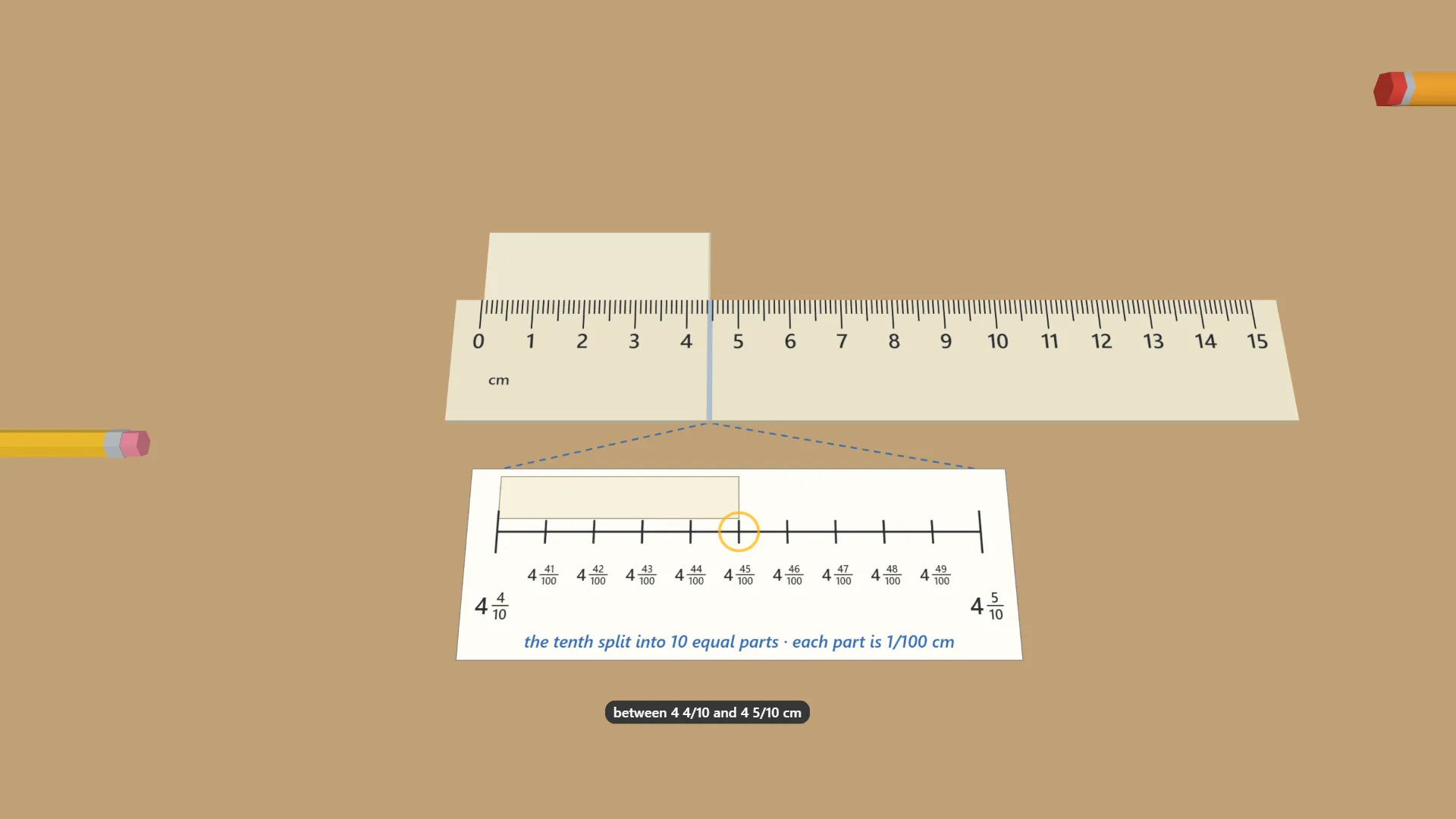
- Lay the 8 9/10 cm paper strip on the ruler and fold it in half. The fold is between 4 4/10 and 4 5/10.
- Split that tenth into 10 equal parts (hundredths). The fold is at 4 4/10 5/100 = 4.45 cm.
- Record every length in words, as a fraction and as a decimal. Write how tenths and hundredths are formed.
Interactive 3D Experiment
Loading simulation…
What to observe
- One centimetre on the ruler is split into 10 equal parts. Each small part is one-tenth (1/10).
- The pencil ends at the 7th small mark after 2 cm, so its length is two and seven-tenths, 2.7 cm.
- The fold of the strip lies between two tenth marks, so tenths are not enough to name it.
- Splitting a tenth into 10 equal parts gives hundredths. There are 100 hundredths in one unit.
- The decimal point separates the whole units from the tenths and hundredths.
Notes
- The word 'decimal' comes from the Latin decem, ten — like the Sanskrit daśha, which also means ten.
- Decimal fractions appear in the 9th-century works of the Indian mathematician Śhrīdharāchārya.
- Around 950 CE al-Uqlīdisī wrote 0.059375 with just a small mark on the whole-number part.
- Start measuring from the zero mark of the ruler, not from its worn edge.
- Keep your eye directly above the mark you read, to avoid a parallax error.
- There are ten small divisions in one centimetre, so the 7th mark is 0.7 cm, not 0.07 cm.
- Place the object flat along the scale so that it does not slant or shift.
- Never leave out the decimal point, and always write the unit (cm or mm).
- Use a sharp pencil to mark a reading, so the mark does not add to the length.