
Sorting Numbers by What Remains
Aim
Sort even numbers into multiples of 4 and numbers that leave a remainder of 2, find when the sum of two even numbers is a multiple of 4, and describe a whole family of numbers with a given remainder using letter-numbers.
Apparatus
- About 60 counters, beads or bottle caps per group
- Strips of squared paper, some 4 columns wide and some 5 columns wide
- Two colours of sketch pens for the two kinds of even numbers
- Chart paper and a marker for the group's poster
Procedure
- Build 8, 10, 12, 14 and 16 as dot arrays on a 4-column strip. Which end with a complete row?
- Sort even numbers into two trays, remainder 0 and remainder 2. Write each as 4p or 4p + 2.
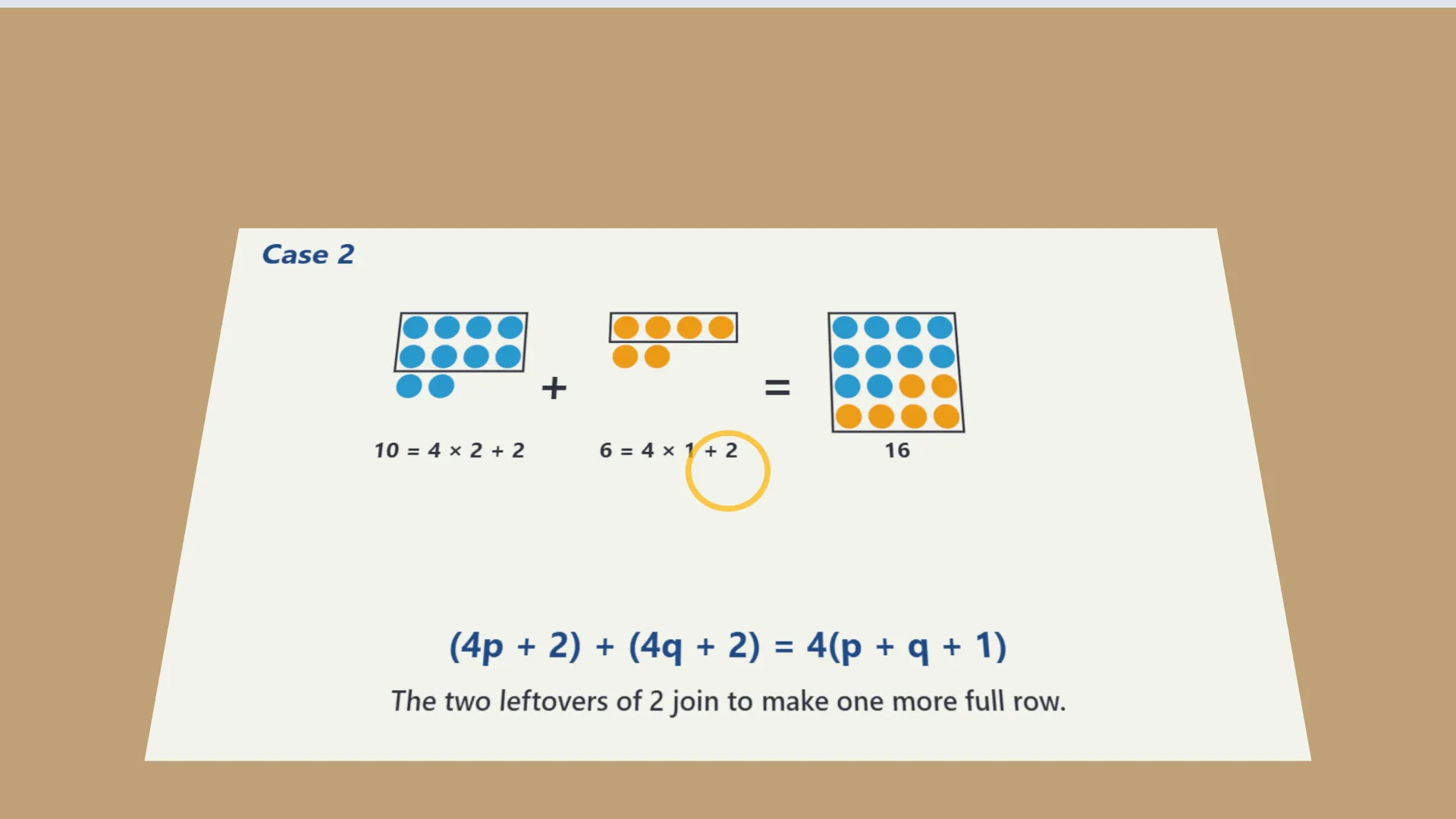
- Add two numbers from one tray, then one from each tray. Is the sum a multiple of 4? Record it in Table 1.
- Explain each case with the dot pictures and the matching algebra.
- On a 5-column strip build 3, 8, 13, 18 (the family 5k + 3). Check that 5k − 2 is the same family.
- Use a 3-column and a 4-column strip together to find the smallest number that leaves 2 on both. Fill Table 2.
- Make a poster of the three cases with dots, algebra and two examples of each.
Interactive 3D Experiment
Loading simulation…
What to observe
- Every even number is 4p (complete rows of four) or 4p + 2 (two dots left over).
- Two numbers from the same tray always add up to a multiple of 4.
- One number from each tray always leaves a remainder of 2.
- The numbers 3, 8, 13, 18 … form the family 5k + 3, which is exactly the same set as 5k − 2.
Notes
- Math Spark: remainders behave like the numbers on a clock face. 9 o'clock plus 5 hours is 2 o'clock, because only the remainder on division by 12 matters. Gauss gave this clock arithmetic its modern form in 1801. Aryabhata (499 CE) gave the kuttaka method for remainder puzzles.
- Make the strips exactly 4 columns or 5 columns wide. An extra column changes the family completely.
- Fill the dots row by row from the left, completing each row before starting the next.
- The remainder must always be less than the divisor. A remainder of 4 on division by 4 means one more full row.
- Use one colour for the 4p numbers and another for the 4p + 2 numbers, and keep the two trays labelled.
- Test each conclusion with at least five pairs before writing it as a rule.
- The letter-number p stands for any whole number, so 4p describes a whole family, not one number.
- When checking that 5k + 3 and 5k − 2 give the same family, substitute values of k carefully.