
Tracing the Journey of a Word — From 'Sindhu' to 'India'
Aim
To trace how the ancient word Sindhu travelled across languages and centuries to become the many names of India, by making a word-origin chain.
Apparatus
- Chart paper or notebook
- Coloured sketch pens
- Ruler
- The textbook chapter, for reference
Procedure
- Read "How Foreigners Named India" in your textbook and note every name mentioned for India.
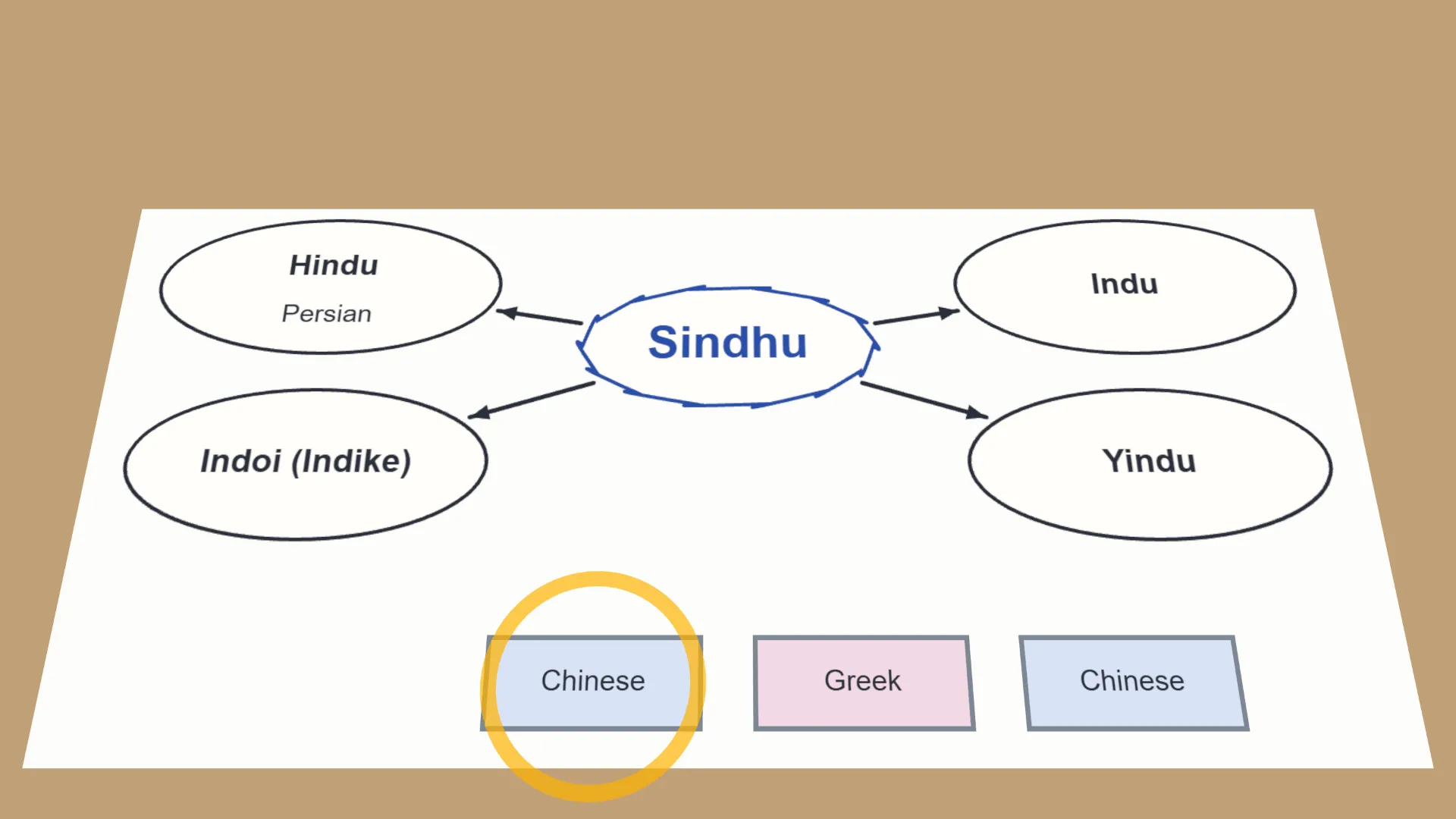
- Write Sindhu in the centre of the chart and draw an arrow outward to each name it gave rise to.
- Beside each arrow, write the language or people who used that word.
- Colour-code the chains. Use one colour for the Persian–Greek route and another for the Persian–Chinese route.
- Add the word Hindustān and write one sentence about when and where it was first used.
- With a partner, check each other's charts and talk about any name you had not heard before.
Interactive 3D Experiment
Loading simulation…
What to observe
- One ancient word, Sindhu, gave rise to several names for India in different languages.
- The names reached other lands by different routes, such as the Persian–Greek and the Persian–Chinese routes.
Notes
- In ancient Persian, Hindu was a purely geographical term describing the land beyond the Indus River. It did not refer to a religion. Many of today's most familiar words began as descriptions of rivers and geography, long before they took on other meanings.
- Use only the textbook and teacher-approved sources. Write each language and word clearly and check the spellings before you finish the chart.