
Simulating a Market: Price Determination Through Buyer–Seller Negotiation
Aim
To act out buying and selling in a simple market and see how a price is fixed by bargaining between demand and supply.
Apparatus
- Play currency notes or tokens
- Product picture-cards (guavas, vegetables)
- Price tags
- A stopwatch
- An observation sheet
Procedure
- Work in pairs. One student is the seller, the other is the buyer.
- The seller asks a very high price, ₹80/kg, for guavas. Does the buyer agree?
- Now the seller asks a very low price, ₹20/kg. How many buyers want guavas? Are there enough?
- Bargain freely for two minutes until you agree on a price. Record it.
- Play two more rounds with 1 buyer and 2 sellers, then 3 buyers and 1 seller.
- Discuss: which round had the highest price? The lowest? What did the numbers of people do?
- Record your observations in the table.
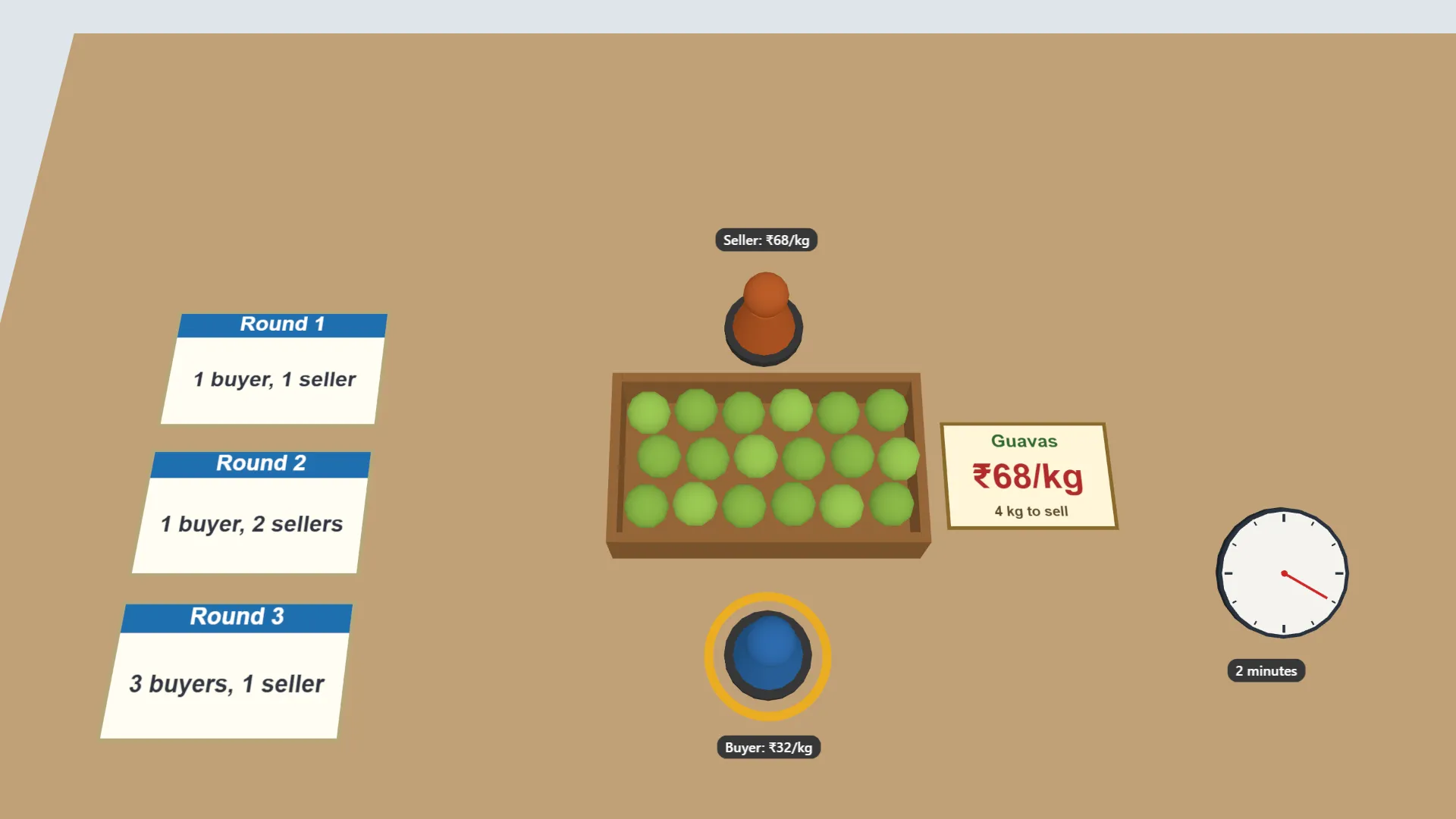
Interactive 3D Experiment
Loading simulation…
What to observe
- At a very high price nobody buys; at a very low price everyone wants to buy, but there are not enough guavas.
- Buyer and seller each give way until they agree on one price.
- More buyers push the price up; more sellers bring it down.
- The prices here come from a simple model. Your class's prices will be different.
Notes
- Social Science Spark: Kautilya's Arthashastra, over 2,000 years ago, had rules to stop buyers of ghee being cheated by wrong measures.
- Collect all play money and tokens back after the activity.
- Keep each bargain polite and to about two minutes per round.