
Simplifying Algebraic Expressions
Aim
Use pictures (a rectangle and paper tiles) to understand like terms and the distributive property. Then show that an expression and its simplified form always give the same value when the letter-numbers are replaced by numbers.
Apparatus
- Squared / graph paper
- Paper "algebra tiles" — small equal squares marked 'c', and unit squares
- Coloured sketch pens (at least 3 colours)
- Ruler, pencil and scissors
Procedure
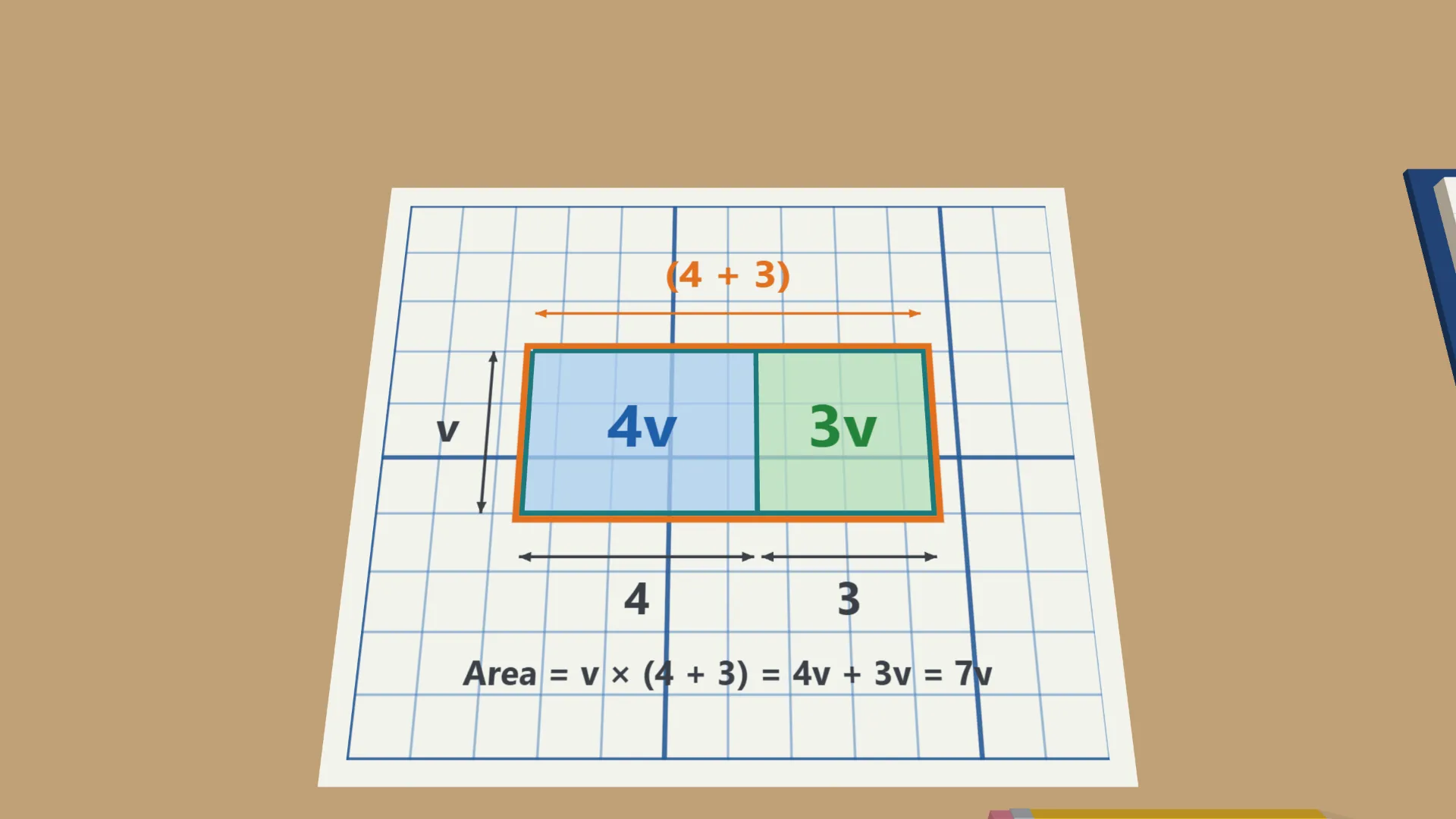
- On graph paper draw a rectangle of height v, split into widths 4 and 3. Colour the two parts.
- Find the area two ways — v × (4 + 3) and 4v + 3v. So 4v + 3v = 7v.
- Lay 5c + 3c + 10c with 'c' tiles, slide them together and count them — 18c.
- Sort a mixed pile into c-tiles and unit tiles. They cannot be joined — unlike terms.
- Simplify each expression in the table. Open brackets first, then collect like terms.
- Check each one — put two different numbers into the expression and its simplified form.
Interactive 3D Experiment
Loading simulation…
What to observe
- v × (4 + 3) and 4v + 3v cover the same region, so 4v + 3v = 7v.
- The tiles of 5c + 3c + 10c slide together into 18 tiles — 18c.
- c-tiles and unit tiles stay apart — 3c + 2 cannot be made simpler.
- Each simplified form gives the same value as its expression, for every number tried.
Notes
- Only like terms can be added — 5 apples + 3 apples = 8 apples, but 5 apples + 3 oranges cannot be combined.
- In a simplest form, the number of letter-numbers is never more than the number of terms. Look for it in the table.
- Add only like terms — 5c and 3d cannot be combined.
- Never add a letter-number to a plain number — 3c + 2 stays as it is.
- Keep each coefficient with its letter, and carry the sign of each term with it.
- Draw the rectangles and tiles to scale on squared paper, or the areas will not look equal.
- When checking, put the same value of the letter-number into both forms.