
Telling Time with Water — Making a Simple Water Clock
Aim
To make a simple water clock from a used plastic bottle, mark equal one-minute intervals on it, and use it to time a short event in the classroom.
Apparatus
- A used transparent plastic bottle (½ litre or larger) with its cap
- A pair of scissors or a cutter (used only under the teacher's supervision)
- A drawing pin or a thin nail, and a permanent marker pen
- A few drops of ink or food colour, and water in a mug or beaker
- A watch or a stopwatch (a mobile phone's stopwatch may be used)
- Science notebook and pencil
Procedure
- Your teacher cuts the bottle in two, roughly in the middle.
- Make one small hole at the centre of the cap with a drawing pin.
- Screw the cap back on. Put the upper part, upside down, over the lower half.
- Add a few drops of ink to the water so that the level is easy to see.
- Fill the upper part with the coloured water. Start the stopwatch at the same moment.
- Mark the water level in the lower half after every minute. Number the marks 1, 2, 3, …
- Your water clock is ready. Pour the water back into the upper part and let it drip again.
- Without looking at the watch, time an event with the water clock. Then check with the watch.
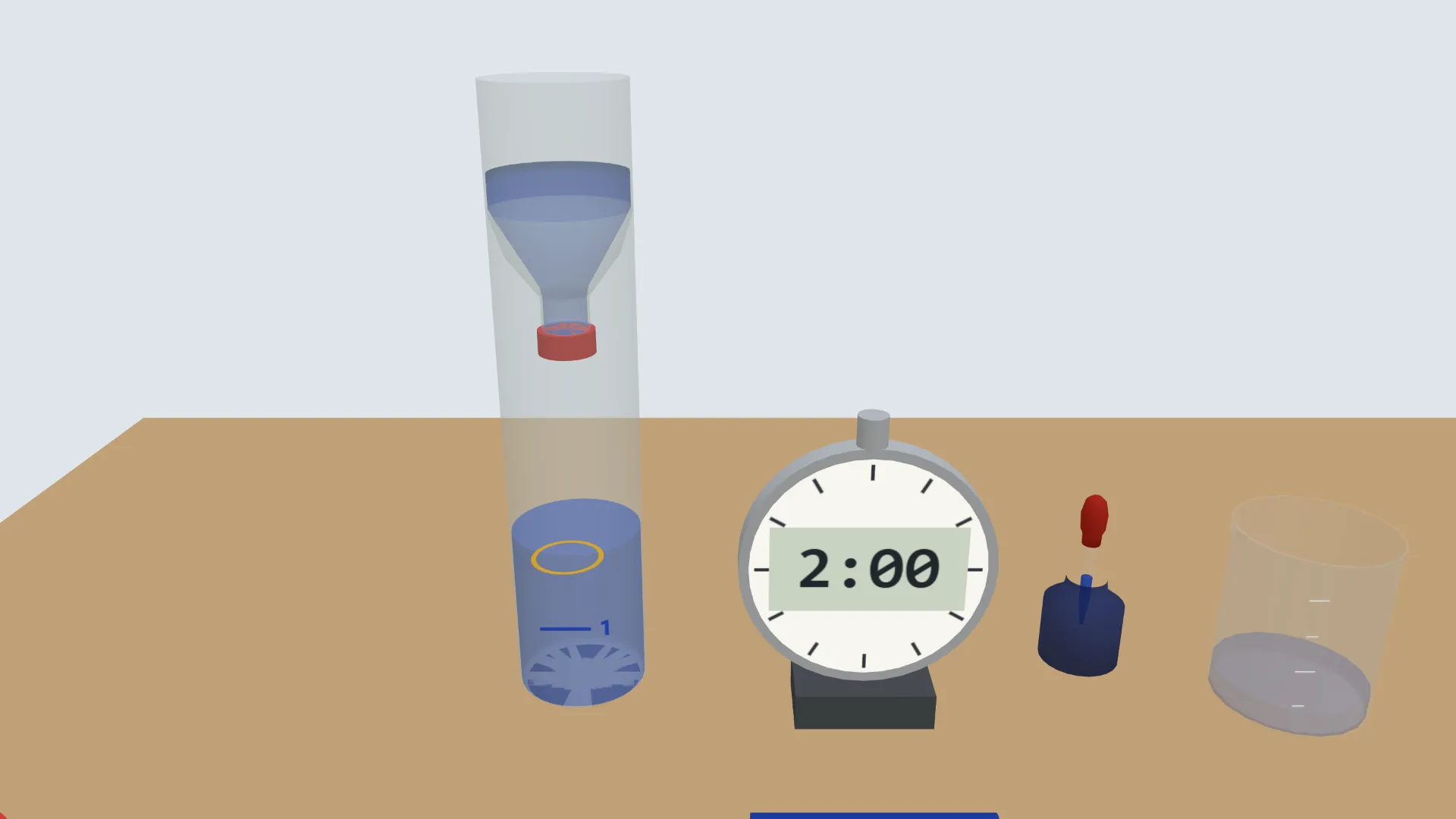
Interactive 3D Experiment
Loading simulation…
What to observe
- The water drips at a nearly steady rate, so nearly equal amounts collect in equal times.
- Any process that repeats itself steadily can be used to measure time — here, the dripping of water.
- Each mark stands for one minute, so counting the marks gives the time that has passed.
- The rise in each minute gets a little smaller, because the dripping slows as the upper part empties.
- So the water clock's time differs a little from the watch's. Water clocks, sand clocks and sundials were used before mechanical clocks.
Safety
- Cutting the bottle is the teacher's task. If a student cuts, use blunt-tipped scissors and cut away from the body.
- The cut edge is sharp. Smooth it with sandpaper or cover it with tape. Use a plastic bottle, never a glass one.
- Make the hole by pressing the pin down on the table, never in your palm. Never use a hot nail or a flame.
- Work over a tray or a sink and wipe up spilt water at once. Keep water away from switchboards.
- Use only a few drops of ink, and never put ink or coloured water in your mouth.
Notes
- Science Spark: the Samrat Yantra at Jantar Mantar, Jaipur, is the world's largest stone sundial, about 27 m tall. Its shadow moves about 1 mm every second.