
Similar or Distorted? Testing Images with Ratios
Aim
Measure the width and height of five image cards, write each width : height ratio in simplest form, and find out why images whose width and height change by the same factor look similar, while others look stretched or squashed.
Apparatus
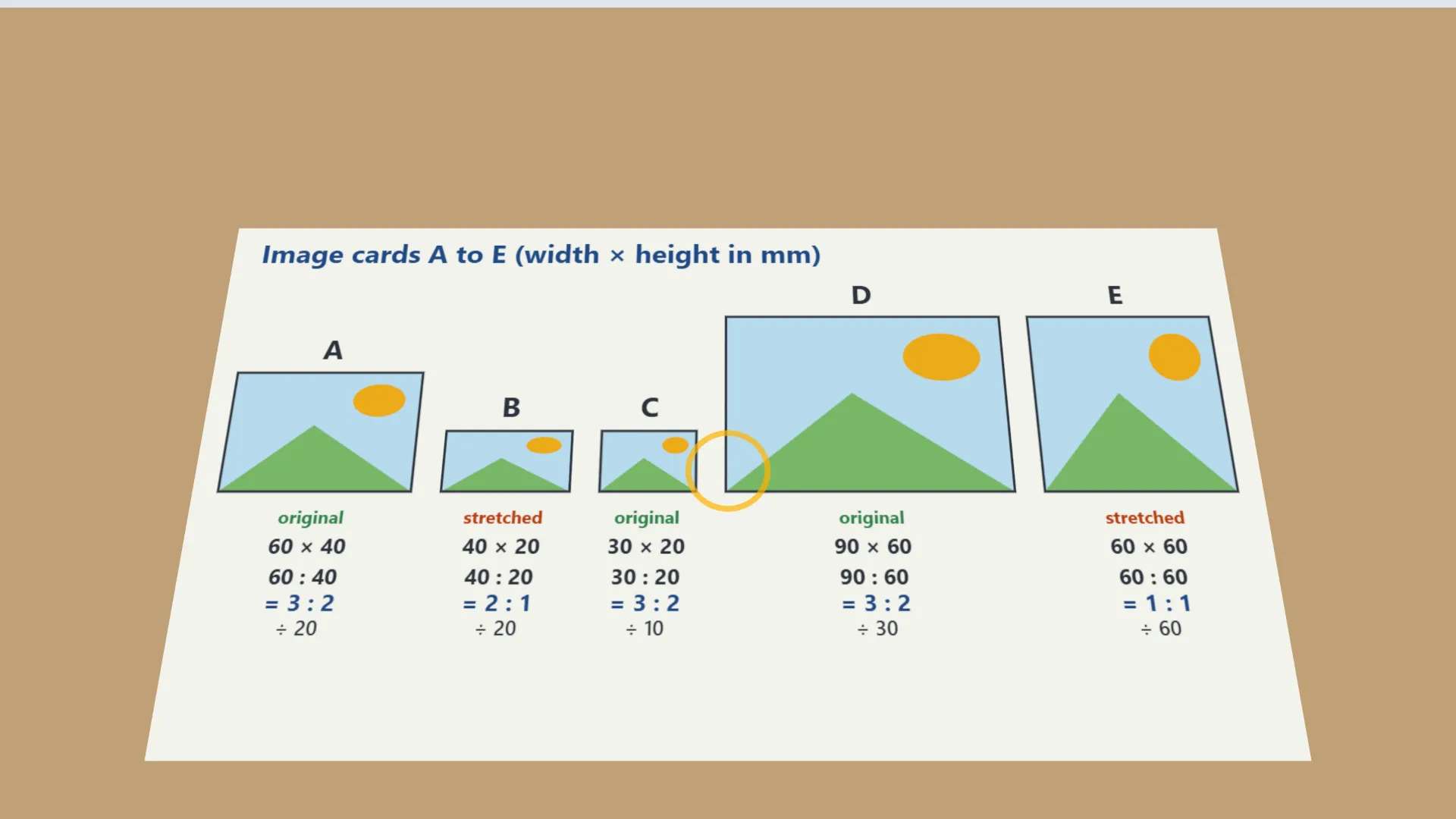
- One picture printed in five different sizes, labelled A to E (or the five rectangles of Fig. 1.1 cut out of card)
- Ruler with millimetre markings (15 cm or 30 cm)
- Graph paper or dot grid notebook
- Coloured pencils or sketch pens (at least 3 colours)
- Scissors, gum and a pair of set squares (optional)
Procedure
- Spread the cards A to E. Without measuring, sort them into 'looks like the original' and 'stretched or squashed'.
- Measure the width and height of every card to the nearest millimetre and fill the table.
- Write width : height for each card and divide both terms by their HCF to get the simplest form.
- Tick the cards whose simplest form is the same as A's. Do they match your guess?
- Find the factor of change from A: divide the width by A's width and the height by A's height. Are they equal?
- Try the difference method: subtract A's width and height from a card's. Does an equal difference give a similar card?
- On graph paper draw a 3 cm × 2 cm rectangle and a smaller and a larger one of the same ratio from one corner. Draw the diagonal.
- Write the test you would use to decide whether two rectangles are similar.
Interactive 3D Experiment
Loading simulation…
What to observe
- The cards that look like A have the same simplest ratio as A, 3 : 2.
- In a similar card the width and the height change by the same factor. An equal difference does not keep the shape.
- Rectangles with the same ratio drawn from one corner have their far corners on one straight diagonal.
Notes
- Math Spark: A4 paper has a ratio of about 1 : 1.414. Fold it in half and each half has the same ratio, which is why A3, A4 and A5 look alike. Screens are 4 : 3 or 16 : 9; stretching 4 : 3 video to 16 : 9 makes faces look wide and flat.
- Sort and record your guess before measuring, so the measurements do not influence it.
- Put the ruler's zero mark exactly at the edge of the card, and measure the card, not its printed border.
- Always write the ratio as width : height, in the same order for every card.
- Divide both terms by their full HCF so the ratio is in its simplest form.
- Both quantities must be in the same unit before a ratio is written.
- When finding the factor of change, divide the new value by A's value. Do not subtract.
- Draw the rectangles from the same corner of the grid so the diagonal test can be applied.