
The Sieve of Eratosthenes — Hunting for Primes
Aim
Find all the prime and composite numbers from 1 to 100 with the Sieve of Eratosthenes, and see what prime and composite numbers look like as rectangles of counters.
Apparatus
- Printed hundred chart (numbers 1 to 100 in a 10 × 10 grid)
- Green pencil and one other coloured pencil
- Counters, beads or bottle caps
- Ruler and pencil
Procedure
- Arrange 7 counters, then 12 counters, in equal rows with no gaps. How many rectangles can each make?
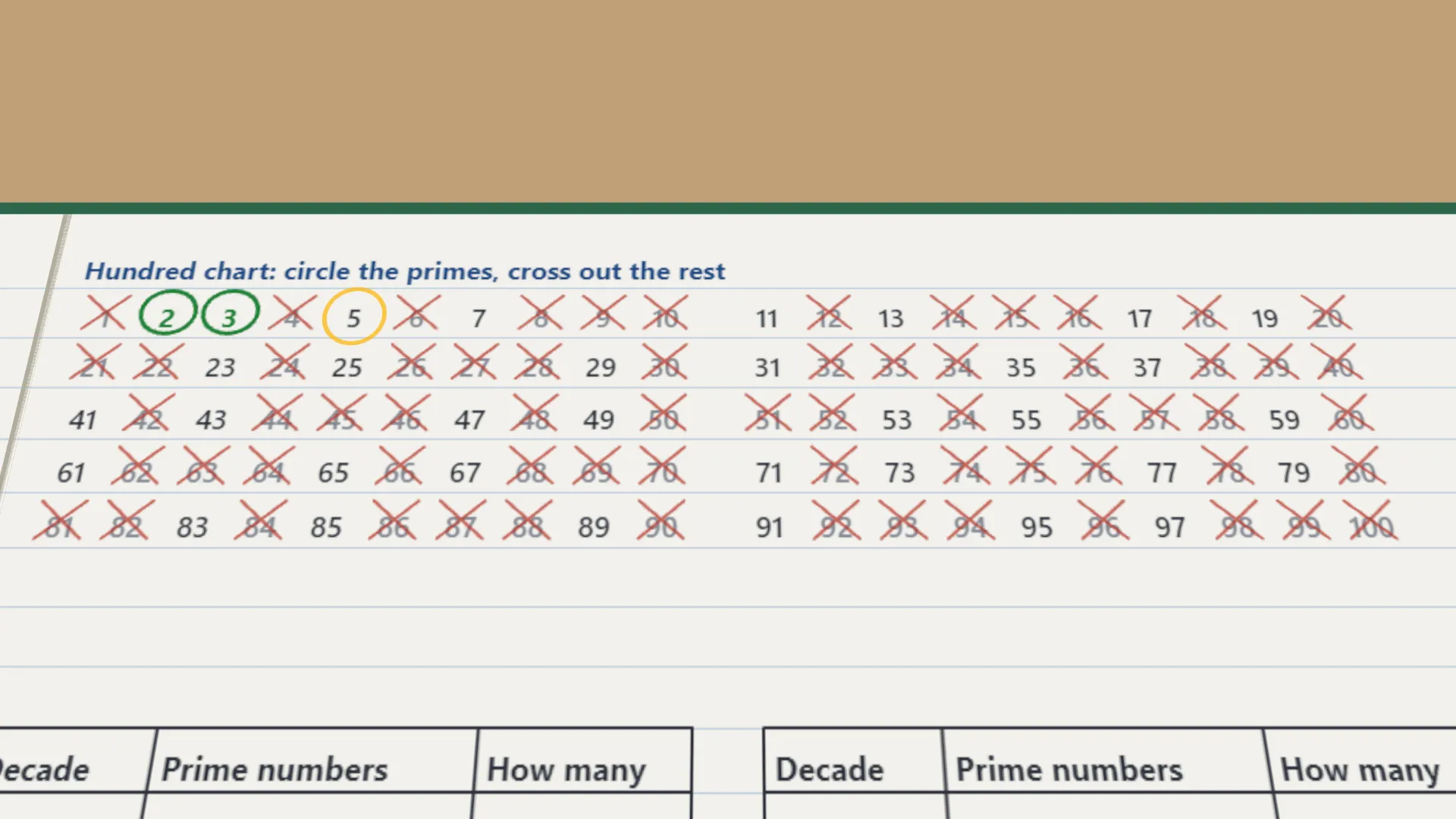
- On the hundred chart, cross out 1. It is neither prime nor composite.
- Circle 2 in green. Cross out every other multiple of 2.
- Do the same for 3, then 5, then 7. Circle each one and cross out only its other multiples.
- Circle every number that is left. The circled numbers are the primes.
- Write the primes in each decade (1–10, 11–20, …), count them, and recount the circled numbers.
Interactive 3D Experiment
Loading simulation…
What to observe
- How many rectangles can 7 counters make? How many can 12 make?
- How many numbers are circled? Which decade has the most primes, and which has the fewest?
- Do the primes get more or fewer as the numbers grow?
Notes
- A prime has exactly two factors; a composite has more than two. 1 is neither.
- The name comes from Eratosthenes, a Greek mathematician who lived about 2200 years ago. The sieve sifts out the composite numbers and leaves the primes behind.
- 2 is the only even prime. Primes never run out. Euclid proved there are infinitely many of them.
- Cross out 1 first.
- Circle each new prime (2, 3, 5, 7) and cross out only its other multiples. Never cross out the prime itself.
- Cross out lightly, so the numbers can still be read afterwards.
- Do not stop halfway. A number may be a multiple of more than one prime and can be crossed out more than once.
- When arranging counters, fill the rectangle completely with equal rows, with no gaps and none left over.
- Recount the circled numbers at the end, so that none is missed.