
Shiny or Dull, Hard or Soft? — Sorting Materials by Appearance and Hardness
Aim
Observe, group and record materials as shiny (lustrous) or dull (non-lustrous), and as hard or soft.
Apparatus
- Science notebook / lab record and pencil
- Small pieces of paper, cardboard, wood, chalk, stone, copper wire and aluminium foil
- Any article made of brass, bronze or steel (for example a spoon or key)
- A metal key or similar blunt object for the scratch test
- Everyday objects such as a water bottle, pillow, table, tumbler and a sweater
Procedure
- Collect the pieces of paper, cardboard, wood, chalk, stone, copper wire and aluminium foil.
- Hold each piece up to the light. Is it shiny or dull?
- Record each result in Table 1.
- Gently scratch wood, aluminium, stone and chalk with the metal key.
- Note which materials scratch easily (soft) and which resist (hard).
- Hold each object in your hands. Is it hard or soft? What is it made of?
- Record your findings in Table 2 and compare them with a partner's.
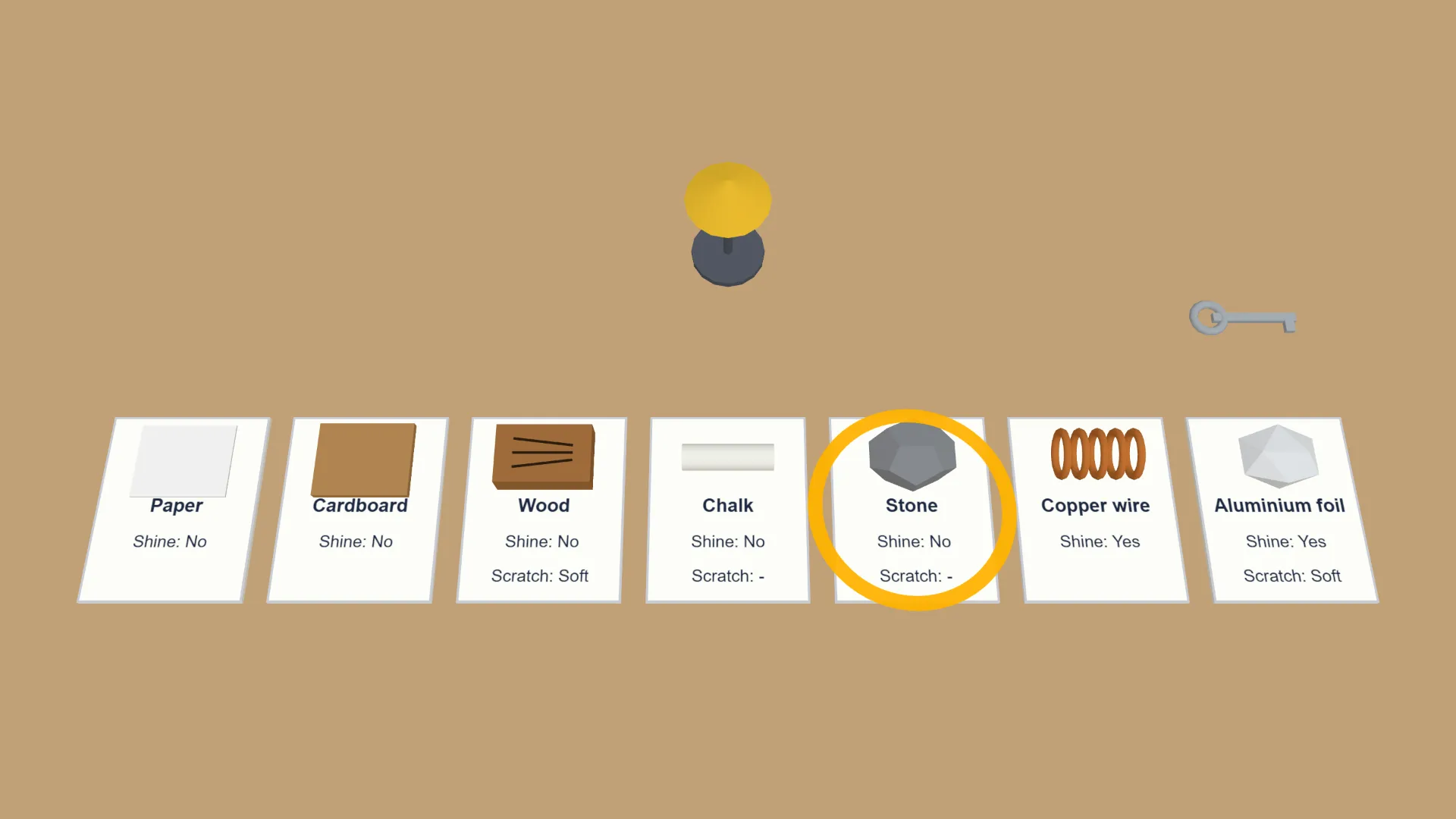
Interactive 3D Experiment
Loading simulation…
What to observe
- Which materials look shiny and which look dull?
- Which materials does the key scratch easily?
- Which objects feel hard and which feel soft?
Safety
- Use only a blunt key for the scratch test, never a blade, knife, compass point, scissors or nail. Scratch away from your holding hand.
- Scratch only the samples provided, never desks, walls, window panes, floors or anyone's belongings.
- The cut ends of copper wire and aluminium foil are sharp. Hold them by the middle and ask the teacher to blunt or tape the ends.
- Never test hardness by biting, licking or tasting, and never test an electrical wire, plug, socket or appliance.
- Do not crush chalk into dust or blow it towards anyone. Wipe chalk dust with a damp cloth and wash your hands afterwards.
Notes
- A material can lose its shine over time. Freshly cut iron or copper looks bright, but air and moisture make the surface dull. That is why old copper coins look brownish.