
Seeing Through — Testing Transparency of Materials
Aim
Sort everyday materials as transparent, translucent or opaque by seeing how clearly objects show through them.
Apparatus
- Science notebook / lab record and pencil
- A glass tumbler and a plastic or steel tumbler
- A sheet of butter paper and a sheet of coloured cellophane
- A piece of frosted or ground glass (or a frosted plastic sheet)
- A wooden board or a book, and a cardboard sheet
- A torch (optional, to shine light through each material)
Procedure
- Hold the glass tumbler in front of a pencil. Can you see the pencil clearly through it?
- Repeat with the other tumbler, butter paper, cellophane, frosted glass, wooden board and cardboard.
- If you have a torch, shine it through each material in a dim room. How much light passes?
- Sort each material as transparent, translucent or opaque.
- Record what you saw in the table.
- Discuss why a shop keeps sweets in a clear jar but tea leaves in an opaque tin.
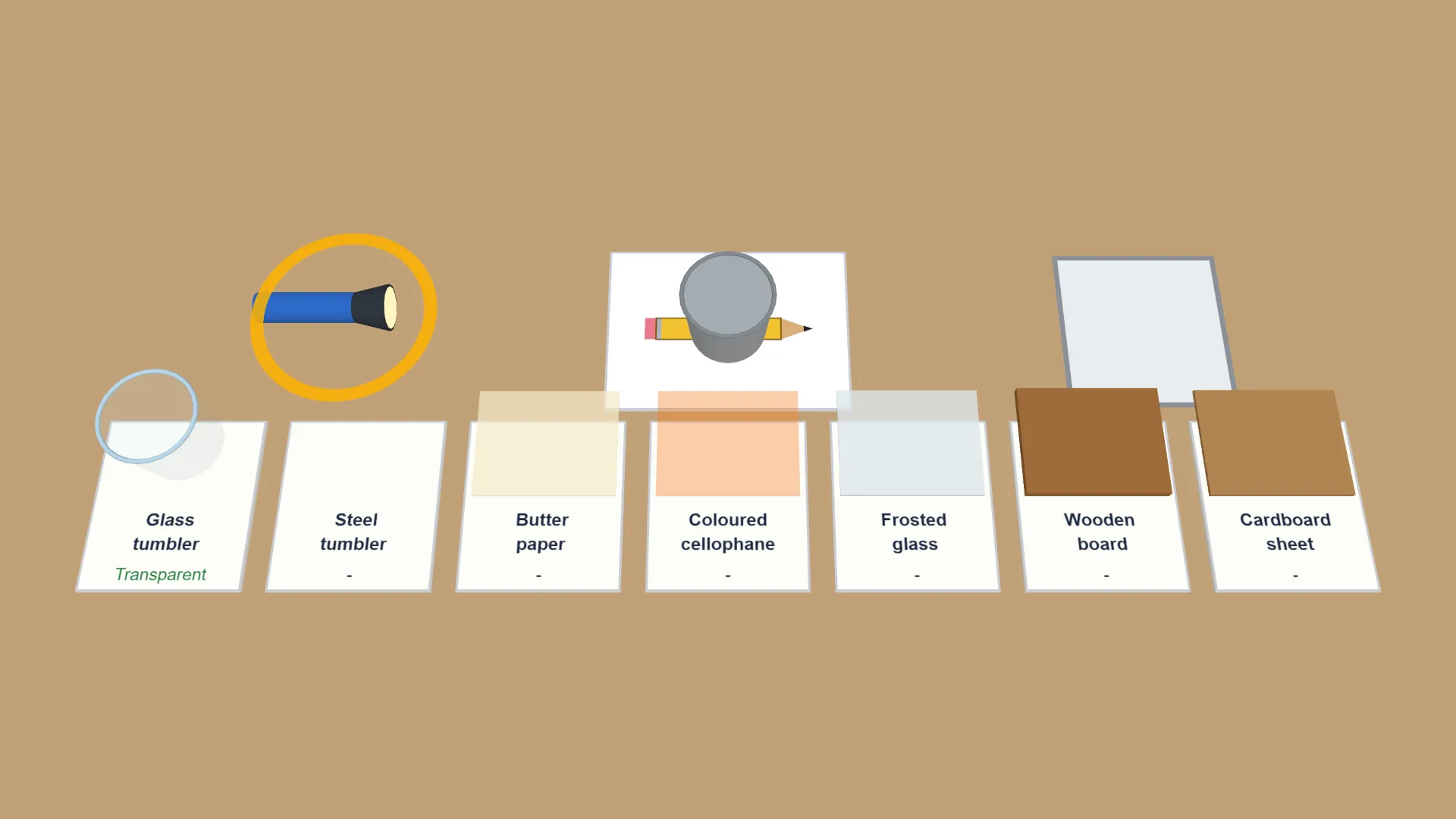
Interactive 3D Experiment
Loading simulation…
What to observe
- Which materials let you see the pencil clearly?
- Which show it only hazily, and which not at all?
- How much torch light gets through each one?
Safety
- Never look at the sun through any material (cellophane, butter paper, frosted glass, X-ray film, a CD or a phone camera). It can cause permanent blindness.
- Use a torch or the classroom light, never sunlight. Do not look into the torch beam or shine it at anyone's face.
- Handle the glass tumbler and frosted glass carefully, prefer plastic where you can, and report every breakage.
- Keep cellophane, butter paper and cardboard away from candles, lamps, heaters and hot bulbs.
- Dim the room only partly. Do not switch off all the lights, and no one should walk or run while it is dark.
Notes
- Frosted glass is ordinary glass whose surface has been roughened, often by sandblasting or acid etching. The rough surface scatters light in many directions, so shapes look hazy. That is why it is used in bathroom windows and doors.