
Why Do the Seasons Change?
Modelling the Revolution of the Tilted Earth
Aim
Model the Earth going round the Sun, and show that the seasons and the changing length of the day come from the tilt of the Earth's axis and its round shape, not from its distance from the Sun.
Apparatus
- Science notebook and pencil
- A globe on a stand, with its axis fixed at a tilt
- An electric table lamp without a shade, or a bright torch (the Sun)
- A large sheet of chart paper, a marker and a piece of chalk
- Four sticky labels marked MARCH, JUNE, SEPTEMBER and DECEMBER
- Two small stickers, for your town and for a place in the Southern Hemisphere, such as Melbourne
- A metre scale
Procedure
- Put one sticker on your town and the other on Melbourne.
- Draw a circle 1 m across. Fix the four labels around it, opposite one another.
- Your teacher puts the lamp at the centre and switches it on. Darken the room.
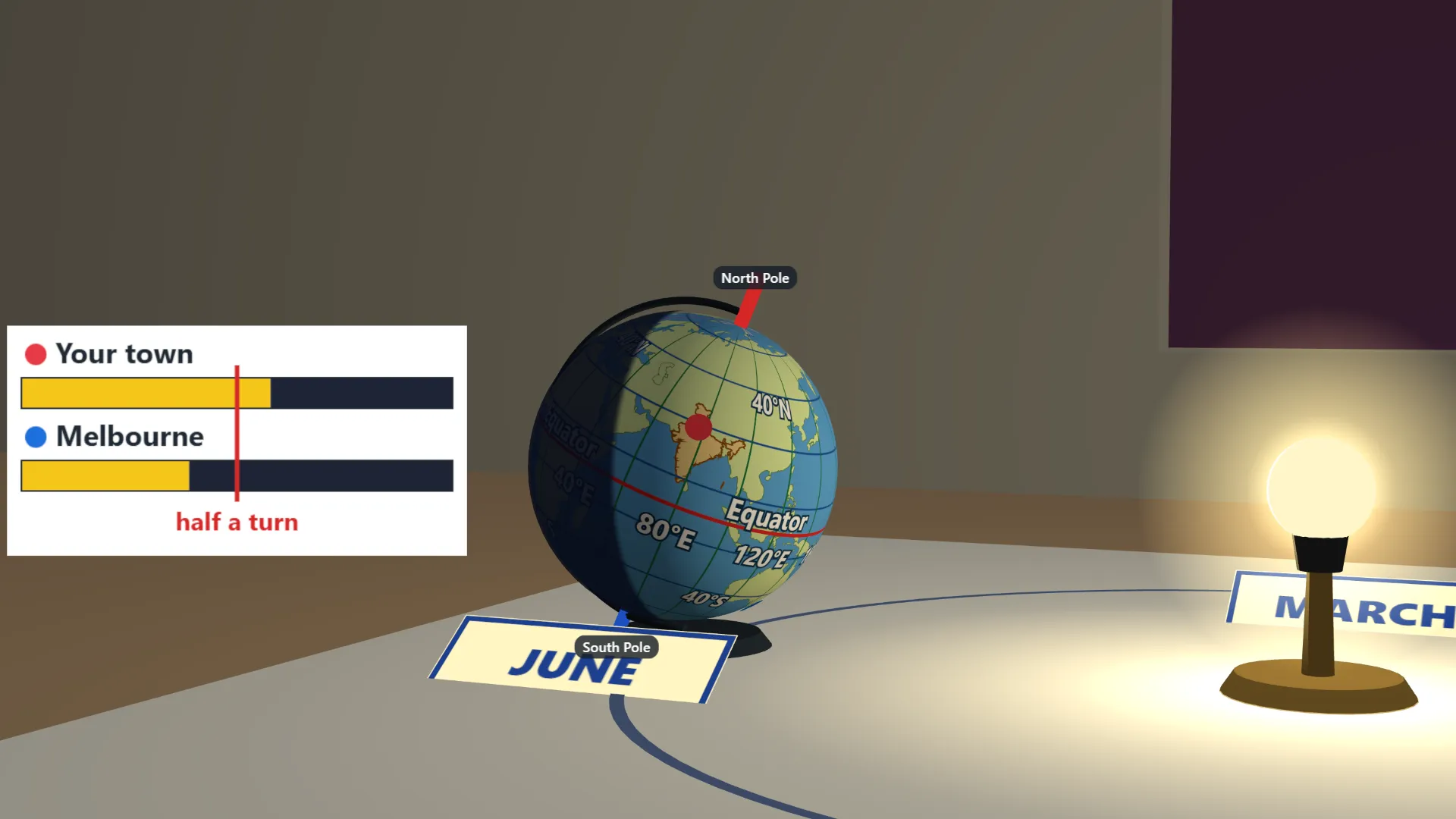
- Put the globe at JUNE. Turn it so the top of its axis leans towards one fixed corner.
- Which hemisphere leans towards the lamp? Look at how much of each half gets light.
- Turn the globe once. Does your sticker stay lit for more, exactly or less than half a turn?
- Which pole stayed lit through the whole turn? Then write the row of the table.
- Carry the globe to SEPTEMBER, DECEMBER and MARCH, keeping the tilt. Repeat at each.
- Hold a sheet facing the lamp, then slowly tilt it. Watch the patch of light.
- Compare your own sticker with the sticker in the Southern Hemisphere.
Interactive 3D Experiment
Loading simulation…
What to observe
- At JUNE the Northern Hemisphere leans towards the lamp and your town is lit for more than half a turn.
- At DECEMBER the same tilt leans it away. Now the Southern Hemisphere has the longer days.
- At SEPTEMBER and MARCH neither hemisphere leans towards the lamp, and your town is lit for half a turn.
- The axis points the same way all year; only the Earth's place on its orbit changes.
- June brings summer to India and winter to Australia on the same day.
- The tilt and the round shape cause the seasons, not the distance from the Sun.
Safety
- The bare bulb gets hot enough to burn. Never touch it while it is on, or for several minutes after.
- Only the teacher places, plugs in and switches on the lamp. Tape the cable along the wall so that nobody trips.
- Keep paper, labels, notebooks, curtains and cloth away from the bulb. Keep water and wet hands away from the lamp.
- Darken the room with the curtains only, leaving enough light to walk by. Move slowly round the circle, and do not draw it on a wet floor.
- Carry the globe with both hands by its stand. Never walk backwards. Switch the lamp off at the wall and let it cool before moving it.
Notes
- The Earth is nearest the Sun in January (about 14.7 crore km) and farthest in July (about 15.2 crore km), only about three parts in a hundred apart. If distance caused the seasons, January would be the hottest month everywhere.