
Investigating Sacred Ecology and Local Sacred Sites
Aim
To study an account of a long pilgrimage, and to record sacred sites, their stories and how they protect nature.
Apparatus
- A short paraphrase of the Dharampal excerpt from the textbook (pilgrims from Rameswaram to Haridwar)
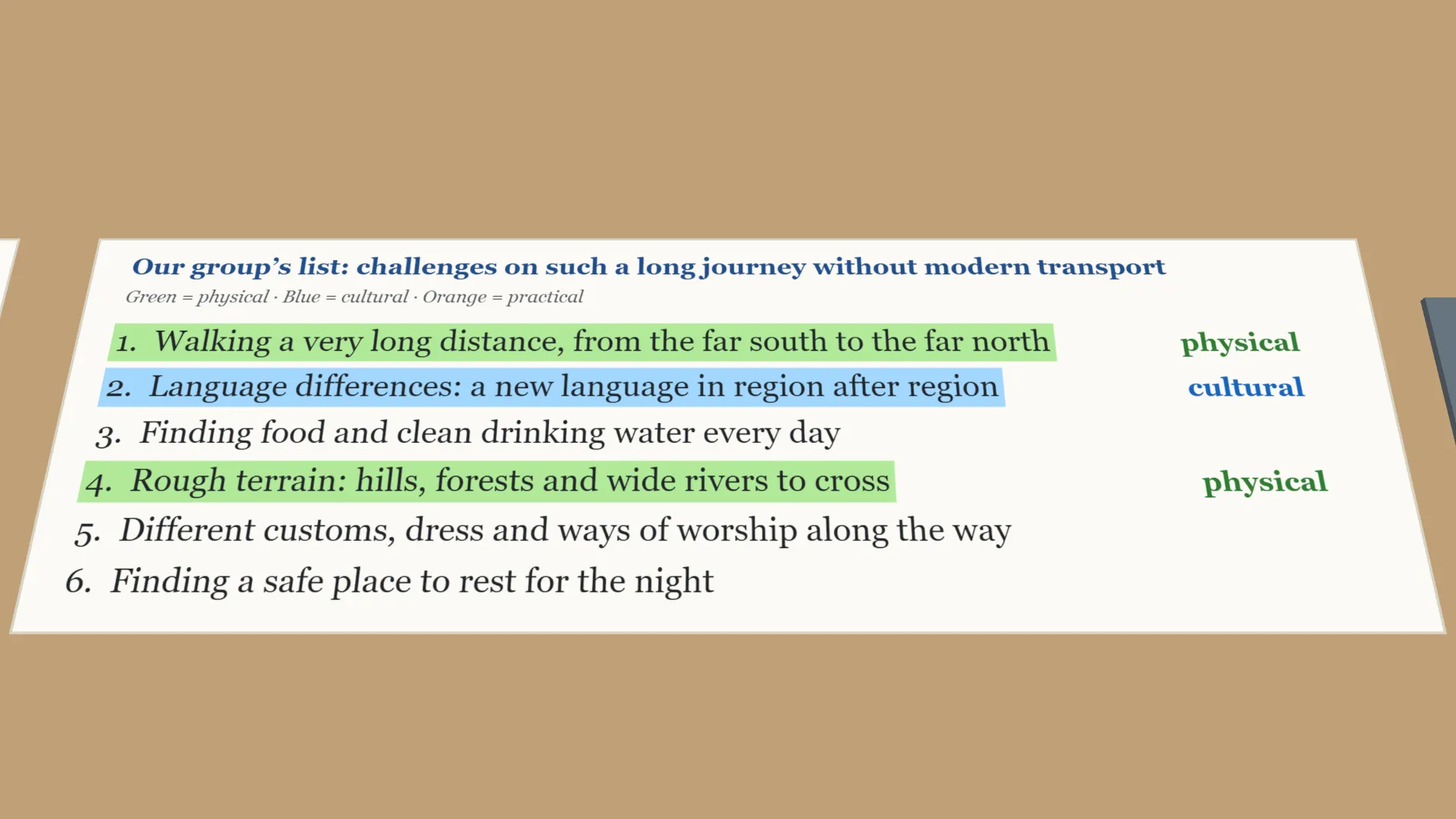
- A group list of challenges and three highlighters (green, blue, orange)
- Four example source cards on sacred groves, in place of an elder’s interview
- A notebook with the observation table, a pencil
Procedure
- Read about Dharampal’s pilgrims, who walked from Rameswaram to Haridwar via Delhi. Trace their route.
- List the physical, cultural and practical challenges they may have faced, such as language and food.
- Find out about sacred sites. Here, read four example cards; at home, ask an elder about a local site.
- Record each site’s name, why it is sacred, its story and its ecological role in the table.
- Compare the sites with your classmates’ and note the common patterns.
- Suggest one way the community could protect a sacred site and its nature.
Interactive 3D Experiment
Loading simulation…
What to observe
- Pilgrims crossed the whole land, from the far south to the north, facing long distances, rough terrain and new languages.
- Each sacred grove is protected because people believe it is the home of a deity.
- Rules such as “cut nothing, take nothing away” keep old trees, springs, ponds and wildlife safe.
- Sacred groves are among India’s oldest informal conservation zones.
Notes
- Sacred groves such as the kāvu of Kerala, the devrāī of Maharashtra and the sarnā of Jharkhand have protected patches of forest for centuries, because communities regard them as the abode of a deity.
- The sites in the simulation are examples. Your own local site — a temple, shrine, grove, tree, river ghat or hill — will differ. Ask an elder and add it as row 5.
- Be polite and respectful when you interview elders. Write down what they say accurately, and check facts with more than one source.
- The Dharampal passage is given as a short paraphrase, not his exact words. Read the full excerpt in your textbook.