
Classifying Fundamental Rights, Fundamental Duties and Directive Principles
Aim
To sort statements under Fundamental Rights, Fundamental Duties or the Directive Principles of State Policy (DPSP), and to tell what can be enforced by law from what is a guiding goal.
Apparatus
- Textbook reference (Fig. 10.14)
- A worksheet with statement cards, or a notebook
- Coloured pencils or sticky notes
Procedure
- Revisit the difference. Fundamental Rights must be kept and can be taken to court, Duties are moral obligations, and Directive Principles are goals that cannot be enforced in court.
- Draw a table with two columns, Statement and Classification (FR / FD / DPSP).
- Read the eight statements. Decide whether each shows a Right, a Duty or a Directive Principle.
- For each Right, underline the words that tell you a citizen could go to court.
- Swap answers with a partner and talk about any statements you disagreed on.
- Answer the reflection question about why Directive Principles are in the Constitution.
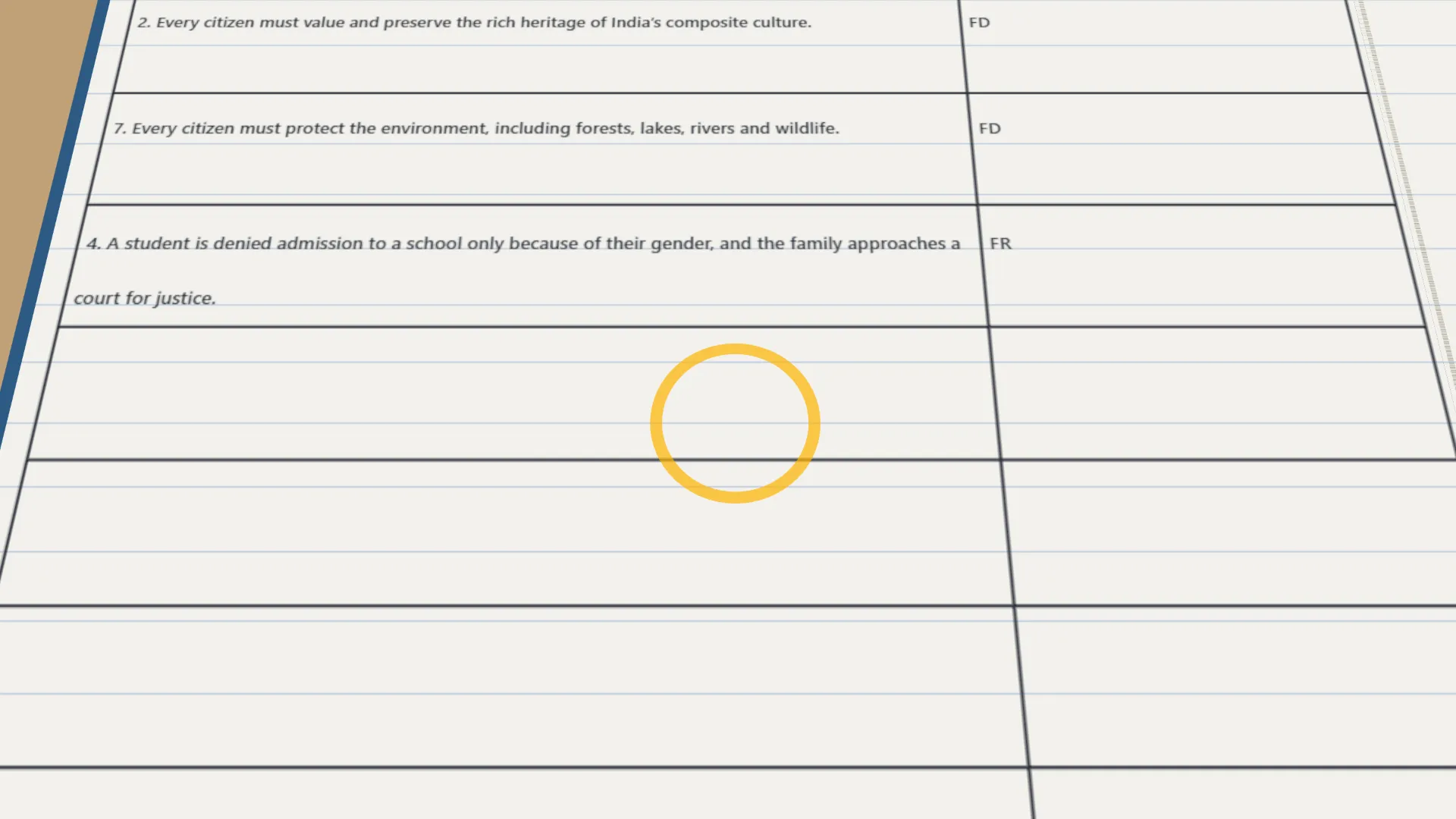
Interactive 3D Experiment
Loading simulation…
What to observe
- A statement where a person can approach a court is a Fundamental Right.
- A statement that says what every citizen must do is a Fundamental Duty.
- A statement about what the government aims to achieve, which no one can sue over, is a Directive Principle.
Notes
- Social Science Spark: the Fundamental Duties were not in the original Constitution of 1950. They were added in 1976 by the 42nd Amendment, the same one that added Socialist, Secular and Integrity to the Preamble.
- Put each statement in only one category. Use the textbook's difference between promises that must be kept and guidelines when in doubt.