
Mapping Regional Food Diversity in India
Aim
To identify staple food grains used across different regions of India and to observe how a few common ingredients unite the country’s enormous variety of regional cuisines.
Apparatus
- Chart paper or a blank outline diagram
- Coloured pencils
- Reference textbook (Fig. 8.1, page 127)
- An atlas
- Sticky notes
Procedure
- Look at Fig. 8.1 in the textbook, which shows cereals and pulses from different regions of India.
- On chart paper, draw five labelled boxes for North, West, Central, East and South India around a central circle.
- In each box, list the staple grains, millets or pulses of that region, using the textbook and an atlas.
- In the central circle, write the ingredients that appear in most or all of the boxes - the unity ingredients.
- Colour-code cereals, millets and pulses using a key of your choice.
- Record your findings in the observation table.
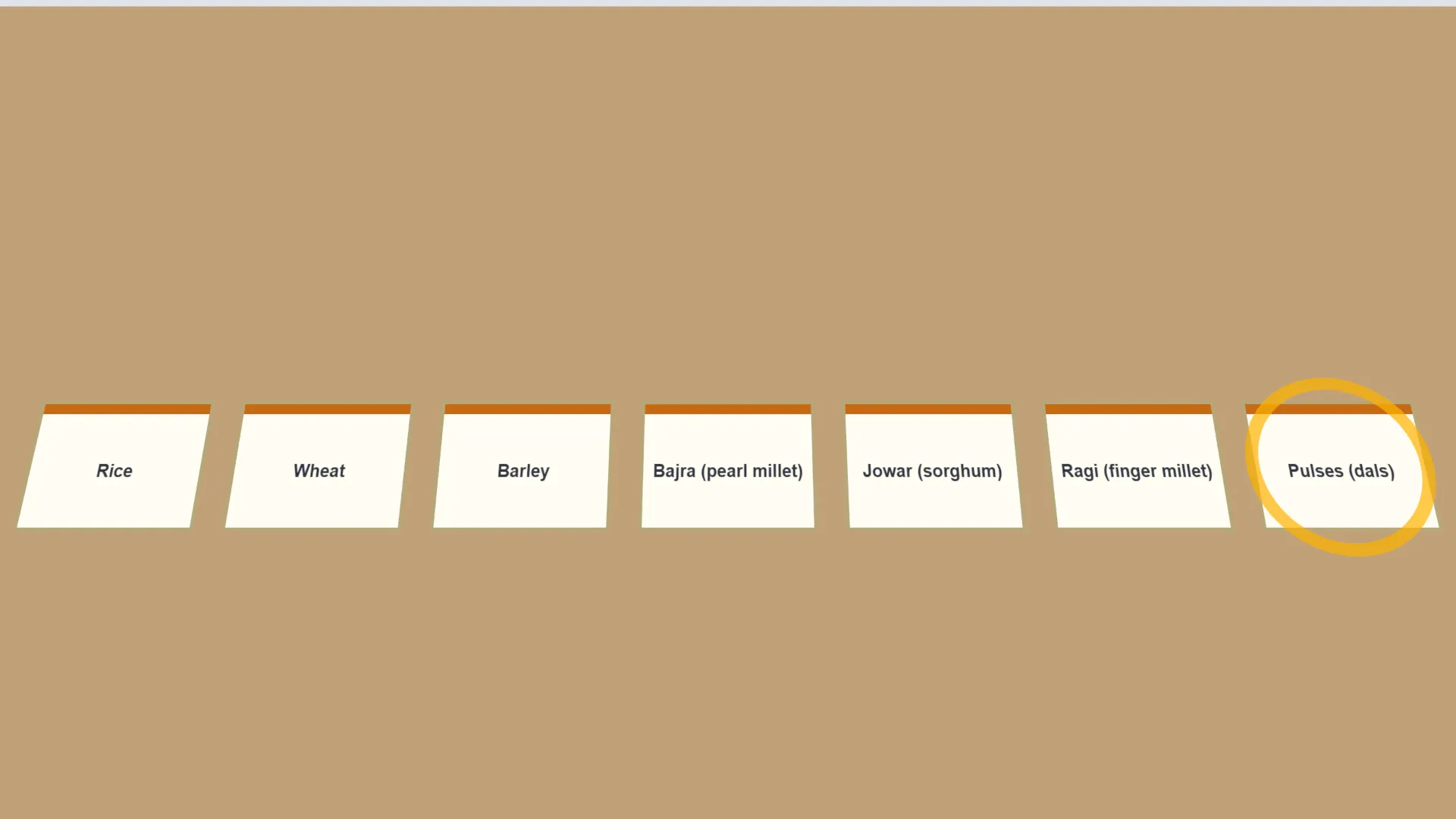
Interactive 3D Experiment
Loading simulation…
What to observe
- Every region has its own staple grains.
- A few ingredients - rice, wheat and pulses - are found in most regions and link them together.
Safety
- Use the textbook and atlas as reliable references.
- Write regional and food names carefully and correctly.
- Respect all regional food traditions while presenting your findings.
Notes
- The 1990s “People of India” survey by the Anthropological Survey of India studied 4,635 communities and recorded 325 languages written in 25 scripts - yet found staple grains such as rice, wheat and pulses common to nearly every region.