
Making Your Own Indicator — The Red Rose Extract
Aim
To prepare an acid-base indicator from red rose petals and to use it to identify acidic, basic and neutral solutions.
Apparatus
- A fistful of fallen red rose petals (picked up from the ground, never plucked from a plant)
- Mortar and pestle
- A glass tumbler with a lid, and hot water
- Funnel and filter paper (a clean strainer or a thin cloth will also do)
- Two test tubes marked A and B, a test-tube stand and droppers
- Lemon juice, soap solution and the other samples used in Practical 1
- Science notebook / lab record and pencil
Procedure
- Wash the petals and crush them in a mortar and pestle.
- Put the crushed petals in a glass tumbler and pour hot water over them.
- Cover the tumbler and wait 5 to 10 minutes, until the water is coloured.
- Filter the coloured water. The filtrate is your red rose extract.
- Put 10 to 20 drops of the extract into test tube A or B.
- Add 20 to 30 drops of the sample, swirl gently and record the colour.
- Repeat with the other samples and complete the table.
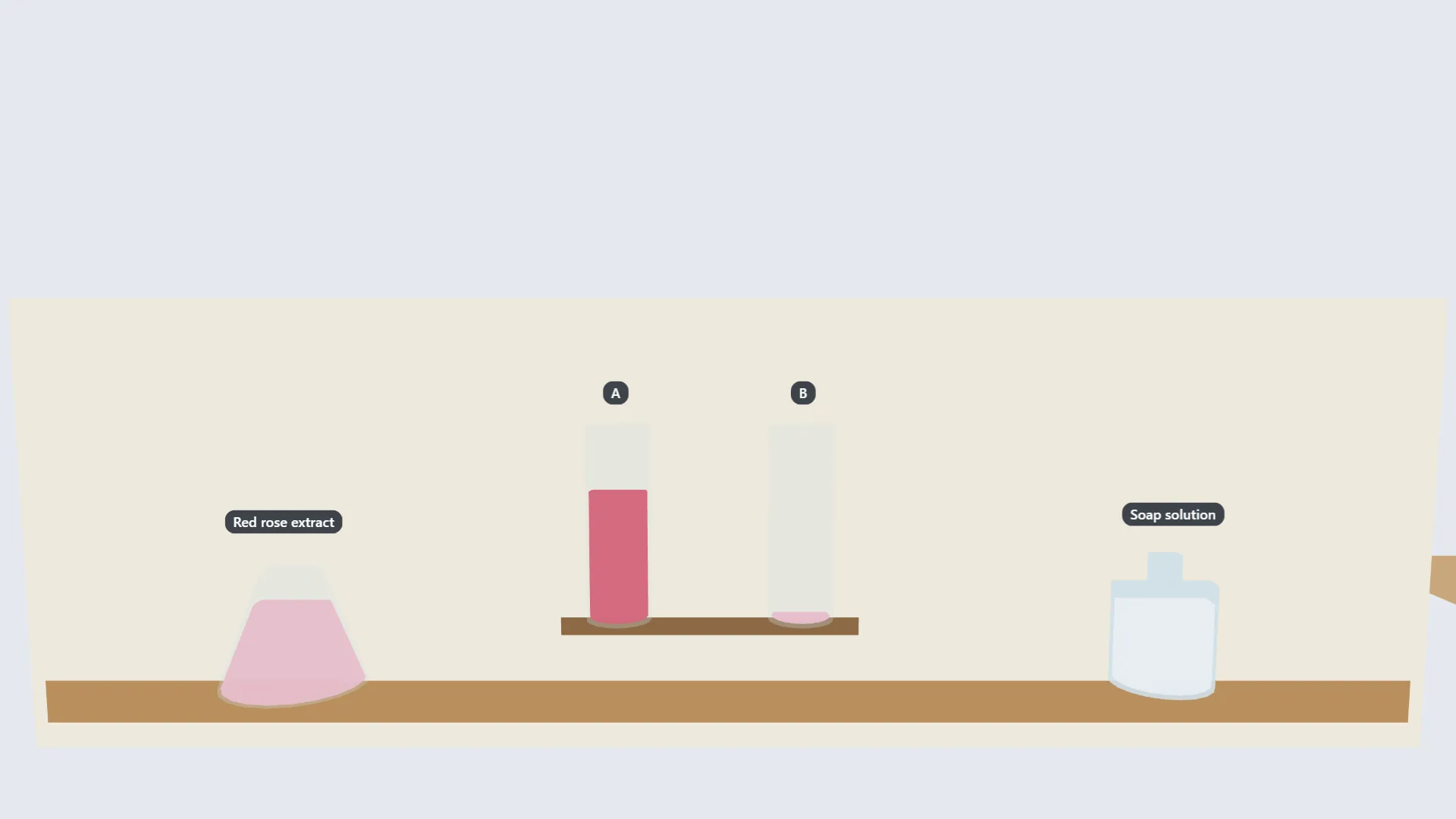
Interactive 3D Experiment
Loading simulation…
What to observe
- Which samples turn the extract red? Which turn it green?
- Are the samples that turn the extract red the same as those that turned blue litmus red?
- Are the samples that turn it green the same as those that turned red litmus blue?
Notes
- Did you know? The red, purple and blue colours of rose petals, jamun, beetroot and purple cabbage all come from one family of pigments called anthocyanins. They change colour because the pigment itself changes shape in an acid and in a base.