
Recreating Geometric Twins
Aim
Understand congruence by tracing, turning, flipping and laying figures on each other, and find the fewest measurements needed to recreate a two-arm symbol, a circle and a rectangle as an exact twin.
Apparatus
- Tracing paper and plain white paper
- A pair of scissors and a glue stick
- Ruler, compass and protractor
- Coloured pencils or sketch pens (at least 3 colours)
- A few cardboard cut-out shapes (an arrow, a leaf, a cloud) and their copies
Procedure
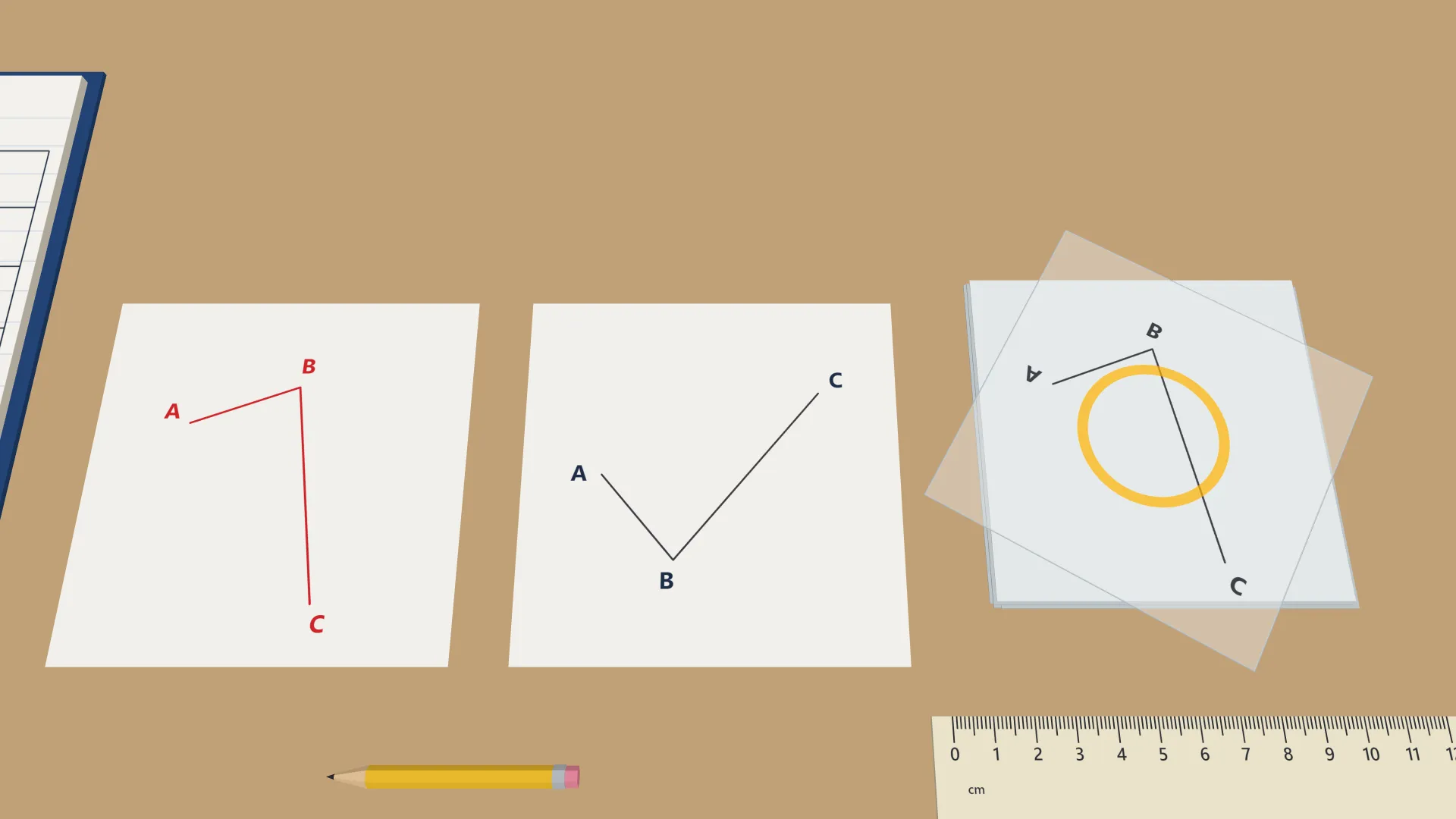
- Draw a tick ABC. Trace it and slide the tracing onto a fresh copy. Do they fit?
- Turn the tracing, flip it over and lay it on a turned copy. Does it still fit?
- Measure AB and BC. Your partner draws a symbol with only these. Is it a twin?
- Measure ∠ABC too. Your partner redraws it with AB, BC and ∠ABC. Is it a twin now?
- Measure the circle's radius and the rectangle's sides. Make each twin and test it with a tracing.
- Write the smallest set of measurements that recreates each figure.
Interactive 3D Experiment
Loading simulation…
What to observe
- A traced copy fits exactly, even after it is turned or flipped.
- Two arm lengths alone do not fix the symbol; the arms and the angle between them do.
- The radius alone fixes a circle; the length and breadth fix a rectangle.
Notes
- Congruent comes from the Latin congruere, 'to agree'. Congruent figures agree in every matching part.
- Tracing paper checks congruence without measuring. If a tracing can be slid, turned or flipped to sit exactly on a figure, they are congruent.
- Hold the tracing paper firmly so it does not shift while you trace.
- Trace exactly along the outline with a sharp pencil.
- Try turning and flipping the tracing before deciding two figures are not congruent.
- Congruent means an exact fit. Same shape but a different size is not congruent.
- Measure the arm lengths and the angle carefully; read the correct scale of the protractor.
- Use scissors carefully, cutting away from your fingers, and keep the glue stick capped.