
Reading a Laboratory Thermometer — Range, Least Count and Measurement
Aim
Find the range and the least count of a laboratory thermometer, and use it correctly to measure the temperature of water.
Apparatus
- One laboratory thermometer (mercury or coloured-alcohol type)
- Two beakers
- Warm water and ice-cold water
- A stand and clamp (if available)
- Science notebook, pencil and ruler
Procedure
- Look at the glass tube and its scale without touching the bulb.
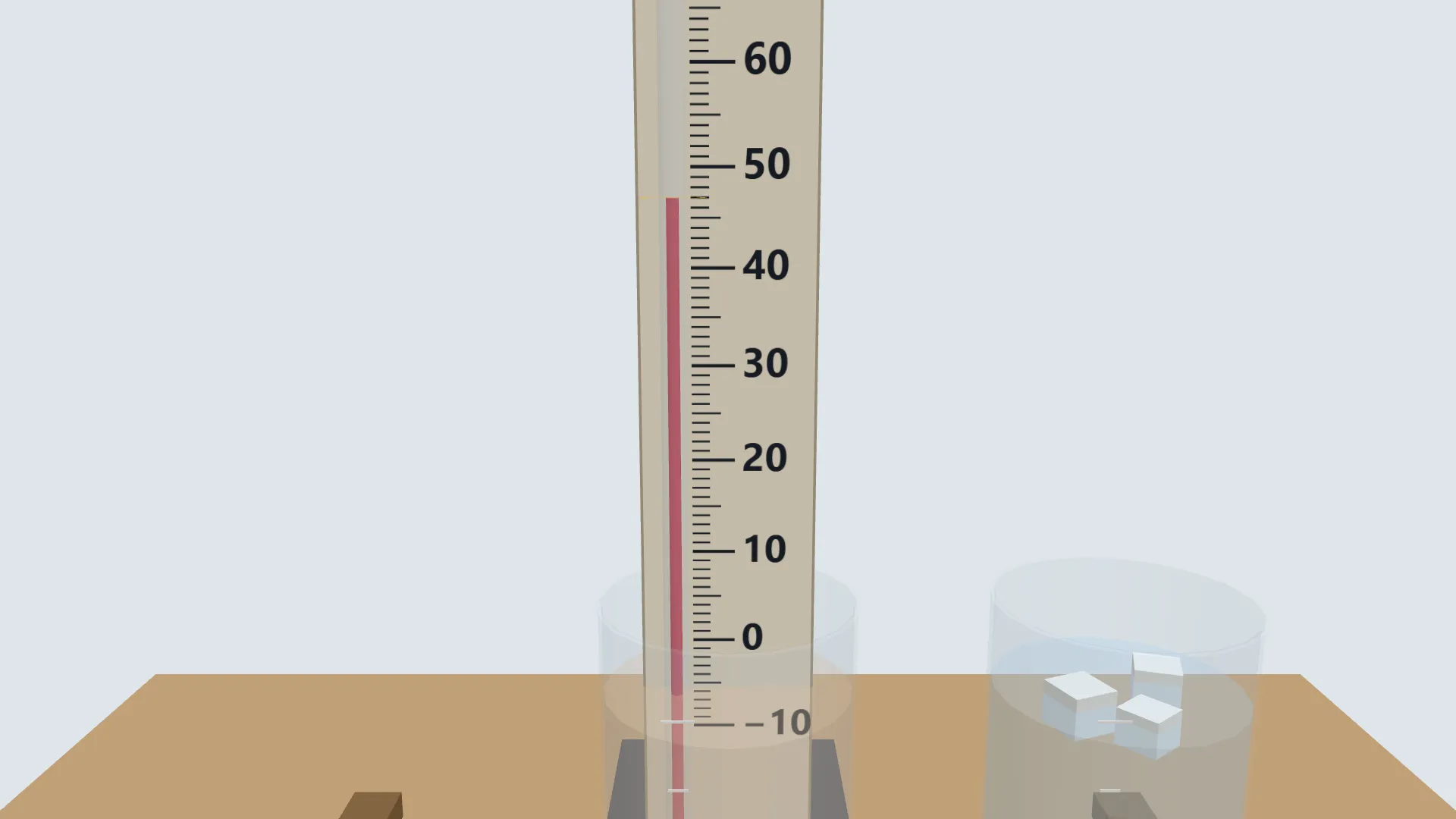
- Note the lowest and highest marks on the scale. This is the range.
- Pick two neighbouring labelled marks and find the difference between them.
- Count the small divisions between those two marks.
- Divide the difference by the number of divisions. This is the least count.
- Hold the thermometer upright by the stem and dip the bulb into warm water.
- Wait until the liquid column stops, then read with your eye level with it.
- Let the thermometer rest, then repeat with ice-cold water.
Interactive 3D Experiment
Loading simulation…
What to observe
- What are the lowest and highest temperatures on the scale?
- How much temperature does one small division stand for?
- How do the readings in warm water and in ice-cold water compare?
Safety
- Always hold the thermometer by the stem, never by the bulb, and keep it in a stand or rack.
- Never stir water with the thermometer, knock the bulb on the beaker, or shake it. Never use it for body temperature.
- If a mercury thermometer breaks, do not touch the mercury. Move away and tell the teacher at once.
- Use warm water only, not boiling. Never move the thermometer straight from hot water into ice-cold water.
- Wait until the column stops, then read with the bulb still in the water and your eye level with the top of the column.
Notes
- A laboratory thermometer ranges from about –10 °C to 110 °C. A clinical thermometer only reads about 35 °C to 42 °C, just wide enough for the human body, so a laboratory thermometer is used for boiling water or ice.