
Reading a Line of Heights
Aim
Read how a line of people is arranged by height, using the rule 'each person calls out the number of taller people standing in front of them', and find out which number sequences are possible and which are not.
Apparatus
- 7 stick-figure cut-outs of clearly different heights (or paper strips or straws), each labelled with a letter
- Dot grid or plain notebook and pencil
- Ruler
- Coloured sketch pens
Procedure
- Stand the 7 cut-outs A to G in a row on the desk, in the order of Fig. 1.1.
- Tap each figure from left to right. It counts the taller figures in front of it (to its left).
- Record the numbers from left to right in the notebook.
- Rearrange the figures (shortest first, then tallest first). Count and record each new line.
- Challenge: arrange the figures so that the line calls out 0, 1, 1, 2, 4, 1, 5.
- Is it possible? Try to make a line whose first number is 1, and explain why it fails.
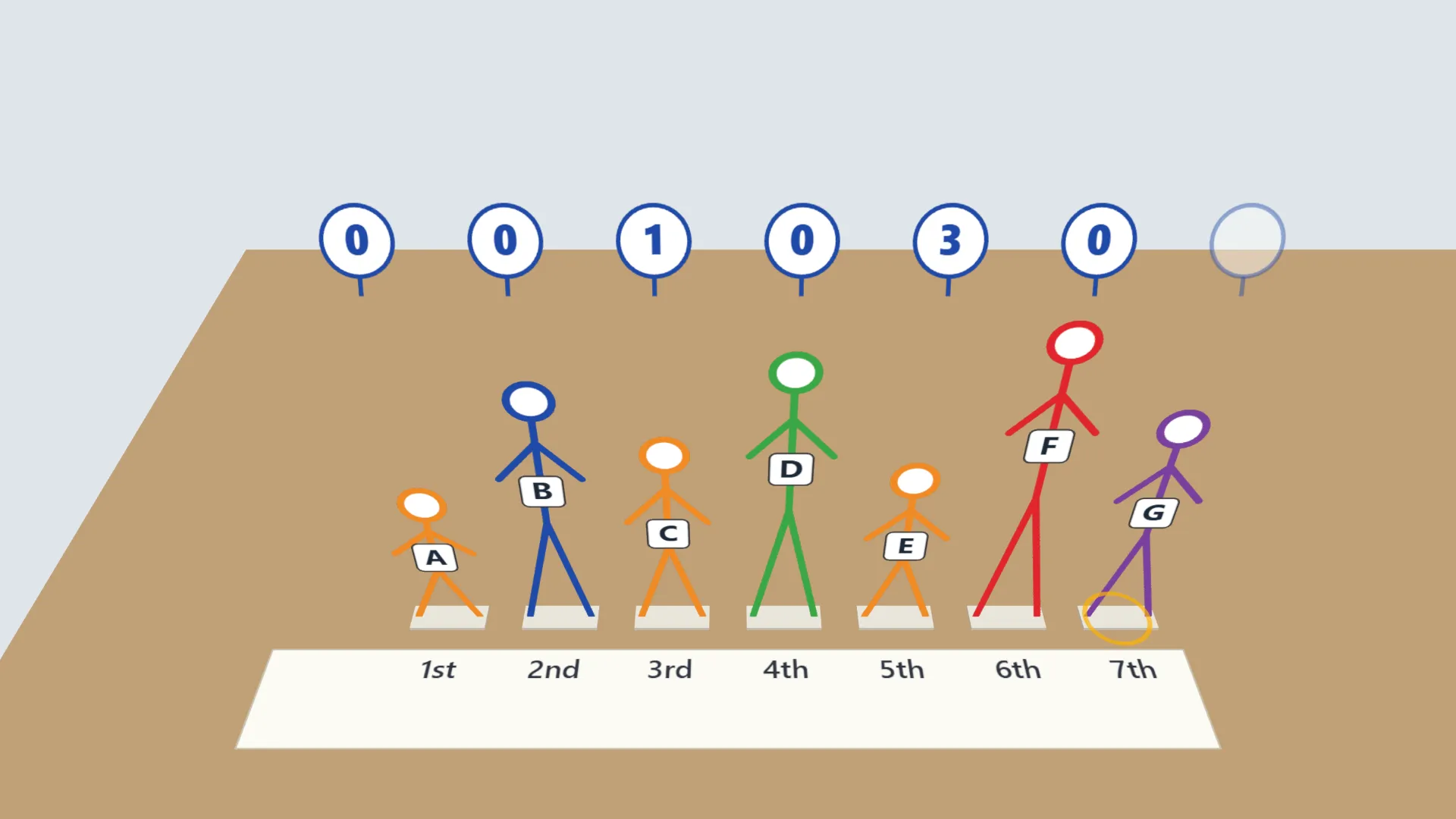
Interactive 3D Experiment
Loading simulation…
What to observe
- The first number is always 0, because nobody stands in front of the first person.
- The number at any position is never more than one less than that position (the 5th can call at most 4).
- Shortest first, every figure calls 0. Tallest first, the line calls 0, 1, 2, 3, 4, 5, 6.
- Every rearrangement changes the sequence. Each arrangement gives its own sequence.
- A sequence is possible only if each of its numbers obeys the limit set by its position.
Notes
- The number each person calls out is an 'inversion count'. No two different arrangements of the same heights give the same code. Computer scientists call it a Lehmer code.
- Count only the taller figures in front of (to the left of) a figure, not those behind it.
- Keep the figures in a straight line and do not shift them while counting.
- Label each figure, so that an arrangement can be made again exactly.
- Recount the whole line after every rearrangement instead of adjusting the earlier numbers.
- All seven cut-outs must be of clearly different heights, or the counts become ambiguous.