
Ratios in Maps — Reading the Scale
Aim
Understand the Representative Fraction (RF) printed on a map, find distances between places by measuring, and draw a scale plan of the classroom using the ratio 1 : 50.
Apparatus
- An atlas, a physical or political map with an RF printed on it (at least two maps of the same region at different scales)
- A 30 cm ruler and a length of thread or string
- Measuring tape (5 m or longer)
- Chart paper or graph paper, pencil, eraser and coloured sketch pens
Procedure
- Find the RF near the lower right corner of the map, e.g. 1 : 60,00,000. What does 1 cm on the map stand for?
- Divide the denominator by 1,00,000 to change cm to km. Check that 60,00,000 cm = 60 km.
- Choose two cities. Measure the straight-line distance between them with a ruler, to the nearest mm.
- Multiply the map distance by the RF denominator to get cm, then change to km. Enter both in the table.
- Repeat for three pairs of cities, then measure the same pair on a second map and compare the answers.
- With the tape, measure the length and breadth of the classroom, the blackboard, the teacher's desk and the door.
- Divide every length by 50. Draw the plan on chart paper with symbols, a legend and the label 'Scale 1 : 50'.
Interactive 3D Experiment
Loading simulation…
What to observe
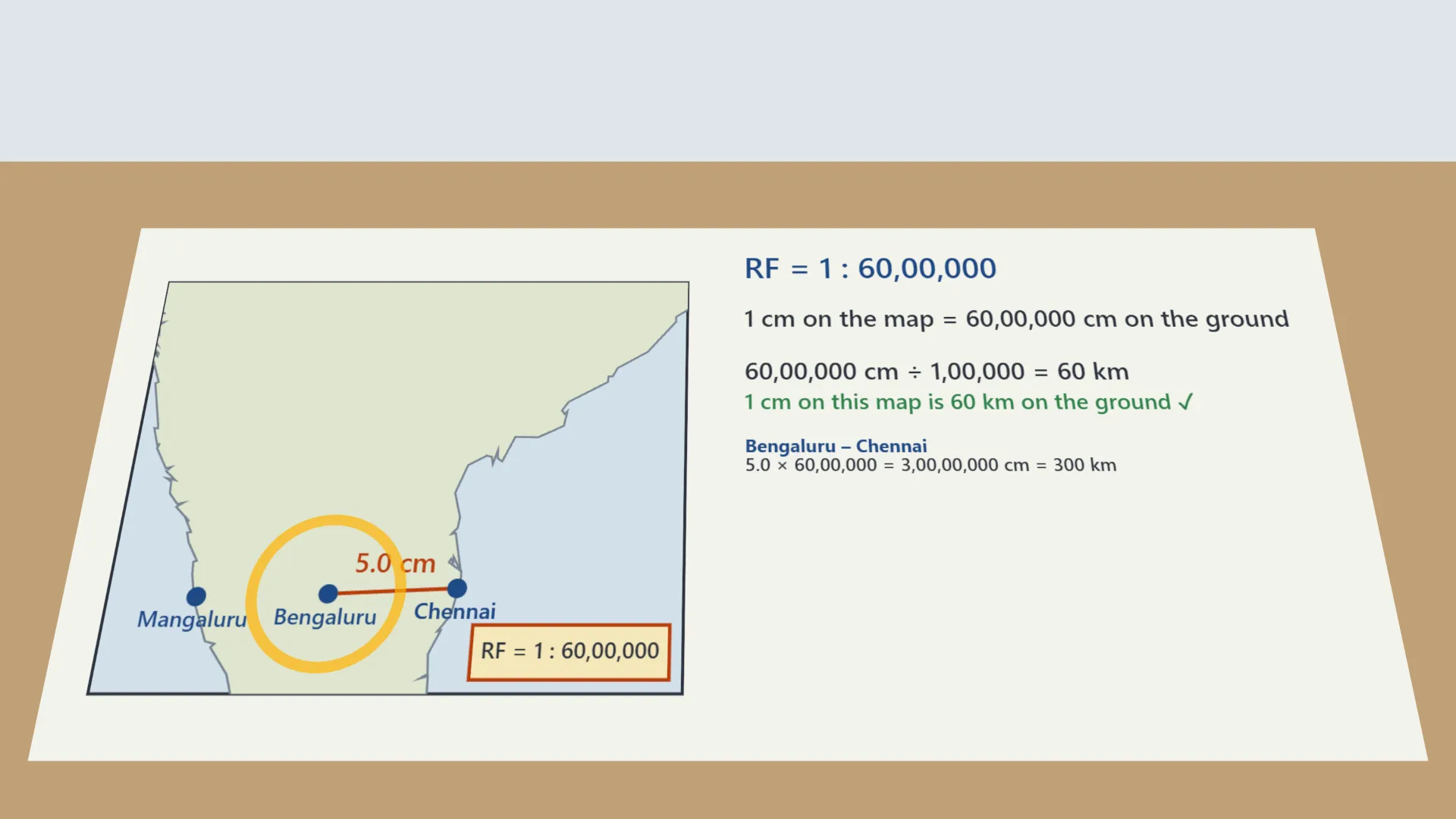
- With RF 1 : 60,00,000, 1 cm on the map is 60,00,000 cm = 60 km on the ground.
- Bengaluru – Chennai: 5.0 cm × 60,00,000 = 3,00,00,000 cm = 300 km.
- The same pair on a map with a different RF gives nearly the same distance: the RF fixes the distance, not the size of the map.
- On the plan every 1 cm stands for 50 cm of the real room.
Notes
- Math Spark: an RF has no units, because it compares two lengths in the same unit. The larger the denominator, the smaller the scale: the map covers more ground but shows less detail. A map gives the straight-line distance; the road distance is always longer.
- Spread the map flat and keep the fold away from the line being measured.
- Measure the straight-line distance between the two marked points, to the nearest millimetre.
- The RF has no units: never write it as 1 cm : 60 km. That is the statement of scale, not the RF.
- Convert centimetres to kilometres by dividing by 1,00,000, and keep the working visible.
- Both terms of the RF must be in the same unit before it is used.
- Use the thread only for a curved route: lay it along the route, then straighten it against the ruler.
- Do not compare distances from two maps of different scales without converting both to ground distance.
- Hold the tape straight and horizontal, and have a partner hold the other end.