
Measuring Rainfall — Building and Using a Rain Gauge
Aim
To make a simple rain gauge, use it to record daily rainfall over a period of time, and work out the weekly average rainfall.
Apparatus
- Science notebook / lab record and pencil
- A large, clean, transparent plastic bottle (1–2 litre) with a wide, flat base
- Scissors (used under adult supervision)
- A ruler
- A waterproof marker
- A flat, open outdoor space away from trees, walls or buildings
Procedure
- Cut the top third off the plastic bottle.
- Turn the top piece upside down and fit it into the bottom part as a funnel.
- With the ruler and marker, mark a scale in millimetres up the side, starting from the base.
- Place the gauge on flat, open ground, away from trees and walls, so it cannot tip over.
- At the same time every day, read the height of the water in millimetres and record it.
- Empty the gauge after each reading, so each day's rain is measured on its own.
- At the end of each week, add the seven readings and divide by 7 to get that week's average.
- Do this for a month (4 weeks) and compare the weekly averages.
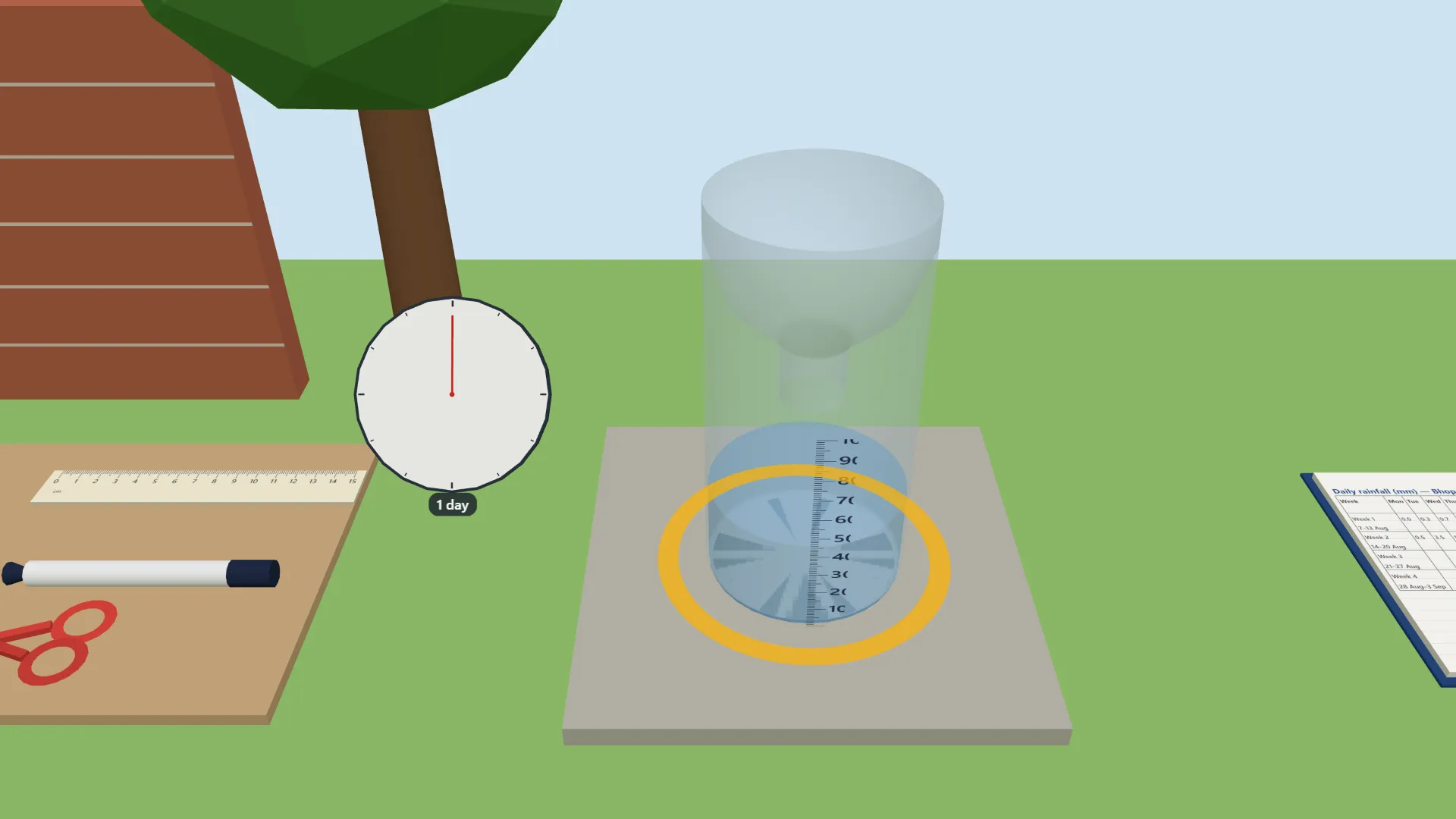
Interactive 3D Experiment
Loading simulation…
What to observe
- The readings are real rainfall: Bhopal, 7 Aug – 3 Sep 2023 (Open-Meteo archive, fetched 2 Nov 2026).
- How much did the rainfall change from day to day? Were there dry days?
- Which week had the highest average, and which the lowest?
- In your own words, describe how the rainfall varied from week to week, and suggest one reason for it.
Notes
- Did you know? Mawsynram in Meghalaya, the wettest place on Earth, gets over 11,000 mm of rain a year.
- The readings in the simulation are real daily rainfall for Bhopal, Madhya Pradesh, 7 Aug – 3 Sep 2023 (Open-Meteo historical weather archive, ERA5 data).
- Use scissors only with an adult. Keep the gauge where it cannot tilt or be knocked over.