
Question the Answer — Learning to Ask Like a Scientist
Aim
To practise framing curious, creative questions that could lead to a given answer, and to sort those questions into ones that can be tested by an experiment and ones that cannot.
Apparatus
- Science notebook / lab record and pencil
- Small slips of paper or index cards, about ten for each pair
- A box, bowl or envelope to hold the folded slips (the class Question Box)
- Chart paper and sketch pens for displaying the best questions
- Two or three everyday things to wonder about (a lemon, a magnet, an ice cube in a glass, a torch)
Procedure
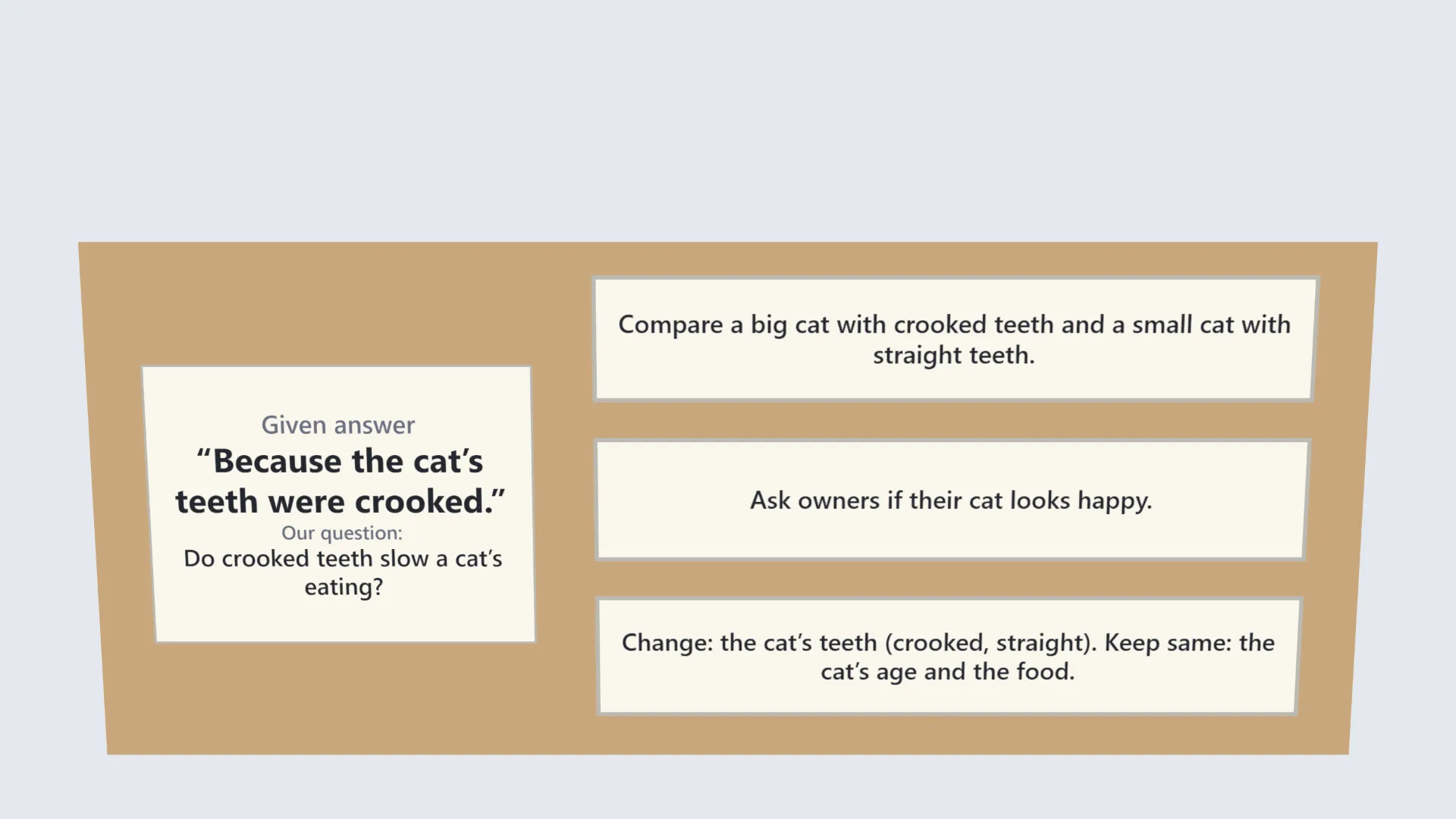
- Work in pairs. Read the answer on the card and think of questions it could be a reply to.
- Sort each question. Can an experiment test it, or is it only an opinion?
- Choose one testable question.
- Choose how to test it: change one thing and keep two things the same.
- Write the answer, the questions, the verdicts and the test in the observation table.
- Write your most interesting question on a slip and drop it into the Question Box.
Interactive 3D Experiment
Loading simulation…
What to observe
- The same answer can be the reply to many different questions.
- A testable question can be answered by doing something. An opinion cannot.
- A fair test changes one thing and keeps two things the same.
Safety
- Treat the objects brought for wondering (a lemon, a magnet, an ice cube, a torch) as apparatus, not toys. Do not taste the lemon or any other sample.
- Keep the magnet away from a watch, a mobile phone or a calculator, and do not shine the torch into anybody's eyes.
- Wipe up the water from the melting ice cube at once so that nobody slips.
- Write no one's name on the question slips, and make no remark that could hurt a classmate whose question is read aloud.
- Handle the scissors and sketch pens carefully, cap the pens after use, and return every slip and the Question Box to the teacher.
Notes
- Did you know? The Nobel Prize-winning physicist I. I. Rabi said his mother made him a scientist without meaning to. Other mothers asked their children what they had learnt at school. His mother asked whether he had asked a good question that day.