
The Curious Case of the Puri — Investigating Variables Like a Scientist
Aim
To find out what makes a puri puff up when it is fried — by asking one focused question, changing only one thing at a time, and recording what you observe, as scientists do.
Apparatus
- Science notebook and a pencil
- Wheat-flour (atta) dough
- Rolling pin and rolling board
- Kadhai with cooking oil on a stove — handled only by the teacher or an adult
- Slotted spoon (jhaara) and a plate lined with paper
- A ruler and a stopwatch
Procedure
- Observe: watch a puri being fried. Does it puff up? Is one side thinner? Note it down.
- Question: does the thickness of the rolled dough change whether the puri puffs up?
- Variables: list what you could change and measure. Choose ONE thing to change: thickness.
- Hypothesise: write your guess — a thicker puri will not puff up as well.
- Fair test: roll a thin, a medium and a thick circle of the same size and flour. Measure each.
- Test: the teacher fries them one at a time. Start the stopwatch as each touches the oil; record it.
- Analyse: compare the puris, write a one-line conclusion, then a new question.
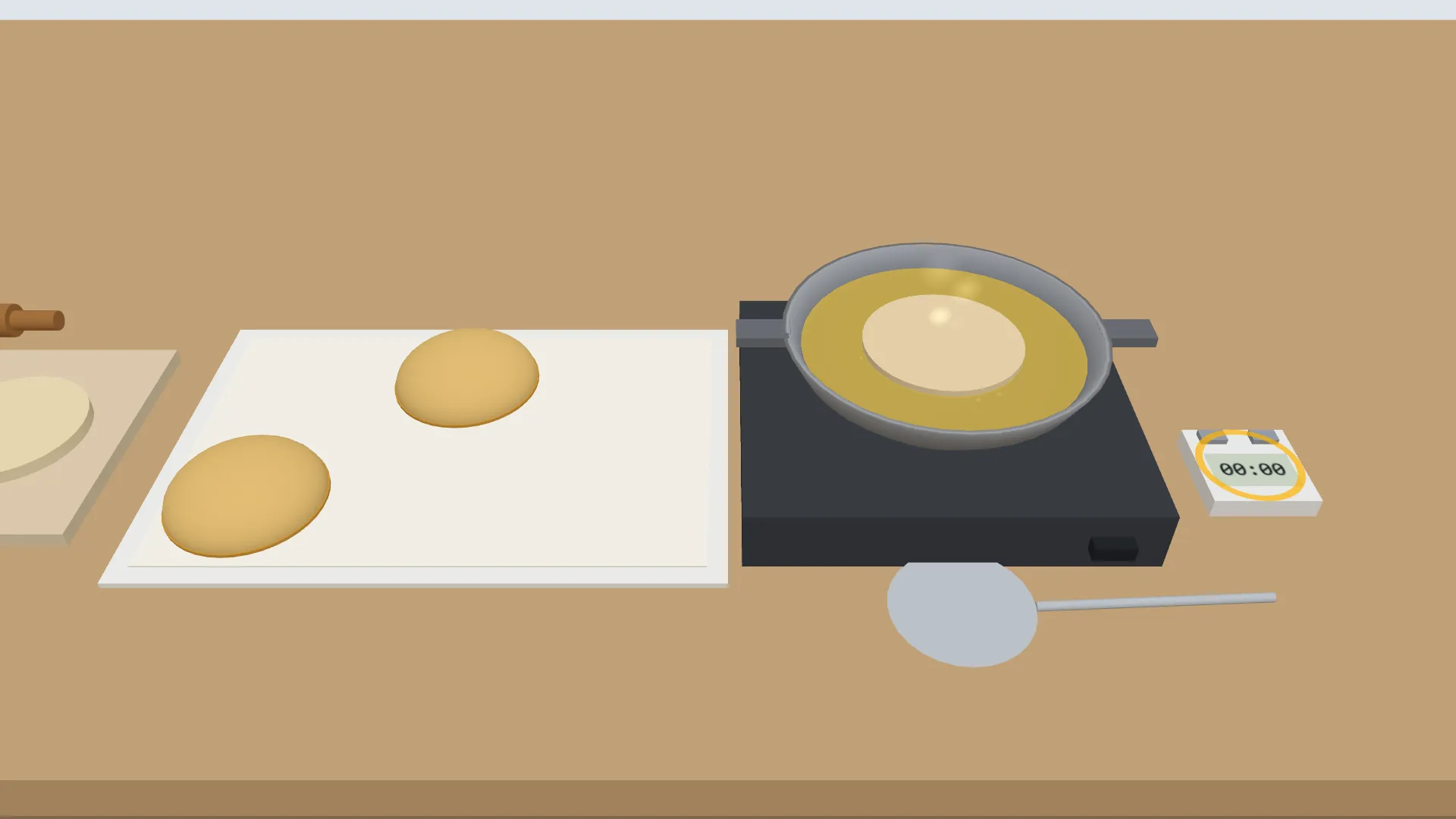
Interactive 3D Experiment
Loading simulation…
What to observe
- The thin circle seals, traps the steam and puffs up within a few seconds, with one thinner side.
- The thicker circles puff up only partly or not at all, and take longer to cook.
- Only the thickness was changed, so the difference comes from thickness alone — a fair test.
Safety
- All frying is done only by the teacher or an adult. Watch, measure and record from a safe distance.
- Hot oil can splatter and burn — never lean over the kadhai, and never add water or wet dough to hot oil.
- Slide the dough in gently, away from yourself, with a slotted spoon; never drop it in from a height.
- Keep the flame moderate, never leave hot oil unattended, and turn the kadhai's handle inward.
- Roll every circle to the same size with the same flour, so only one thing differs.
- Measure the thickness before frying, and start the stopwatch the moment the puri touches the oil.
- Record every result honestly, even the ones that do not support your guess.
Notes
- Science Spark: when water boils into steam it takes up about 1,600 times more space. In a frying puri, water in the dough turns to steam; if the surface has sealed, the steam is trapped and blows the puri up like a balloon.
- Why one side often stays thinner is still not completely understood by scientists today!