
Proving Patterns with Pictures
Aim
Use dot pictures to show that the sum of the first n odd numbers, starting from 1, is always a square number (n × n).
Apparatus
- Graph paper (at least 8 × 8 grid)
- Six different coloured sketch pens or highlighters
- Ruler and pencil
Procedure
- On graph paper, mark one dot at a corner of the grid. It stands for the first odd number, 1.
- Around it, add an L-shaped border of 3 dots in a second colour. Count the total — it is 4.
- Add L-shaped borders of 5, 7, 9 and 11 dots, each in a new colour, and record each running total.
- Check that each running total is a square number, then use the pattern for the row n = 10.
- Draw the 'adding up and down' diamonds 1, 1 + 2 + 1, 1 + 2 + 3 + 2 + 1, … and check each total.
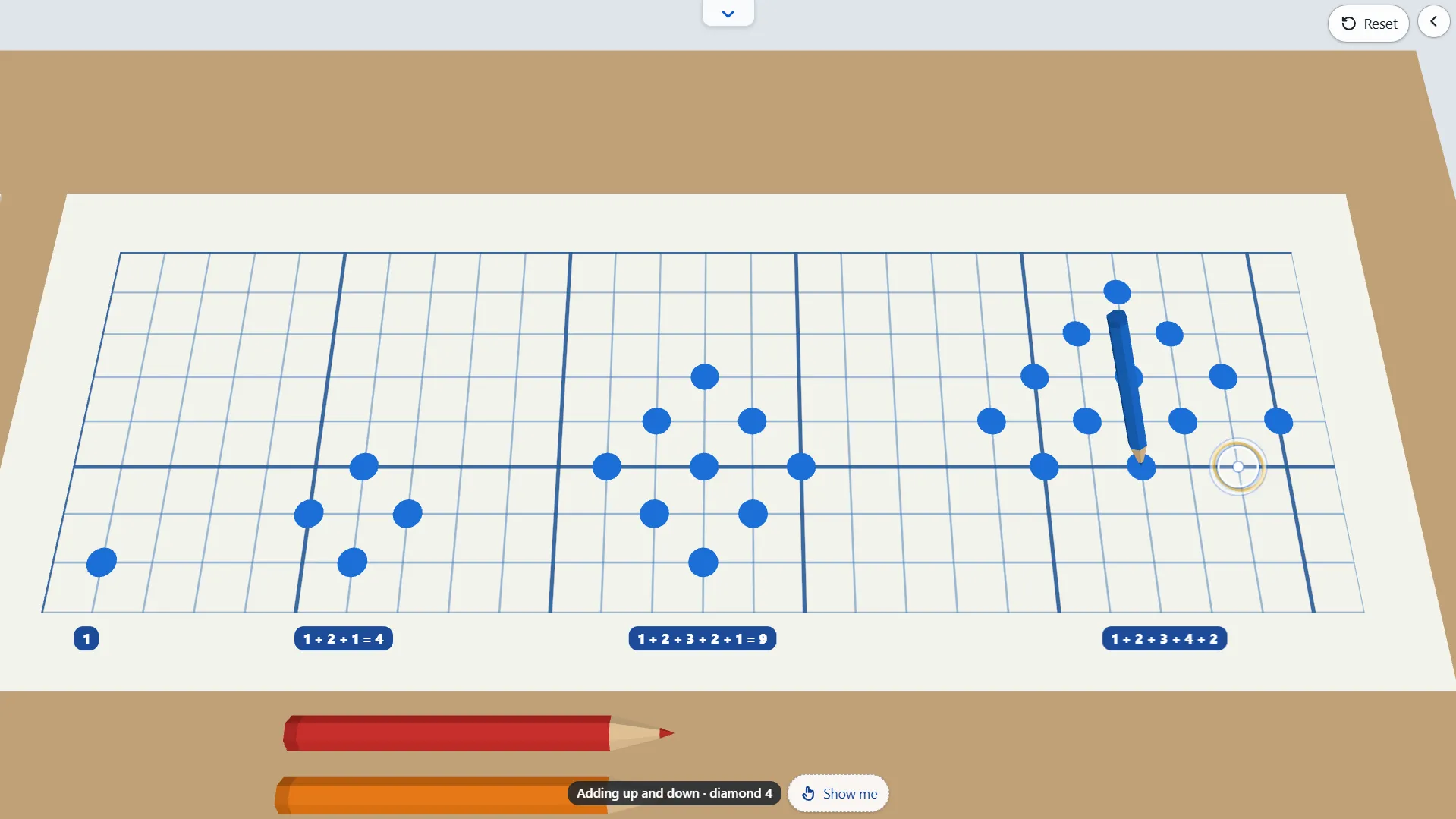
Interactive 3D Experiment
Loading simulation…
What to observe
- What does each new border add?
- Are all the totals square numbers?
- Discuss: why does it work for a grid of any size?
Notes
- The ancient Greeks called 1, 4, 9 and 16 'square numbers' because they arranged pebbles in square shapes on the ground, more than 2500 years ago.
- They called the L-shaped strip added to a square a 'gnomon', because it looked like the shape of a sundial seen from above.
- Work on graph paper so that every dot sits where two grid lines cross and the L-shape stays exact.
- Begin at a corner of the grid, so there is room for the borders to grow outwards.
- Each border must wrap around two sides of the square so far — do not add the dots in a straight line.
- Use a fresh colour for each border, and count that border before adding the next one.
- Check every running total against its square number before moving on.
- Keep the dots of each diamond symmetrical about its middle row.