
Tracing Interdependence of the Three Sectors through a Flow Diagram
Aim
To trace the journey of a chosen product from its natural source to the final consumer, and to show how the primary, secondary and tertiary sectors depend on one another.
Apparatus
- A4 sheets
- Pencil
- Ruler
- Sketch pens (green, blue and orange)
Procedure
- Choose one everyday product, such as milk, sugar, a cotton shirt or a notebook.
- List all the stages the product passes through, from its natural source to the consumer.
- Identify which sector - primary, secondary or tertiary - each stage belongs to.
- Draw a box for each stage and connect the boxes with arrows to form a flow diagram.
- Colour-code the boxes: green for primary, blue for secondary and orange for tertiary.
- Write one sentence below the diagram on how the three sectors depend on each other.
Interactive 3D Experiment
Loading simulation…
What to observe
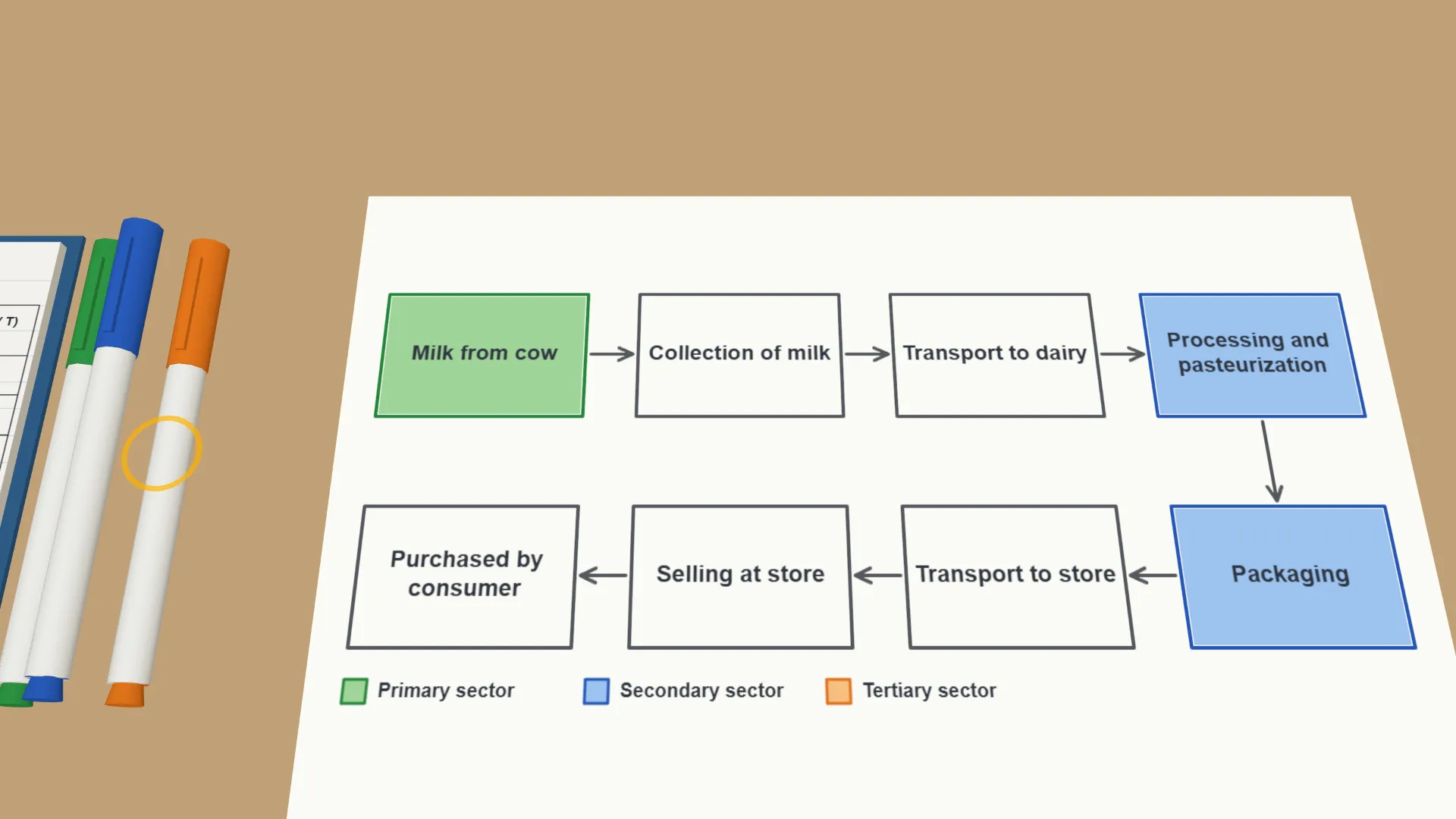
- Milk comes from the cow - a primary activity.
- Processing, pasteurization and packaging make it a product - secondary activities.
- Collecting, transporting and selling the milk are services - tertiary activities.
- Without any one of the three sectors, the milk would not reach the consumer.
Notes
- AMUL, set up in 1946 at Anand in Gujarat, is one of the world's largest dairy cooperatives. It is a classic example of the three sectors working together - from the farmer's cow to the milk packet on a shop shelf.
- Use a ruler for neat boxes and arrows, keep the colour code the same throughout, and place every stage under only one sector.