
Diagnosing the Problems of Barter
Aim
To name the problems of the barter system shown in a set of scenarios, and to explain how money solves each one. The problems are double coincidence of wants, no common standard of value, divisibility, portability and durability.
Apparatus
- Textbook reference (the farmer's story)
- A notebook
- Coloured pencils or sticky notes
Procedure
- Revisit the five problems of barter described in the chapter.
- Draw a table with two columns, Scenario and Problem of Barter Illustrated.
- Read the eight scenarios. Decide which of the five problems each one shows.
- For each scenario, write one line on how using money instead of goods would solve it.
- Swap answers with a partner and talk about any scenario you disagreed on.
- Answer the reflection question about which problem would trouble traders most on longer routes.
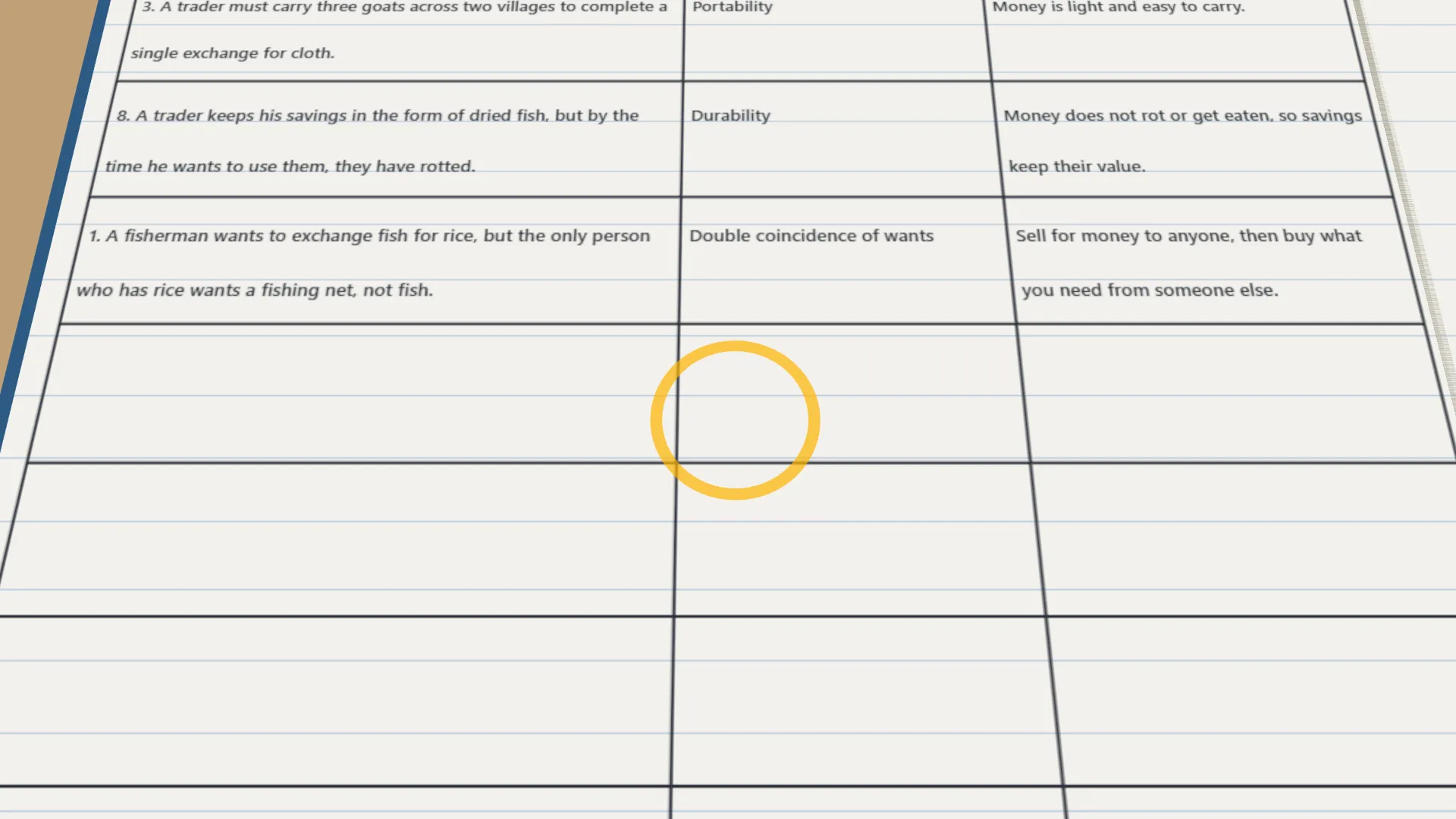
Interactive 3D Experiment
Loading simulation…
What to observe
- Two scenarios each show double coincidence of wants, no common standard of value, and durability.
- Divisibility and portability are each shown once.
- Money, as a common medium of exchange, solves each of the five problems.
Notes
- Social Science Spark: the barter system never fully disappeared. The Junbeel Mela in Assam, held every year since the 15th century, is a fair where communities still exchange local produce and handmade goods without money.
- Match each scenario to only one problem. Use the chapter's definitions when in doubt.