
Analysing Primary Sources on Colonial Exploitation
Aim
To analyse quotations by William Digby, W. W. Hunter, Brooks Adams and Charles Metcalfe, and to classify the statements in them as fact, opinion or inference.
Apparatus
- The four quotations (Digby, Hunter, Brooks Adams, Metcalfe)
- Notebook
- Pencil
- Two highlighters of different colours
Procedure
- Read each quotation carefully.
- Note who the author was, and when and in what context it was written.
- With the first highlighter, mark each verifiable fact: a number, a date or a documented event.
- With the second highlighter, mark each opinion: the author's own judgement or feeling.
- In your notebook, write one inference for each source.
- Complete the observation table for all four sources.
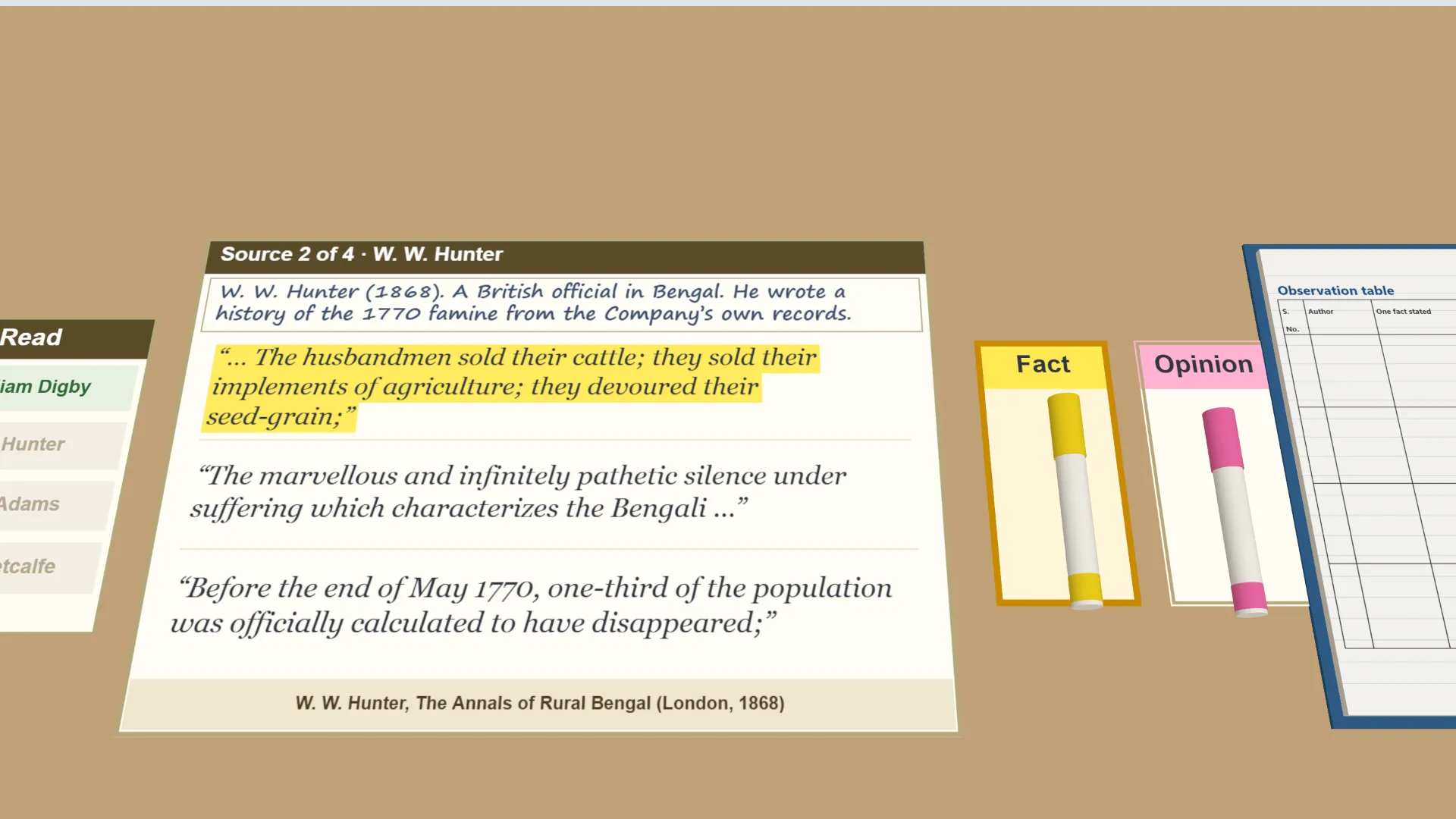
Interactive 3D Experiment
Loading simulation…
What to observe
- Facts give numbers, dates and documented events that other records can check.
- Charged words such as "outrageously", "marvellous" or "little republics" show an opinion.
- One sentence can hold both a fact and an opinion, as in Brooks Adams's line on Plassey.
- An inference is not written in the source; the reader draws it from the facts.
Notes
- Social Science Spark: a fact can be checked against other evidence; an opinion is the author's own judgement; an inference is a conclusion the reader draws from stated facts.
- Precaution: a strongly worded number, such as a death toll, is still a fact claim, but check whether it is only an estimate.
- The quotations are copied from the original public-domain editions: W. Digby, 'Prosperous' British India (1901); W. W. Hunter, The Annals of Rural Bengal (1868); Brooks Adams, The Law of Civilization and Decay (1895); C. T. Metcalfe, Minute of 1830, in the Select Committee Report of 1832.