
Bigger Push or Smaller Point? — Exploring Pressure and Area
Aim
Investigate how the area over which a force acts changes the pressure it produces, and relate this to everyday situations.
Apparatus
- A hammer and an iron nail
- A small wooden block (or modelling clay, or soft soap)
- An apple and a sharpened pencil
- A sharp kitchen knife and a blunt table knife (with an adult's help)
- A notebook and pencil
Procedure
- Tap the nail into the block, pointed end down. Note how easily it goes in.
- Turn the nail over and tap its flat head with the same gentle force.
- Press the pencil's sharp point and then its eraser end into clay with the same push.
- Cut an apple with the sharp edge and then the blunt edge, with the same downward force.
- For each pair, record the area, whether it was easy, and what you concluded.
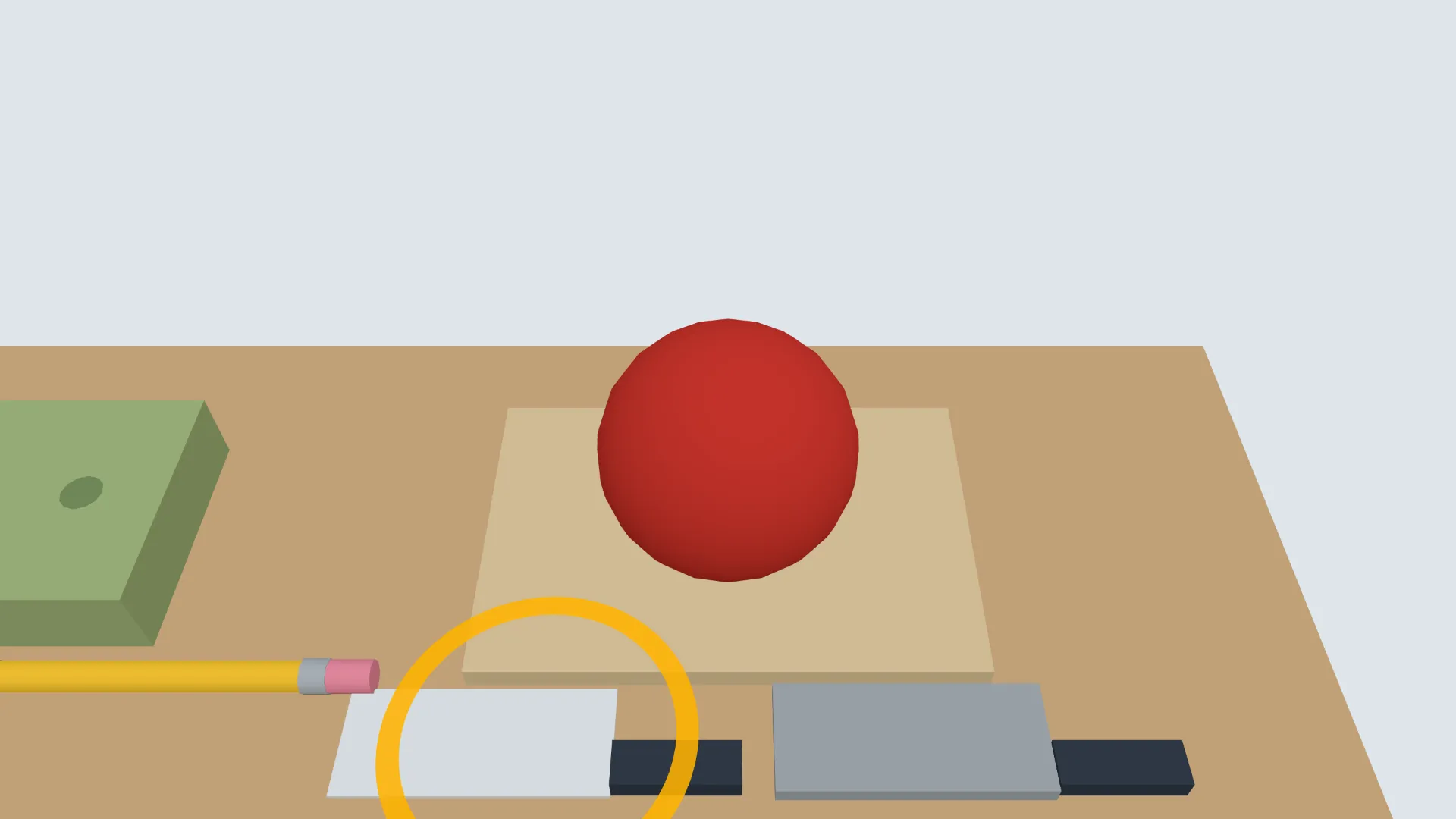
Interactive 3D Experiment
Loading simulation…
What to observe
- The pointed end of the nail goes in easily. The flat head hardly makes a dent.
- The sharp pencil point makes a deep mark. The eraser end makes only a shallow one.
- The sharp knife cuts the apple easily. The blunt knife needs much more effort.
- With the same force, a small area gives a high pressure and a large area gives a low pressure. Pressure = force ÷ area.
Notes
- A camel's wide, flat feet and snowshoes spread weight over a large area, which lowers the pressure.
- Use the hammer, nail and knife only with a teacher or an adult.
- Hold the nail near its head, tap gently, and keep your fingers clear of the point of impact.
- Put the block on a firm, steady surface. Cut the apple on a board, with the blade moving away from your body.
- Use the same force in both trials of each pair. Only the area of contact should change.
- Never test a blade or point against your skin.