
Power Lines & the Laws of Exponents
Aim
Arrange the powers of 2 along a line and use it to discover and check the laws of exponents: the product law, the quotient law, the power of a power, and the meaning of the zero and negative powers.
Apparatus
- A long paper strip or graph paper to draw a number line
- Small blank cards (about 12) and a marker
- Coloured pens or pencils and a ruler
- A calculator to check products and quotients
Procedure
- Write 2⁰, 2¹, … 2⁸ on cards with their values 1, 2, … 256. Set them in order on the line.
- Notice that one step up multiplies by 2 and one step down divides by 2.
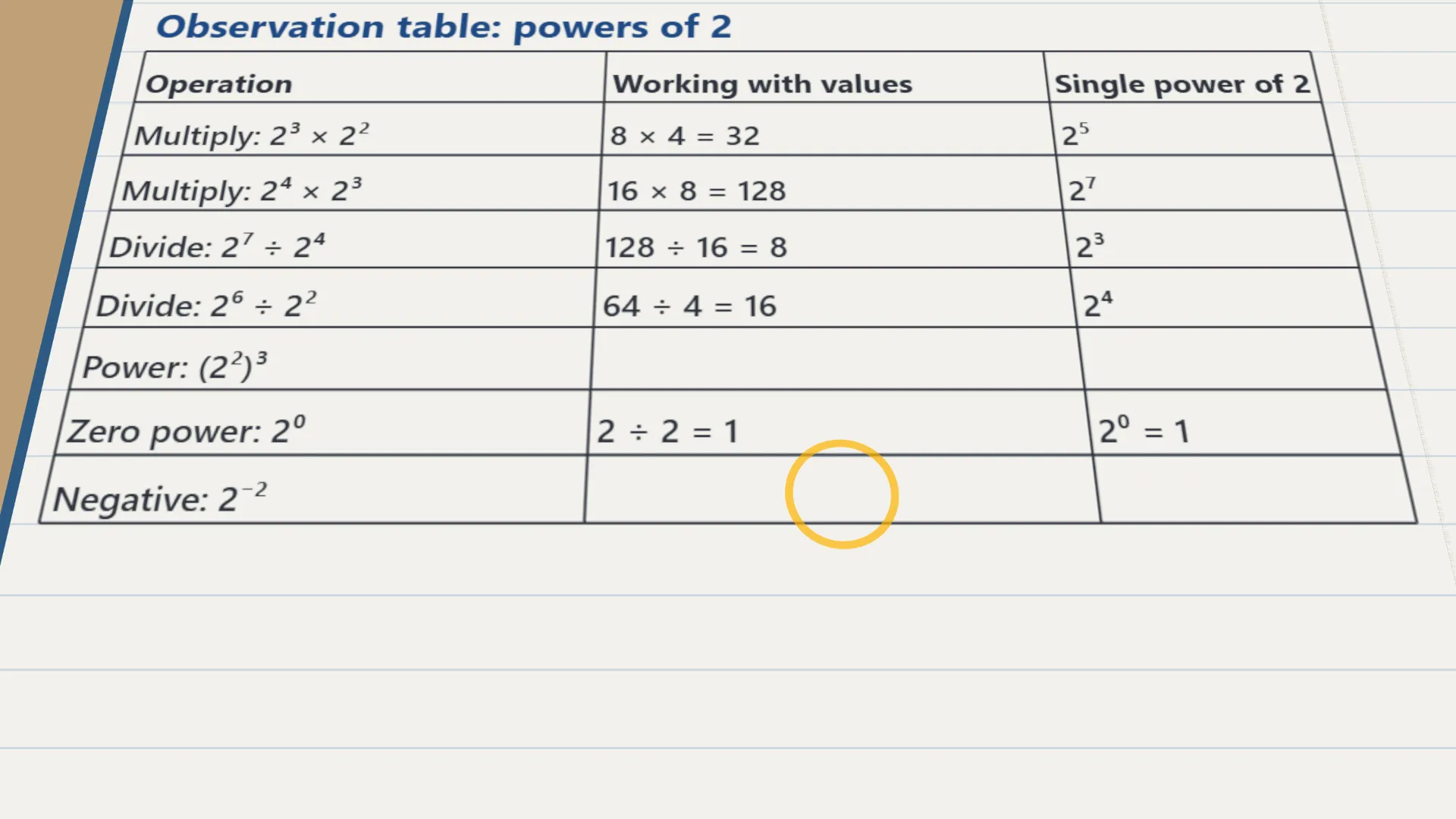
- Product law — pick 2³ and 2². Multiply the values, find the answer on the line. The powers add.
- Quotient law — divide 2⁷ by 2⁴, find the answer on the line. The powers subtract.
- Extend the line below 2⁰. Each step down divides by 2, so 2⁰ = 1, 2⁻¹ = ½, 2⁻² = ¼.
- Power of a power — (2²)³ means 2² × 2² × 2² = 2⁶, so the powers multiply.
- Write the general laws in your own words, using letters.
Interactive 3D Experiment
Loading simulation…
What to observe
- Each step up the line multiplies the value by the base, and each step down divides it by the base.
- For the same base, powers add when you multiply, subtract when you divide, and multiply for a power of a power.
- Carrying the line down gives a⁰ = 1 and a⁻ⁿ = 1/aⁿ — the same pattern carried on, not new rules.
Notes
- Math Spark: René Descartes made the raised exponent popular in 1637. Long before that, India named large powers of ten — koti (10⁷), ayuta (10⁴), niyuta (10⁵) and many more.
- Mark the powers at equal gaps along the line. Unequal gaps hide the pattern of × a and ÷ a.
- Write one power on one card, and place it against its own exponent.
- The product and quotient laws work only for the same base. 2³ × 3² cannot be combined.
- Do not confuse aⁿ with a × n. 2³ is 8, not 6.
- A negative power gives a fraction, not a negative number. 2⁻³ = 1/8.
- The base must not be 0 when using the quotient law or a negative power.
- Use the calculator only to check a result after working it out by the law.