
Constructing a Timeline of the Age of Reorganisation
Aim
To build a timeline of the major dynasties and rulers after the Mauryas (2nd century BCE to 3rd century CE), and to find which dynasties existed at the same time in different regions.
Apparatus
- A long strip of chart paper, or several A4 sheets taped together
- Ruler, pencil and eraser
- Coloured pencils or sketch pens
Procedure
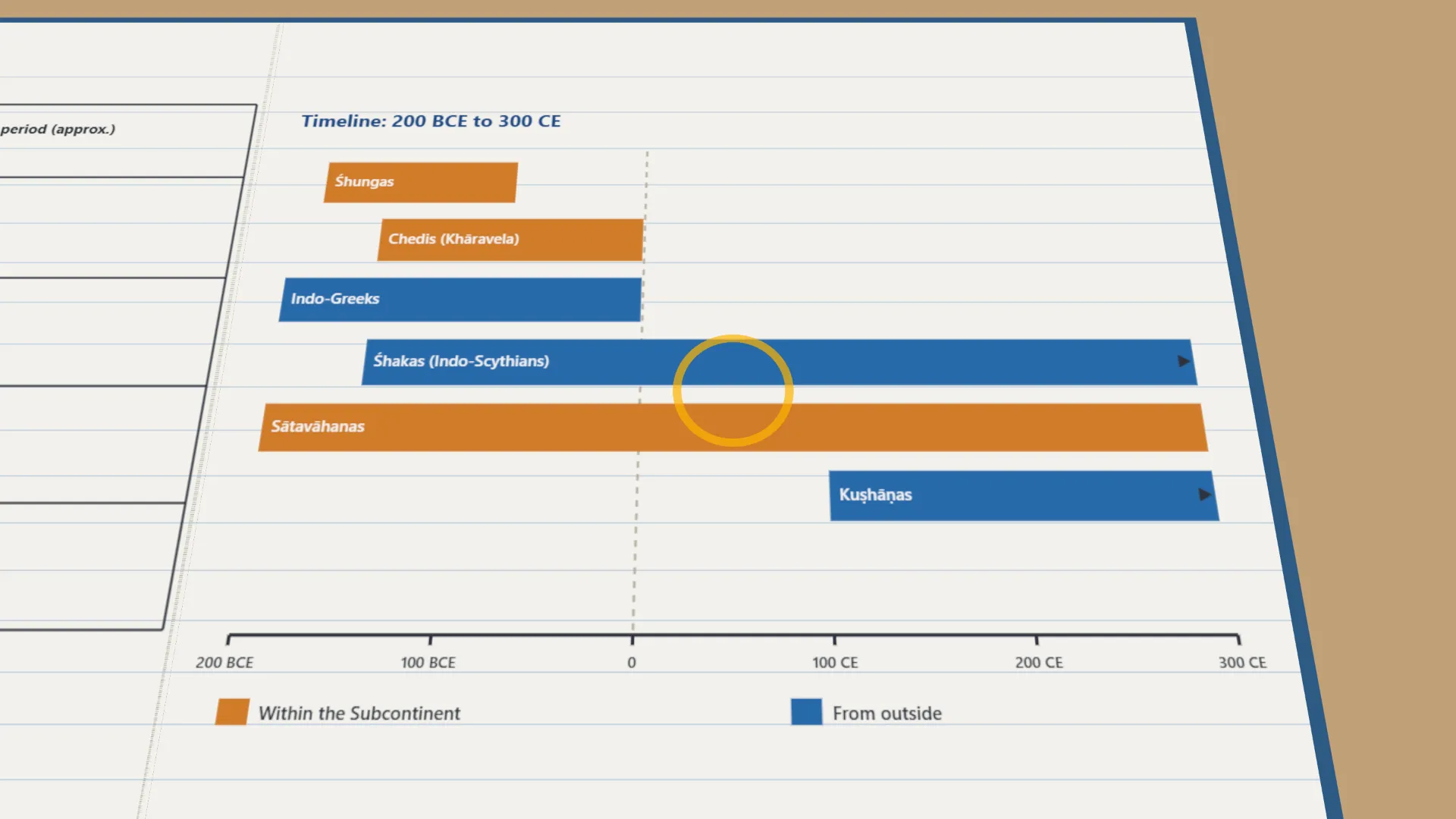
- Draw a horizontal line from 200 BCE to 300 CE, at 1 cm for 10 years. Mark where BCE changes to CE.
- Using the reference data, draw a coloured bar for each dynasty from its start date to its end date.
- Mark the dates of key rulers with small arrows. These are Puṣhyamitra Śhunga, Khāravela, Gautamīputra Sātakarṇi, Karikāla and Kaṇiṣhka.
- Make a key with two colours. One is for dynasties that arose within the Subcontinent, the other for those from outside.
- List at least three pairs of dynasties that were contemporaries, and when they overlapped.
Interactive 3D Experiment
Loading simulation…
What to observe
- The Śhungas, Chedis, Indo-Greeks, Śhakas, Sātavāhanas and the southern kingdoms did not follow one another; many ruled together.
- The Śhungas and the Kuṣhāṇas were not contemporaries.
- Dynasties from outside the Subcontinent (Indo-Greeks, Śhakas, Kuṣhāṇas) lived alongside those from within.
Notes
- Social Science Spark: a timeline that shows several dynasties side by side is called a multiple or comparative timeline. It shows that different regions had their own flourishing kingdoms at the same time.
- Keep one scale throughout, label the BCE to CE change clearly, and use one colour for each kind of dynasty.