
Fuel for Growth — Planning a Balanced Diet for Adolescents
Aim
Find out which nutrients locally available foods give, and plan a balanced meal (a thali) for an adolescent.
Apparatus
- Small samples or pictures of local foods — milk, curd, paneer, roti, millets, rice, dal, rajma, green leafy vegetables, seasonal fruits, raisins, figs and groundnuts
- Two or three empty food packets with a printed nutrition label
- A paper plate to plan the thali on
- Chart paper and sketch pens
- Science notebook and pencil
Procedure
- Tap a food on the tray. Which nutrient does it mainly give?
- Choose the nutrient. Table 2.1 records it and what it does for a growing body.
- Turn packet A, then packet B, over and read the nutrition label.
- Tap the packet that is high in sugar, salt or fat. Then note both labels.
- Plan a thali on the plate. Tap one food for each of its five parts.
- Mark the best source of iron on your thali, then the best source of calcium.
- Present your thali. Tap the notebook to fill Table 2.2 and the best ideas.
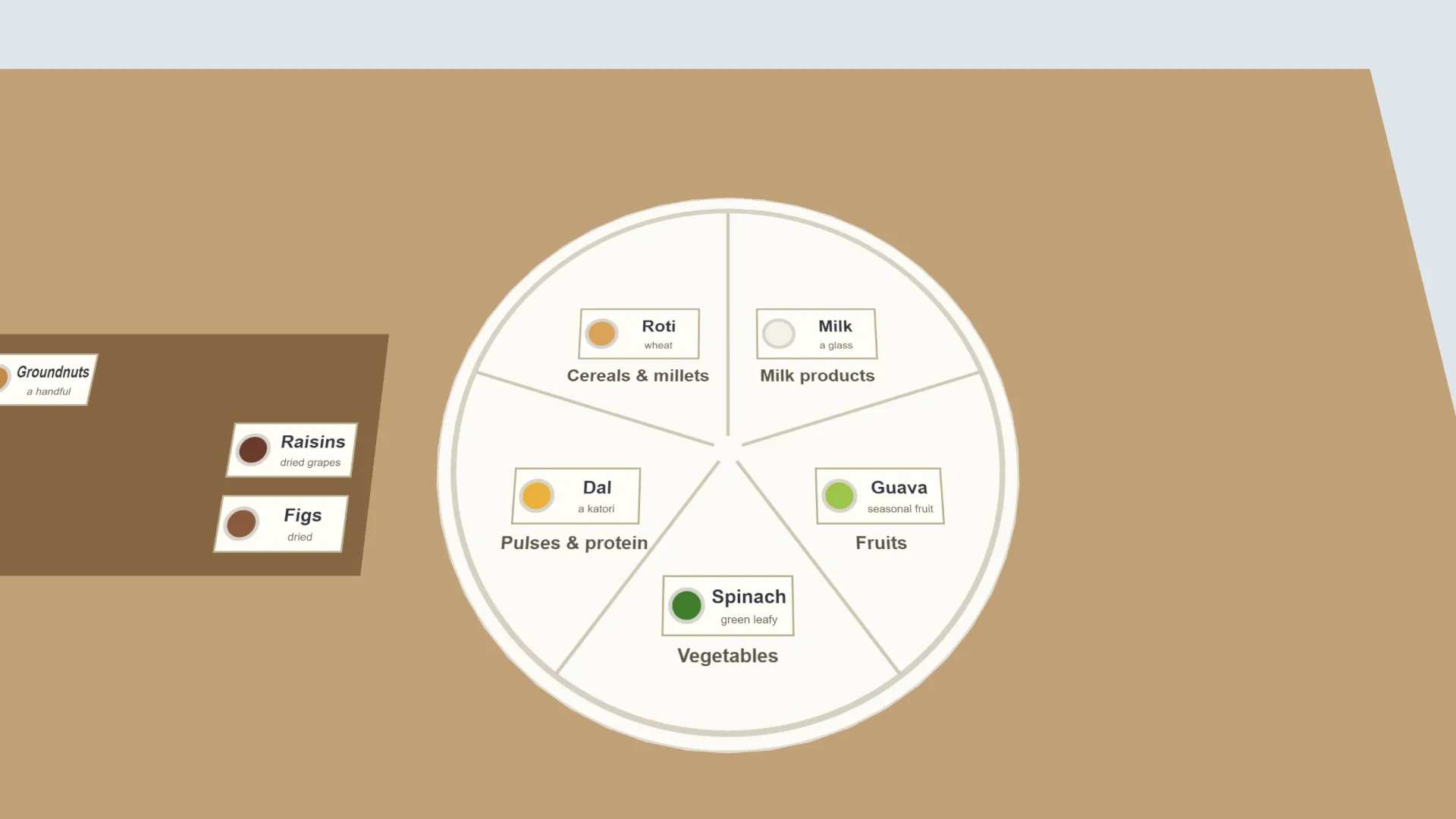
Interactive 3D Experiment
Loading simulation…
What to observe
- Cereals and millets give carbohydrates, dal and rajma give proteins, oil seeds like groundnuts give fats.
- Fruits and vegetables give vitamins, minerals and roughage; milk gives calcium.
- The wafers label shows a lot of fat and salt; the roasted chana label does not.
- A balanced thali has a food from every group. No single food gives everything.
Safety
- Food samples are for looking at only. Do not eat or taste them. Wash your hands before and after.
- Tell the teacher first if you are allergic to a food such as groundnuts or milk, and do not handle it.
- Keep samples covered and away from flies. Use pictures for foods that spoil quickly.
- Use only clean, empty packets, and check that no packet has a sharp torn edge.
- Never comment on what a classmate eats, what their food costs, or anybody's body or size.
Notes
- Adolescents need extra iron to make more blood and muscle. The iron in spinach, rajma and figs is taken up much better with vitamin C — amla, guava, orange or a squeeze of lemon over your dal.
- The packet labels in the simulation are example labels with typical values per 100 g. Real packets differ, so always read your own packet.
- The "two best ideas from other groups" in the notebook are an example. Your class's ideas will differ.